

What Is Myotherapy Used For? Conditions, Treatment and When to Seek Help

Could the same sore neck or aching back call for different care depending on what’s affecting your movement? If you’re wondering what is myotherapy used for, the answer isn’t one fixed technique or a guaranteed result. It may be considered for musculoskeletal concerns such as back or neck discomfort, headaches, and overuse or sports-related soreness. Whether it’s suitable depends on your symptoms and circumstances.
It’s understandable to be unsure whether myotherapy is relevant to your pain, how it differs from remedial massage or physiotherapy, or whether treatment might feel uncomfortable. A practitioner should discuss your health history, symptoms and movement goals, explain what an appointment may involve, and take your comfort and feedback into account.
This article covers concerns for which myotherapy may be considered, what an individual assessment and treatment could involve, and when another health professional may be more appropriate. At Body Therapist, Lee Carnegie is a qualified remedial massage and dynamic movement therapist who incorporates myotherapy-informed techniques within individual therapeutic care. The aim is to help you feel prepared to discuss your options, not to promise a particular outcome.
Table of Contents
What is myotherapy used for? Common muscle and movement concerns
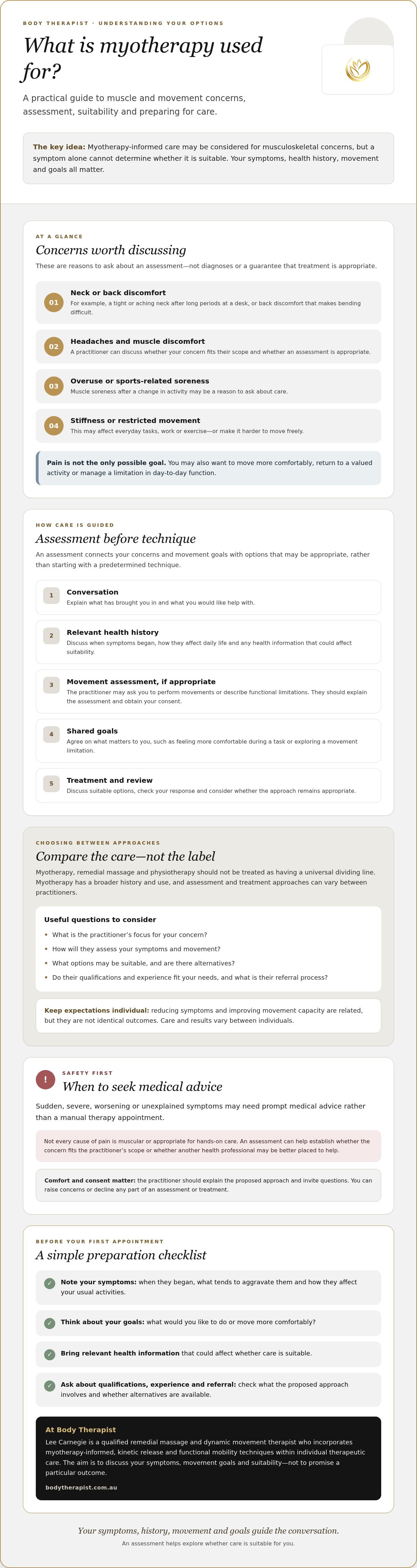
What is myotherapy used for? It’s an assessment-led approach to musculoskeletal concerns, including muscle discomfort, stiffness and restricted movement. A practitioner considers your symptoms, health history and goals before discussing whether myotherapy-informed care may be suitable. The term Myotherapy has a broader history and use, so assessment and treatment approaches can vary between practitioners.
Suitability can’t be determined from a symptom name alone. Pain can have different causes, and not every cause is muscular or appropriate for hands-on care. An assessment helps establish whether your concern fits the practitioner’s scope or whether another health professional may be better placed to help.
What kinds of concerns may prompt someone to seek myotherapy?
People may enquire about a tight or aching neck after long periods at a desk, back discomfort that makes bending difficult, or muscle soreness after a change in activity. Others may notice stiffness or difficulty moving freely during everyday tasks, exercise or work. These are reasons to discuss an assessment, not signs of a particular diagnosis or a guarantee that treatment is appropriate.
Be ready to explain when the discomfort began, what tends to aggravate it and how it affects your usual activities. Sudden, severe, worsening or unexplained symptoms may need medical advice rather than a manual therapy appointment.
Is myotherapy only for pain?
No. Pain relief may be one goal, but you might also want to move more comfortably, return to a valued activity or manage a limitation in day-to-day function. These goals help shape the discussion about whether hands-on or movement-based approaches are relevant and how progress might be reviewed.
Reducing symptoms and improving movement capacity are related, but they aren’t identical outcomes. You may feel less discomfort without immediately regaining your preferred range of movement, or focus on function even when pain isn’t your main concern. Results and appropriate care vary between individuals.
A treatment aim can guide care, but it isn’t a guaranteed outcome. At Body Therapist, qualified remedial massage and dynamic movement therapist Lee Carnegie incorporates myotherapy-informed, kinetic release and functional mobility techniques within individual therapeutic care. An appointment gives you the opportunity to discuss your symptoms, movement goals and suitability without assuming one approach fits everyone.
How myotherapy assessment guides the choice of treatment
Knowing what is myotherapy used for is only part of deciding whether it suits you. An assessment connects your current concerns and movement goals with an approach that may be appropriate, rather than starting with a predetermined technique. The Victorian Government’s myotherapy treatment overview offers background, but your own care should be discussed with the practitioner who assesses you.
An appointment may follow a considered sequence:
Conversation: Explain what has brought you in and what you’d like help with.
Relevant history: Discuss when symptoms began, how they affect daily life and any health information that could affect suitability.
Movement assessment: If appropriate, the practitioner may ask you to perform movements or describe functional limitations. They should explain this and obtain your consent.
Shared goals: Agree on what matters to you, such as feeling more comfortable during a task or exploring a movement limitation.
Treatment and review: Discuss suitable options, then check your response and whether the approach remains appropriate.
What may happen during an initial myotherapy appointment?
You can expect to discuss when and how your symptoms started, their impact on work or everyday activities, relevant health history and your priorities. There isn’t one assessment script that applies to everyone. Any movement or function checks should relate to your concern, be clearly explained and take place with your agreement.
Before care begins, the practitioner should outline the proposed approach and invite questions. Ask why an option is being suggested, what it may involve and whether alternatives are available. You can raise concerns or decline any part of the assessment or treatment.
How can treatment be adjusted to your response?
Your feedback matters throughout the appointment. Let the practitioner know if pressure, positioning or a technique feels uncomfortable, or if your symptoms change. This can guide an adjustment or prompt a pause. Treatment choices should reflect the assessment, your consent and the practitioner’s scope, rather than follow a fixed set of techniques.
Reassessment may involve checking your comfort or revisiting a movement discussed earlier. This helps you and the practitioner consider whether the approach is meeting your agreed goals and whether it needs to change. Progress varies, and no particular response can be guaranteed.
Assessment links your goals to a considered choice of care, while your feedback helps shape what happens next. At Body Therapist, Lee Carnegie incorporates myotherapy, kinetic release and functional mobility techniques within individual therapeutic care. You can learn about Body Therapist before deciding whether to discuss your needs and suitability with the practitioner.
Myotherapy, remedial massage and physiotherapy: how to compare care
These approaches can share features, so a treatment label alone may not tell you which is suitable. If you’re asking what is myotherapy used for compared with remedial massage or physiotherapy, consider the practitioner’s approach to your concern, the assessment they provide and whether your goals fit their scope. The Better Health Channel offers an Australian overview of myotherapy, but it can’t determine which care is right for your symptoms.
How is myotherapy different from remedial massage?
Both may involve hands-on care, but assessment, treatment choices and goals can differ between practitioners and appointments. There isn’t a universal dividing line that makes one approach more advanced or effective. Ask what the practitioner will assess, how they’ll select care and how your response will inform the session. For more context on hands-on care, see this clinical massage therapy guide.
When might physiotherapy or medical assessment be a better next step?
Physiotherapy may be worth discussing if your main concern relates to movement or function and you want to understand what assessment and care the provider can offer. Similarly, for individuals experiencing persistent neck or spinal issues, consulting a clinic such as Restore Chiropractic Center for dedicated cervical care may be another avenue to explore. If symptoms are unexplained or concerning, seek advice from an appropriate health professional rather than assuming manual therapy is suitable. A recommendation to seek another assessment is responsible care, not a failure of myotherapy.
This comparison is educational, not a way to diagnose symptoms or choose treatment for you. Before proceeding, ask about the practitioner’s relevant qualifications, experience and scope for your particular concern.
When myotherapy may not be appropriate: safety, consent and referral
Whether myotherapy is suitable depends on your current symptoms and health history, not simply on what is myotherapy used for in general. Tell the practitioner about relevant health conditions, injuries, medicines, recent procedures and any changes in your symptoms. This helps them consider whether an approach is appropriate, needs modification or should wait until you’ve spoken with another health professional.
What should you tell a myotherapist before treatment?
Share information that could affect treatment, even if you’re unsure it’s relevant. Mention a recent injury or procedure, a diagnosis or medication, and whether your symptoms have changed since you booked. You can also raise concerns about pressure, positioning or a technique. The practitioner should explain proposed care, seek your consent and listen to your preferences.
Consent is ongoing. You can ask questions, request an adjustment, or pause or stop a technique at any point. If you’re uncomfortable, say so. Treatment shouldn’t continue simply because it has started.
When should you seek medical advice instead?
Seek prompt medical advice for symptoms that are sudden, severe, worsening or unexplained. If you think you need urgent help, contact an appropriate medical or emergency service. Persistent symptoms, or concerns that aren’t settling, also warrant assessment by a suitable health professional. Myotherapy isn’t a substitute for medical diagnosis, emergency care or treatment prescribed by another practitioner.
Referral is a responsible next step when symptoms need assessment beyond the practitioner’s role or scope. It doesn’t mean you’ve done anything wrong or that hands-on care could never be considered later. The priority is finding the right kind of assessment for your situation.
If you’re considering dry needling as a separate technique, read this clinical dry needling guide and discuss whether it’s relevant with an appropriately qualified practitioner. Don’t assume a technique is suitable based on a guide alone.
At Body Therapist, Lee Carnegie incorporates myotherapy-informed techniques within individual therapeutic care. If you’d like to discuss your symptoms, goals and suitability, contact Body Therapist about your care options.
Choosing myotherapy for your goals and planning a first appointment
Before arranging an appointment, consider what you want help with and what you need to know to feel comfortable proceeding. Understanding what is myotherapy used for can help you frame the conversation, but the practitioner still needs to consider your individual concern and whether their approach is suitable.
Use this checklist to prepare:
Your goal: Note what you’d like to do more comfortably, such as a particular everyday movement or activity.
Your symptom history: Jot down when the issue started, how it has changed and what affects it.
Your questions: Ask how the practitioner assesses your concern, agrees on goals and decides which treatment approaches may be appropriate.
Your preferences: Ask how consent and comfort are managed, and how you can request an adjustment or pause.
Your next steps: Ask about the practitioner’s relevant qualifications and experience, and when they might recommend referral to another health professional.
Questions to ask before booking a myotherapy appointment
It’s reasonable to ask what an initial assessment may involve, which techniques might be considered and how your feedback will guide the session. You could also ask how progress is reviewed and what might prompt the practitioner to recommend another type of assessment. Clear answers help you judge whether the approach feels appropriate for your needs.
What to bring and how to set realistic expectations
A short symptom timeline can make it easier to explain the issue, especially if it comes and goes. Describe how it affects everyday movement, work or activities, and mention relevant health information. If a movement assessment may be involved, ask what clothing would be comfortable and allow you to move as needed.
Agree on a practical way to review progress, such as discussing whether a chosen movement or daily task feels different over time. Responses vary, and there’s no guaranteed timeline or outcome. A practitioner should be willing to revisit the plan with you rather than assume one approach will suit every session.
At Body Therapist, Lee Carnegie is a qualified remedial massage and dynamic movement therapist who incorporates myotherapy alongside kinetic release and functional mobility techniques. This is relevant practitioner context, not a promise that any particular technique will suit your concern. If you’re weighing up your options, consider discussing your goals and asking whether an appointment may be appropriate for you.
Take the next step towards informed care
Understanding what is myotherapy used for can help you decide what to ask, but the right approach depends on your symptoms, health history, movement goals and an individual assessment. Myotherapy and remedial massage may overlap, while physiotherapy or medical advice may be more appropriate for some concerns. Treatment should be discussed with you, adapted to your feedback and never treated as a guaranteed outcome.
At Body Therapist, Lee Carnegie is a qualified remedial massage and dynamic movement therapist who combines myotherapy, kinetic release and functional mobility techniques within individual therapeutic care. You can use an appointment to discuss your concerns, ask about suitability and consider possible next steps, without assuming one approach fits everyone.
If you’d like to explore whether a tailored therapeutic appointment may suit your goals, discuss your needs with Body Therapist. A clear conversation is a practical place to start, and you can take the next step at a pace that feels right for you.
Frequently Asked Questions
What conditions is myotherapy commonly used for?
Myotherapy may be considered for musculoskeletal concerns such as back or neck discomfort, headaches, muscle tension, sports-related soreness or overuse discomfort. For people asking what is myotherapy used for, these are examples of reasons to discuss an assessment, not diagnoses or a promise of treatment. Suitability depends on your symptoms, health history, goals and the practitioner’s scope. Pain can have causes that aren’t muscular, so seek medical advice for unexplained or concerning symptoms.
Can myotherapy help with back or neck pain?
It may be an option to discuss for back or neck pain, but suitability depends on what’s contributing to your symptoms and how they affect you. An assessment can help establish whether myotherapy-informed care is appropriate or whether another health professional should assess you. For example, if neck discomfort relates to upper cervical alignment, specialised clinics like Precision Spinal Care highlight how gentle spinal assessments can help determine whether structural care is needed. Share when the pain began, what changes it and whether it affects movement or daily activities. Seek prompt medical advice if symptoms are sudden, severe, worsening or unexplained.
No, they aren’t necessarily the same, although the approaches can overlap and both may include hands-on care. Assessment, treatment choices and goals vary between practitioners, so there’s no universal dividing line or reason to assume one is always more effective. Before booking, ask what the practitioner will assess, what approaches they may consider and how care will relate to your goals. The practitioner’s relevant experience and scope matter more than the label alone.
What happens during a myotherapy appointment?
An appointment may begin with a discussion about your symptoms, relevant health history and what you’d like to achieve. If appropriate and with your consent, the practitioner may assess movement or function before explaining care options. Treatment should be guided by the assessment and your feedback, not assumed in advance. You can ask questions, raise concerns about pressure or positioning, and request an adjustment or pause at any point during the session.
Is myotherapy safe for everyone?
No, myotherapy isn’t suitable for everyone or every symptom. Tell the practitioner about relevant diagnoses, injuries, medicines, recent procedures and changes in your health so they can consider whether care is appropriate or needs modification. Consent and comfort matter throughout treatment, and you can pause or stop a technique. Myotherapy doesn’t replace medical diagnosis, prescribed care or emergency services. Seek prompt medical advice for symptoms that are sudden, severe, worsening or unexplained.
How many myotherapy sessions will I need?
There’s no set number of sessions that applies to everyone. The amount of care considered may depend on your concern, health history, goals and how you respond. Discuss what you’d like to monitor, such as comfort during a particular activity or changes in movement, and review progress with the practitioner. They should be open to adjusting the plan. If symptoms worsen, remain unexplained or don’t respond as expected, ask whether another health professional should assess them.
What is the difference between myotherapy and physiotherapy?
Both may involve assessing musculoskeletal or movement concerns, but their approaches and scopes can differ. Myotherapy may involve individualised care for musculoskeletal symptoms, while physiotherapy may address movement and physical function through assessment and a care plan. Neither label alone determines the right choice. Ask whether the practitioner can assess your specific concern and what their approach includes. If symptoms are concerning or unexplained, seek medical advice rather than relying on manual therapy alone.


Comments