

Non-Surgical Skin Tightening for Arms: 2026 Guide

Choosing a treatment for firmer-looking upper arms starts with identifying what’s causing the concern, rather than selecting the most appealing treatment name. If you’re considering non-surgical skin tightening for arms, first distinguish reduced skin firmness from excess fat, or a combination of both. Each concern has a different treatment focus and calls for realistic expectations.
Ageing, genetics, sun exposure and significant weight loss can all contribute to changes in upper-arm skin. Radiofrequency (RF) skin tightening is a non-surgical option to discuss when reduced firmness is the main concern. It uses controlled heat with the aim of encouraging a collagen response, but results vary and it doesn’t remove substantial excess skin. Ultrasonic fat cavitation addresses a different concern, while surgery is a more invasive option.
This 2026 guide explains what each approach may and may not address, how RF compares with other options, and what to consider when assessing suitability. It also covers practical questions to raise before deciding whether to proceed.
Table of Contents
Non-surgical skin tightening for arms: what causes loose upper-arm skin?
How radiofrequency skin tightening for arms is intended to work
RF, fat cavitation or surgery: comparing options for upper-arm concerns
How to assess suitability and prepare for arm skin tightening
Body Therapist RF skin tightening for arms: a considered next step
Non-surgical skin tightening for arms: what causes loose upper-arm skin?
A crepey surface, a soft fold beneath the upper arm or a change in firmness after weight fluctuation can be frustrating, especially when the cause isn’t clear. These concerns don’t all point to the same issue. Skin laxity means the skin has reduced firmness or elasticity. Excess subcutaneous fat is fatty tissue beneath the skin that can create fullness.
Ageing, genetics, sun exposure and changes in body weight may all contribute to upper-arm skin changes. Their effects vary, and several factors can be involved at once. A change in weight can alter the volume beneath the skin, while skin firmness may also change over time. Appearance alone can’t confirm the cause.
Non-surgical arm skin tightening is an approach intended to improve the appearance of skin firmness without an operation. Methods differ, and their intended effects and limitations depend on the treatment used. For general background, Radio-frequency skin tightening outlines radiofrequency approaches and their applications.
Loose skin or arm fat: how can you tell what concerns you?
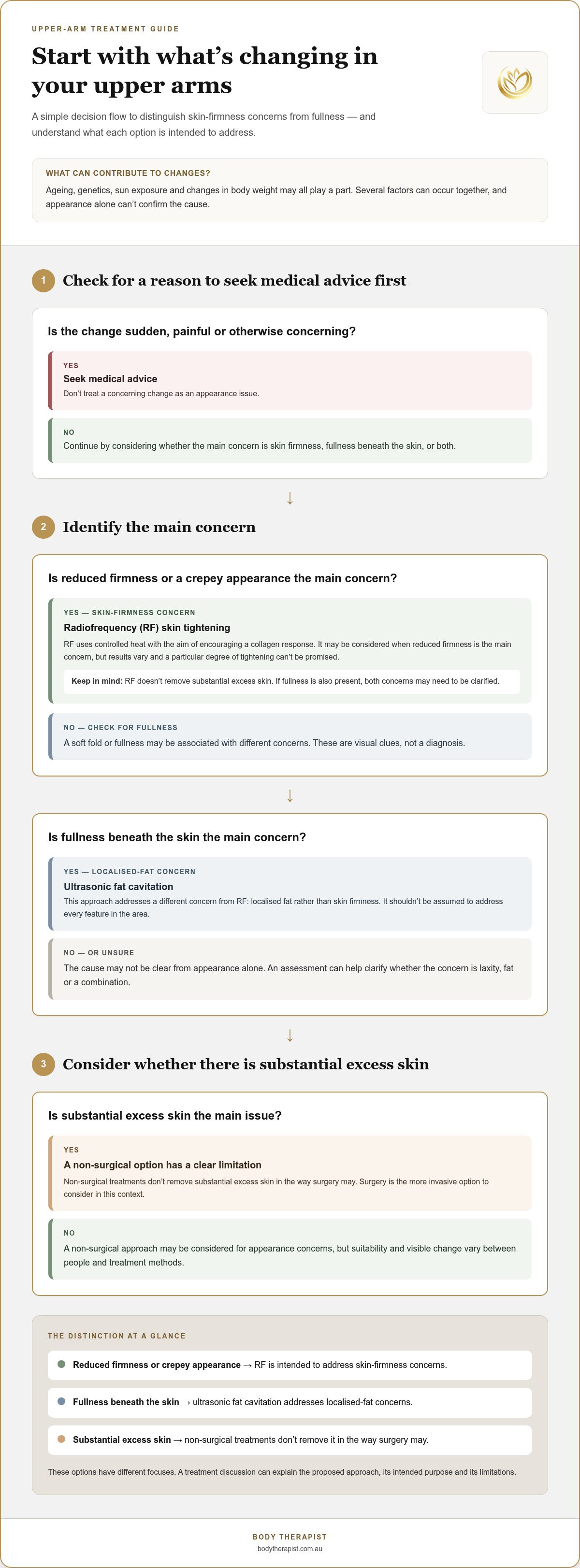
A crepey surface or soft fold may be associated with reduced skin firmness, while fullness may reflect fat beneath the skin. These are general visual clues, not a diagnosis. How tissue feels can vary with position and movement, so pinching or inspecting the area at home can’t reliably establish which treatment may suit.
Laxity and localised fat can also occur together. An upper arm, for example, may have both a soft fold and fullness beneath it. These concerns have different treatment focuses: RF skin tightening is intended for skin-firmness concerns, while ultrasonic fat cavitation is used for localised fat concerns. Neither approach should be assumed to address every feature in the area.
What can non-surgical arm tightening realistically address?
Non-surgical options may be considered for appearance concerns, but they aren’t a substitute for medical assessment or care. Suitability and visible change vary between people and treatment methods. An assessment can help clarify whether the main concern is laxity, fat or both, and whether the expected scope is realistic.
Keep the distinction clear:
Skin laxity: reduced firmness or a crepey appearance.
Localised fat: fullness beneath the skin.
Substantial excess skin: non-surgical treatments don’t remove it in the way surgery may.
If the change is sudden, painful or otherwise concerning, seek medical advice rather than treating it as an appearance issue. For a longstanding cosmetic concern, identifying what you’re noticing is a useful first step when comparing options.
How radiofrequency skin tightening for arms is intended to work
Radiofrequency (RF) skin tightening uses electrical energy to generate heat in tissue. In aesthetic treatments, the intended aim is to warm selected skin layers and encourage a response associated with collagen, a structural protein that helps support skin. The effect depends on the treatment method and equipment, so a general explanation can’t predict what will happen to an individual’s upper arms.
For context on changes in this area, Loose skin and tissue under the upper arms discusses possible causes and treatment approaches. A proposed biological mechanism isn’t a guaranteed cosmetic outcome. RF may be considered for skin-firmness concerns, but it can’t promise a particular degree of tightening or a specific appearance.
What happens during radiofrequency treatment?
In broad terms, RF energy is applied to a selected area of skin. The intended effect is controlled heating, but the process varies with the equipment and method used. Details such as how deeply energy acts, the temperatures reached and the tissue response are device-specific. They shouldn’t be assumed from the term “radiofrequency” alone.
A treatment discussion should explain the approach being considered in clear terms, including its intended purpose and limitations. Exact tissue depths, settings or cellular effects shouldn’t be generalised across different devices and applications.
What affects the visible response in the upper arms?
Response can differ with skin condition, degree of laxity, age and individual biological variation. The appearance of the arms may also involve more than one concern, such as skin laxity alongside localised fullness. The same approach won’t necessarily suit everyone, and a general description of RF can’t predict visible change.
Evidence also needs to be interpreted in context. Findings for one device, treatment area or method may not apply to another. Claims about effectiveness, safety or expected outcomes should relate to the specific technology rather than being treated as universal facts about RF.
Consistent records can make progress easier to discuss. With consent, photographs taken in similar lighting and with the arms in similar positions may help compare appearance over time. Treatment records and follow-up assessments can also document what was done and how the area looks or feels afterwards. These records don’t guarantee a result, but they provide a clearer basis for reviewing expectations.
If you’re considering non-surgical skin tightening for arms, a personalised conversation can connect the proposed approach with your concern and explain its intended scope and limitations. Body Therapist offers RF skin tightening. Read more about RF skin tightening as you weigh up your options.
RF, fat cavitation or surgery: comparing options for upper-arm concerns
Start by matching the approach to the concern. RF skin tightening is directed at skin-firmness concerns; ultrasonic fat cavitation is a separate non-surgical service intended for localised fat concerns. Surgery is a different kind of intervention. These options aren’t interchangeable, and none should be assumed to address every feature of the upper arm.
When does RF make more sense than a fat-targeting treatment?
RF may be worth discussing when the main concern is skin that appears less firm, rather than fullness beneath it. It shouldn’t be presented as a fat-removal method. Ultrasonic fat cavitation is a distinct treatment category for localised fat concerns; claims about how it works or what it may achieve depend on the method and evidence available.
Some people have both laxity and fullness. Choosing a treatment based on only one feature could leave the other unaddressed. An assessment can help clarify the main concern, the intended target of each approach and whether the expected scope is realistic. There’s no universal combination or sequence that suits everyone.
How does non-surgical treatment differ from an arm lift?
Non-surgical skin tightening for arms doesn’t involve an operation, but its scope differs from surgery. An arm lift is a surgical procedure that may be considered for substantial excess skin and involves removing tissue. It also has surgical risks and recovery considerations to discuss with an appropriately qualified medical practitioner.
Non-surgical approaches don’t remove substantial excess skin in the way surgery may. They may be relevant when considering a less invasive approach to appearance concerns, but they aren’t a direct substitute for surgery and shouldn’t be expected to produce comparable changes. Discuss the expected scope, limitations and recovery implications of any option before deciding.
Body Therapist offers RF skin tightening and ultrasonic fat cavitation for different treatment concerns. A discussion can help distinguish whether skin firmness, localised fullness or both are central to your upper-arm concern, without assuming one treatment will resolve every feature.
How to assess suitability and prepare for arm skin tightening
A useful assessment starts with what you’d like to change, not an assumption that a particular treatment is automatically suitable. Before considering non-surgical skin tightening for arms, identify the area that concerns you and whether your priority is skin firmness, localised fullness or both. A practitioner-led discussion can then consider your goals, health history and the treatment method.
What should you discuss before treatment?
Share relevant health conditions, current medicines, skin sensitivity and any previous procedures in the area. Mention irritation or injury to the skin, and raise anything that could affect comfort or healing. This information helps inform an assessment; it doesn’t replace medical advice where that’s needed. Safety considerations can vary with the individual and the technology used.
Use the discussion to clarify what the proposed treatment is intended to address and what it isn’t. Ask how comfort is managed, what aftercare may be advised, and how any response will be reviewed. A clear explanation should acknowledge uncertainty rather than promise a particular appearance.
Your goal: Describe the specific upper-arm area and the change you hope to see.
Your health context: Share relevant conditions, medicines, skin sensitivities and previous procedures.
Expected scope: Ask what the approach may address, what it can’t address and how individual response varies.
Practical details: Discuss likely sensations, aftercare guidance and how progress will be reviewed.
Before choosing treatment, discuss your goals, health history, medicines, skin concerns, likely limitations, comfort, aftercare and how progress will be reviewed.
How should you judge claims, evidence and value?
Look for explanations that distinguish the proposed mechanism from evidence about visible outcomes. Claims should relate to the treatment method and area being considered, with limitations and individual variability stated plainly. If the evidence or device-specific information isn’t clear, ask for an explanation before making a decision.
Before-and-after photographs can illustrate one person’s experience, but they aren’t a forecast of equivalent results. Lighting, posture, camera angle and starting condition can all affect how images look. For your own progress, consistent positioning and lighting make comparisons more meaningful.
Value involves more than the quoted fee. Understand what the proposed plan includes, how progress will be assessed and whether further treatment might be discussed. Don’t assume a particular number of sessions or outcome applies to you. Consider the treatment’s expected scope alongside the information provided, rather than relying on a headline claim.
A discussion with Body Therapist can help you consider RF skin tightening in relation to your goals and relevant health information. Read more about RF skin tightening before deciding whether to proceed.
Body Therapist RF skin tightening for arms: a considered next step
If reduced firmness is your main upper-arm concern, Body Therapist’s RF skin tightening is a non-surgical option to discuss. Start by clarifying what you’d like to address, whether the concern is primarily skin laxity, excess fat or both, and what the treatment is intended to do.
Body Therapist is owned and operated by Lee Carnegie, a qualified remedial massage and dynamic movement therapist. This background informs a considered, individual discussion. Whether RF skin tightening is suitable depends on your concern, personal circumstances and realistic expectations for an aesthetic treatment.
What a personalised treatment discussion should clarify
A useful discussion connects your goal with the area and tissue concern. If you’re hoping to improve the appearance of loose skin, say so, and mention any fullness you’ve noticed as well. The aim is to establish whether RF skin tightening is relevant to your concern, rather than treating it as a universal answer for every change in the upper arms.
Be ready to discuss relevant health information, current medicines, skin sensitivity and previous procedures. This context supports a practitioner-led conversation about suitability and precautions related to you and the treatment approach. You should also be able to clarify the anticipated scope and limitations, how comfort and aftercare will be addressed, and how any change may be reviewed.
Your priority: Explain what you’d like to change and where on the upper arm.
Your context: Share relevant health conditions, medicines, skin concerns and previous procedures.
The treatment’s scope: Clarify what RF skin tightening is intended to address and what it can’t be expected to do.
Your decision: Discuss suitability, comfort, aftercare and review arrangements before deciding whether to proceed.
A considered plan shouldn’t rely on a promised result, fixed timeline or assumed number of sessions. Instead, the treatment discussion should focus on what’s appropriate to your situation and what uncertainties remain.
Explore RF skin tightening with Body Therapist
For people considering non-surgical skin tightening for arms, RF skin tightening may be relevant when skin firmness is the main concern. It isn’t a substitute for surgery where substantial excess skin is present, and it shouldn’t be presented as a treatment for every combination of laxity and fullness. A clear discussion helps establish the scope before you choose.
To learn more about Body Therapist’s RF skin tightening, read about the treatment and consider how its intended scope relates to your upper-arm concern.
Take the next step at your own pace
Choosing an appearance-focused treatment is personal, and there’s no need to rush. Consider what change would feel worthwhile and what limitations you want to understand before proceeding. That gives you a practical point of reference instead of relying on broad claims or someone else’s expectations.
A focused conversation can help you put your priorities into words. Note the upper-arm area you’re concerned about, your main goal and any questions about suitability, comfort or likely scope. You don’t need to arrive with every answer. The aim is to make an informed choice that feels appropriate to your circumstances.
If you’re considering non-surgical skin tightening for arms, explore RF treatment in the context of your own goals. Contact Body Therapist to discuss RF skin tightening and take a considered next step.
Frequently Asked Questions
Can radiofrequency tighten loose skin on the upper arms?
Radiofrequency may help improve the appearance of mild skin laxity for some people, but it can’t guarantee a particular degree of tightening. The likely scope of non-surgical skin tightening for arms depends on factors such as skin condition and the treatment method. Discuss how the approach relates to the area you’re concerned about and what change would be realistic in your circumstances.
Is non-surgical arm skin tightening suitable after weight loss?
It may be an option after weight loss if your main concern is mild skin laxity, but suitability depends on the amount and condition of the remaining skin and your individual circumstances. If your weight is still changing, the appearance of your arms may change too, making it harder to assess a treatment response. Discuss your weight history and goals during an assessment, particularly if there’s substantial loose skin.
How many RF skin-tightening treatments do arms need?
There isn’t a reliable session number that applies to everyone. The treatment method, area and individual response all affect planning, so don’t assume a set number before assessment. Ask what the proposed plan is based on, when progress would be reviewed and how the approach might change if the response differs from expectations. A fixed number of sessions or particular outcome shouldn’t be assumed.
Does radiofrequency skin tightening on the arms hurt?
Comfort varies between people and depends on the treatment method. Some may find the sensation manageable, while others may be more sensitive to heat or contact in the treated area. Before treatment, discuss what you might feel and how to communicate discomfort during the procedure. Mention any skin sensitivity or concerns about tolerating treatment.
Is RF skin tightening the same as fat cavitation for arms?
No. RF skin tightening and ultrasonic fat cavitation are different treatment categories with different intended targets. RF is discussed for concerns about skin firmness, while cavitation is directed towards localised fat concerns. If your upper arm has both reduced firmness and fullness, don’t assume either approach addresses both features. An assessment can help clarify the main concern and whether a treatment’s intended scope matches it.
How long do non-surgical arm-tightening results last?
There’s no single timeframe that can be promised for everyone. Any visible change and how it evolves may depend on the treatment method, individual response, skin changes over time and shifts in body weight. Ask how outcomes are assessed and what follow-up may involve, rather than relying on a general claim about longevity. Consistently taken photographs can help compare changes, but they don’t predict how long a result will last.
Can non-surgical treatment remove excess skin from the arms?
No. Non-surgical treatments don’t remove substantial excess skin in the way an operation may. They may be considered for some appearance concerns, but they shouldn’t be treated as a substitute for surgical assessment where loose skin is extensive. If the amount of excess skin affects your decision, discuss the limitations of non-surgical approaches and seek appropriate medical advice about the options relevant to you.


Comments