

Non-Surgical Love Handle Reduction: Compare Your Options

What if the right non-surgical love handle reduction option depends less on the area you see and more on what is shaping its appearance? A pocket of localised fullness, loose skin or a combination can each affect the waist differently. It’s understandable to feel uncertain when treatment claims sound alike. No non-surgical approach can promise a particular result, and body contouring isn’t a substitute for weight loss.
This guide compares ultrasonic fat cavitation and RF skin tightening, explains their different intended focuses and outlines why outcomes vary from person to person. You’ll also find practical questions to consider before treatment, including what you want to change, whether the proposed option matches that goal and what its limitations are. Start with the concern, not a promise of spot reduction. An individual discussion can help clarify whether your priority is localised fullness, skin appearance or both, and identify a realistic next step.
Table of Contents
What causes love handles, and what can non-surgical reduction realistically address?
How do ultrasonic fat cavitation and RF skin tightening differ?
What results, limitations and risks should you weigh before choosing?
How can you decide whether a love handle treatment suits your goals?
How Body Therapist approaches non-surgical love handle reduction
What causes love handles, and what can non-surgical reduction realistically address?
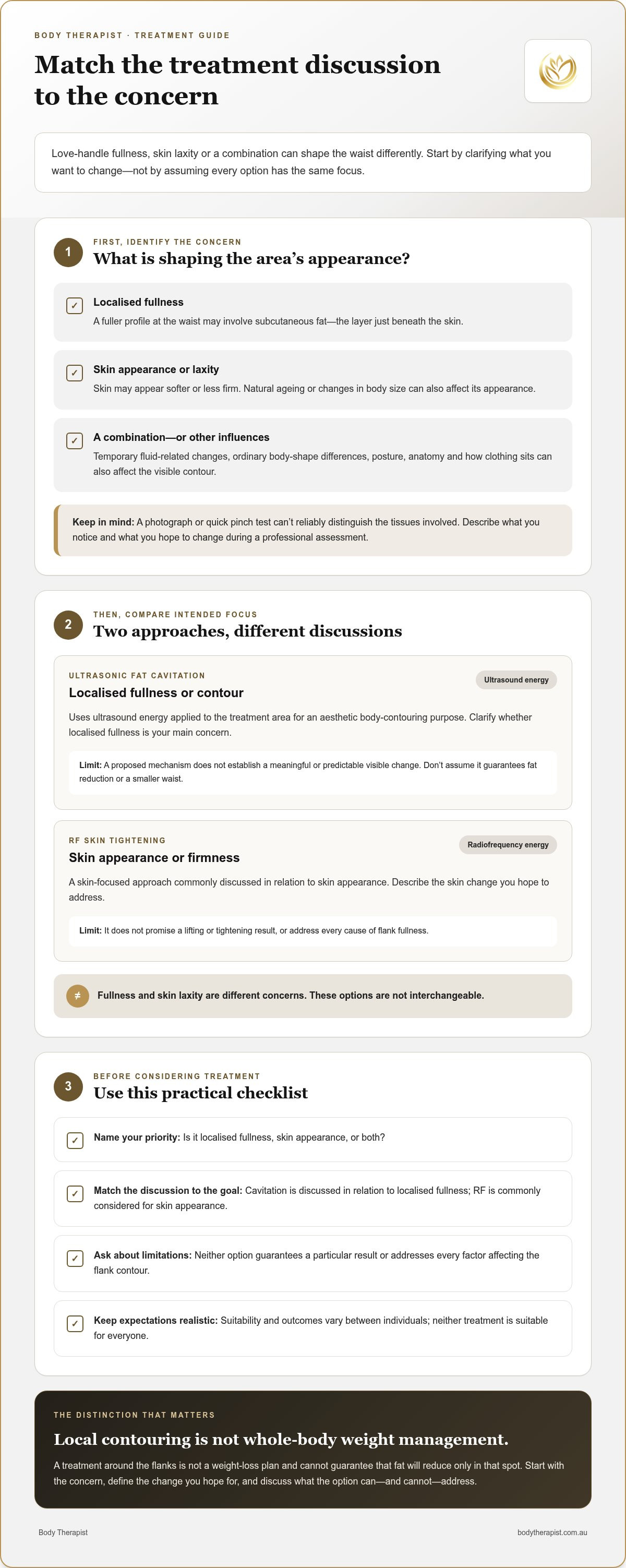
“Love handles” is an informal term for fullness at the sides of the waist, over the flanks between the lower ribs and hips. The contour may include subcutaneous fat, the layer of fat just beneath the skin, but fat isn’t the only factor that affects how this area looks. Skin laxity, temporary fluid-related changes and ordinary differences in body shape can also influence the outline. Love handles is a familiar name, but it doesn’t identify what is contributing to an individual’s waistline.
A useful distinction: Local contouring aims to address the appearance of a specific area. Whole-body weight management concerns changes in body weight across the body. A treatment around the flanks isn’t a weight-loss plan and can’t guarantee that fat will reduce only in that spot.
Is the concern localised fat, loose skin or a combination?
Fat volume can create a fuller profile at the waist, while skin laxity may appear as softer or less firm skin, particularly after changes in body size or with natural ageing. Some people notice both. Temporary fluid-related changes can also affect how an area looks from day to day, but they shouldn’t automatically be interpreted as fat or loose skin.
Posture, normal anatomical variation and the way clothing sits can alter the visible contour, too. A photograph or quick pinch test can’t reliably distinguish the tissues involved. If you’re unsure, describe what you notice and what you’d like to change during a professional assessment rather than trying to diagnose the cause yourself. For example, explain whether the area looks fuller to you or whether the skin’s appearance is your main concern.
What does non-surgical love handle reduction mean?
Non-surgical love handle reduction describes an aesthetic approach that doesn’t involve an operation. It can involve different modalities, but these aren’t interchangeable: ultrasonic fat cavitation and RF skin tightening, for example, have different intended focuses. The relevant discussion depends on the tissue concern and your goals, not simply on the name of the body area.
These treatments are intended to support a change in appearance, not to produce overall weight loss or a guaranteed body shape. Outcomes vary between individuals, and a treatment may not address every factor contributing to the flank contour. A useful starting goal is to work out whether localised fullness or skin appearance is your main concern, while allowing for the possibility that more than one factor may be involved. That distinction gives you a more realistic basis for comparing the options below.
How do ultrasonic fat cavitation and RF skin tightening differ?
Ultrasonic fat cavitation and radiofrequency (RF) skin tightening are distinct non-surgical approaches, not two names for the same result. Cavitation is generally discussed in relation to localised fullness, while RF is commonly considered for skin appearance. The intended focus matters: concern about volume beneath the skin is different from concern about skin firmness. The American Society of Plastic Surgeons overview of non-surgical fat reduction describes several technologies. Evidence and suitability depend on the modality and individual circumstances.
Fat-focused and skin-focused concerns call for different discussions. Reducing the appearance of fullness and addressing skin laxity are not the same goal.
What is ultrasonic fat cavitation used to address?
Ultrasonic fat cavitation uses ultrasound energy applied to an area for an aesthetic body-contouring purpose. Some explanations propose that the energy interacts with tissue beneath the skin, but a proposed biological mechanism doesn’t by itself establish a meaningful or predictable change in appearance. Effects may depend on the equipment, treatment approach and individual factors. Don’t assume it destroys fat cells or guarantees a smaller waist. Body Therapist offers ultrasonic fat cavitation as a non-surgical aesthetic service.
How does RF skin tightening differ?
RF uses radiofrequency energy and is commonly discussed in relation to skin appearance. Its intended focus differs from an approach aimed at localised fullness, so it shouldn’t be treated as a substitute for fat-focused contouring. Skin response can vary, and the service name isn’t a promise of a particular lifting or tightening result. Body Therapist offers RF skin tightening as an aesthetic option to discuss when skin appearance is a priority.
The comparison is a starting point, not a diagnosis or prediction. For non-surgical love handle reduction, an individual discussion can clarify whether your priority is fullness, skin appearance or a combination, and explain the limits of each approach. Body Therapist offers ultrasonic fat cavitation and RF skin tightening to consider in that context. Neither modality is suitable for everyone.
What results, limitations and risks should you weigh before choosing?
Non-surgical treatment may appeal if you want to explore a change in one area without an operation. But an aesthetic approach isn’t a guaranteed fix. Its relevance depends on whether the treatment’s intended focus matches your concern. A useful assessment covers potential benefits alongside uncertainty, limitations and safety considerations, rather than relying on idealised before-and-after images.
How much change can non-surgical treatment make?
Visible change, if any, can differ between people and treatment approaches. A change in the outline of the waist isn’t the same as a change on the scales, improved fitness or a broader health outcome. A treatment focused on appearance shouldn’t be presented as a substitute for general weight management or medical care.
Research needs to be interpreted by modality. Findings about one device or energy type don’t establish the size, duration or likelihood of results from another, and can’t predict an individual response. For ultrasonic fat cavitation and RF skin tightening, don’t assume that a proposed mechanism guarantees a noticeable outcome. A careful discussion should explain what the treatment is intended to address and what remains uncertain.
Be cautious of promises of permanent fat removal, a fixed number of sessions or a particular body shape. Results aren’t uniform, and a change in appearance shouldn’t be guaranteed on a set timeline. Before an assessment, define a modest, specific goal, such as understanding whether local contour or skin appearance is your main concern. This keeps the conversation focused on your priorities rather than a promised transformation.
What safety and suitability considerations matter?
Suitability is individual. During an assessment, discuss your relevant health history, the area you’re considering and what you hope to change. Ask for a clear explanation of the proposed approach, its limitations, possible risks and what to expect during and after treatment. There should be time for your questions and to reconsider whether the option fits your goals.
Risks and precautions can depend on the modality, equipment and individual circumstances. Don’t assume the same safety profile applies to every treatment. Seek an explanation specific to the approach being discussed. Share relevant health information openly, including any concerns about the treatment area, so these can be considered before proceeding.
Pause before treating unexplained symptoms. New changes, pain or swelling shouldn’t be treated as a purely aesthetic concern. Seek appropriate medical advice to understand the cause before considering body contouring. A cosmetic treatment isn’t a diagnostic service, and an assessment for aesthetic goals doesn’t replace medical evaluation.
For non-surgical love handle reduction, a well-informed decision isn’t simply choosing the option that sounds most effective. Weigh your goal against the treatment’s intended focus, uncertainty around individual results and the safety discussion. If those points aren’t clear, take time to get the information you need before deciding.
How can you decide whether a love handle treatment suits your goals?
A useful assessment starts with your concern, not a device name or a promise of a particular shape. Be ready to describe what you notice around your waist and what kind of change would feel worthwhile. A qualified practitioner can discuss whether an aesthetic option aligns with that goal, explain its limitations and help you consider suitability without guaranteeing an outcome.
Which questions help clarify your treatment goal?
Before discussing options, consider whether your priority is localised fullness, skin appearance or both. You don’t need to identify the tissue yourself. Clear, everyday language about what you see and hope to change is enough to begin a conversation. Aim for a realistic aesthetic goal rather than a dramatic claim or a specific promised body shape.
Clarify your concern. Describe the area and the appearance you’d like to address. Is your main concern fullness at the flanks, skin laxity or a combination?
Define a realistic goal. Focus on a possible change in appearance, not weight loss, a guaranteed result or a broader health outcome.
Compare the modality with the goal. Discuss whether ultrasonic fat cavitation or RF skin tightening is more relevant to the concern you’ve described. Their intended focuses differ, so they shouldn’t be treated as interchangeable.
Discuss suitability. Share relevant health history and ask what the approach involves, what its limitations are and what risks or considerations apply to you. Take time to weigh the information before deciding.
This framework makes a conversation about non-surgical love handle reduction more specific. It also leaves room to adjust your goal if the assessment suggests the concern may not match the treatment’s intended focus.
When might another conversation be more appropriate?
A sudden or unexplained change in your body, or persistent swelling, calls for appropriate health advice rather than an assumption that contouring is the answer. Aesthetic treatment isn’t a way to diagnose or manage a medical concern. Keep those goals separate, especially if the area has changed unexpectedly or is uncomfortable.
If fluid-related questions are part of your concern, the clinical guide to manual lymphatic drainage massage offers relevant context. Lymphatic drainage relates to fluid movement. It isn’t fat reduction and shouldn’t be presented as a way to remove localised fat.
Once you’ve clarified your concern and considered whether it’s aesthetic or health-related, an individual discussion can help you explore relevant options. Discuss your body-contouring goals and consider whether ultrasonic fat cavitation or RF skin tightening may be appropriate for what you’d like to address.
How Body Therapist approaches non-surgical love handle reduction
At Body Therapist, non-surgical love handle reduction starts with understanding what you’d like to address, rather than assuming one treatment fits every concern. Body Therapist offers ultrasonic fat cavitation and RF skin tightening as aesthetic options. A discussion about your goals and the area’s appearance helps focus on a relevant option while keeping expectations individual and realistic.
Matching the treatment discussion to the concern
If localised fullness is your main concern, ultrasonic fat cavitation can be discussed as an option, without promising fat reduction or a particular change in contour. If your priority is skin appearance, RF skin tightening may be considered, but its name isn’t a guarantee of tightening or lifting. If your concerns overlap, explain both so the discussion can account for your individual goals and suitability.
Describe your goal in practical terms. For example, explain whether you hope to address the way fullness sits at the sides of your waist or the appearance of skin in that area. You don’t need to determine the cause yourself. The discussion is an opportunity to make your priority clear, explore the relevant service and understand what it may and may not address.
Lee Carnegie, the qualified therapist who owns and operates the practice, brings a background in remedial therapy and dynamic movement to the business. This supports an approach centred on the person’s goals rather than treating a body area as a standardised problem. Any treatment plan should reflect individual concerns and suitability, without promising a specific result.
What is a practical next step?
Before discussing treatment, consider what outcome would feel worthwhile and what questions you need answered. You might want to understand a modality’s intended focus, its limitations, what the process involves and how your circumstances inform suitability. A clear conversation should make room for uncertainty and help you decide whether either option aligns with your aesthetic goal.
Body Therapist’s non-surgical body-contouring services are ultrasonic fat cavitation and RF skin tightening. Exploring them is a way to learn more, not a commitment to proceed. Describe whether your priority is localised fullness, skin appearance or both, and bring your questions. The discussion can then focus on relevant options and realistic expectations, rather than a fixed promise about how your body will look.
To explore these options, visit Body Therapist and start an informed discussion about your goals.
Take the next step with a clear goal
You don’t need to decide on a treatment straight away. Start by noting what you’d like to discuss, what matters most to you and what questions would help you feel informed. For non-surgical love handle reduction, a useful conversation addresses expectations, suitability and limitations openly, without pressure to pursue a particular outcome.
Body Therapist offers ultrasonic fat cavitation and RF skin tightening for aesthetic goals. Qualified therapist Lee Carnegie owns and operates the practice, and an individual discussion can help you explore which option may be relevant to your concern. The aim is to make a considered choice, not to promise a specific body shape.
Explore non-surgical body-contouring treatments and take time to consider what feels right for you. A clear goal and an informed conversation are a positive place to begin.
Frequently Asked Questions
Can non-surgical treatments reduce love handles?
Some non-surgical treatments may change the appearance of localised fullness or skin, but they can’t guarantee a particular contour or replace whole-body weight management. If you’re considering non-surgical love handle reduction, first identify the change you hope for, such as a subtle shift in the waist’s outline. Discuss that goal during an individual assessment, where the treatment’s intended focus and limits can be explained.
How does ultrasonic fat cavitation work on love handles?
Ultrasonic fat cavitation applies ultrasound energy to an area as an aesthetic body-contouring approach. Explanations of how it may interact with tissue aren’t proof of a predictable visible result or a guarantee that fat cells will be destroyed. If you’re considering it for your flanks, discuss the treatment approach, what it’s intended to address and how your goals inform whether it’s appropriate.
Is RF skin tightening suitable for love handles?
RF skin tightening may be discussed if your concern relates to the appearance of skin around the waist. It isn’t automatically the best fit for everyone with fullness at the flanks, particularly if your main goal concerns volume beneath the skin. Suitability depends on individual factors and expectations. Describe what you’d like to change, then discuss the intended focus and limitations before deciding whether RF is relevant.
What is the difference between fat cavitation and RF skin tightening?
Ultrasonic fat cavitation and RF skin tightening use different forms of energy and have different intended focuses. Cavitation is generally discussed for localised contour concerns, while RF is considered in relation to skin appearance. Neither treatment should be assumed to produce the same effect as the other. A practical question is whether your priority is fullness, skin appearance or both, and what each option may realistically address.
How many non-surgical treatments are needed for love handles?
There isn’t one session number that applies to everyone. The recommended approach can depend on the modality, the area being discussed, your goals and how your body responds. Avoid committing to a fixed course based on a generic promise. During an assessment, ask how progress would be reviewed, what would inform any further treatment and when it would be reasonable to reconsider the plan.
Can lymphatic drainage massage remove love handles?
No. Manual lymphatic drainage massage isn’t a fat-removal treatment and shouldn’t be expected to eliminate love handles. It’s distinct from aesthetic body contouring and focuses on lymphatic fluid movement. If your concern is persistent swelling or another fluid-related change, seek appropriate health advice about the cause rather than assuming it is localised fat. An assessment can help clarify which kind of discussion is relevant.
Are non-surgical love handle treatments permanent?
No treatment should be presented as guaranteeing a permanent body shape. Appearance can change over time, and individual outcomes vary. Aesthetic treatment also doesn’t prevent future changes in body composition or skin. Before choosing an option, ask what kind of change it aims to support, what uncertainty remains and how outcomes are considered. This helps keep expectations grounded without relying on claims of permanent fat removal.


Comments