

Ultrasonic Cavitation: At-Home vs Clinic Comparison 2026

What if that handheld beauty gadget sitting in your online cart is doing more to vibrate your skin than to actually metabolise the stubborn adipose tissue it promises to target? It's a common frustration for many who maintain disciplined lifestyles yet struggle with localised fat deposits that resist traditional weight loss methods. You aren't alone if you feel overwhelmed by technical specifications or fear wasting money on ineffective tools; the choice between ultrasonic cavitation at home vs professional clinical treatment involves significant biological and safety considerations. This article provides the clarity you need to distinguish between superficial marketing and genuine physiological impact, ensuring your journey toward body contouring is both effective and safe.
We will explore the 2026 FDA Quality Management System Regulation updates and the technical disparity between DIY devices and clinical-grade equipment. Understanding the importance of professional anatomical knowledge is vital for targeting specific zones safely. You will learn how the integration of manual lymphatic drainage and high-output frequencies ensures your body actually clears treated lipids rather than just moving them around. This methodical comparison aims to give you confidence that your chosen method will result in smoother skin texture and a measurable reduction in circumference without the risks associated with unmonitored treatments.
Table of Contents
Understanding Ultrasonic Fat Cavitation: The Science of Non-Surgical Contouring
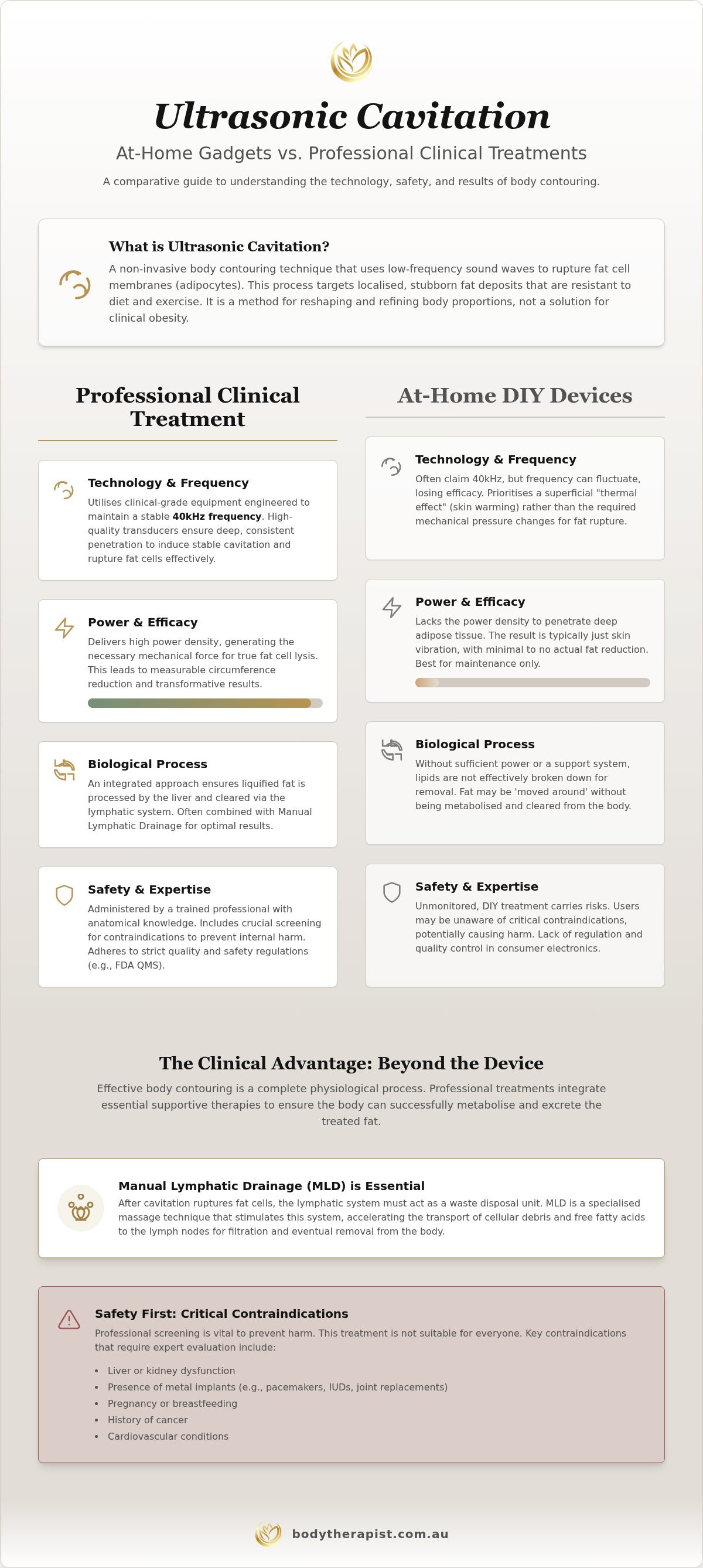
Ultrasonic cavitation utilises low-frequency sound waves to induce a physical phenomenon known as stable cavitation within the subcutaneous fat layer. As these waves penetrate the tissue, they create microscopic bubbles within the interstitial fluid surrounding the adipocytes. The rapid pressure changes cause these bubbles to expand and implode, generating a mechanical force that selectively ruptures the fat cell membranes without damaging surrounding vascular or connective tissue. This process effectively transforms solid fat into a liquid emulsion. While researching ultrasonic cavitation at home vs professional options, it's essential to recognise that this is a sophisticated body sculpting modality designed for contouring, not a weight loss programme for clinical obesity. An ultrasonic cavitation device facilitates this non-invasive fragmentation of tissue by focusing energy precisely where diet-resistant fat resides.
How Cavitation Targets Stubborn Adipose Tissue
Certain anatomical regions, such as the lower abdomen, flanks, and "saddlebags" on the thighs, often contain adipose tissue that is biologically resistant to traditional thermogenesis. These stubborn pockets are frequently the result of hormonal factors or genetic predispositions rather than a lack of caloric discipline. The mechanical impact of ultrasound specifically targets this subcutaneous layer, providing a solution for localised areas that remain unchanged despite a rigorous exercise routine. By applying concentrated energy to the upper arms or waistline, the treatment reduces the volume of fat cells, leading to a visible refinement of the body's silhouette. It's a precise method of reshaping the body's proportions that lifestyle changes alone cannot always achieve.
The Biological Journey: Where Does the Fat Go?
Once the adipocyte membranes are compromised, the internal lipids are released into the interstitial fluid. This liquefied fat is broken down into two primary components: glycerol and free fatty acids. The body intelligently repurposes glycerol as a water-soluble energy source, while the free fatty acids are transported to the liver for processing or eventual excretion. Within this clinical context, lipolysis is defined as the vibration-induced breakdown of lipids into their constituent parts for metabolic removal. The lymphatic system acts as the body's critical waste disposal unit during this phase. It's responsible for collecting the cellular debris and transporting it toward the lymph nodes for filtration. Because the liver must process these fatty acids, maintaining high hydration levels and supporting lymphatic flow are non-negotiable requirements for achieving a successful outcome.
The Technical Gap: Clinical 40kHz vs At-Home Power Specs
The technical disparity between ultrasonic cavitation at home vs professional clinical systems often comes down to the physics of energy delivery. While marketing materials for consumer gadgets frequently highlight the 40kHz figure, the actual power density required to achieve stable cavitation in deep adipose tissue is rarely met by portable units. Clinical-grade machines are engineered to maintain a consistent 40kHz frequency, which is the established industry standard for penetrating deep enough to rupture fat cell membranes without causing resonance in bone or vital organs. Referencing FDA information on ultrasound safety helps clarify how these biological effects, including tissue heating and cavitation, must be precisely controlled to avoid adverse reactions.
Professional transducers are constructed from high-quality piezoelectric materials that prevent frequency drift during a session. If the frequency fluctuates, the treatment loses its mechanical efficacy. Many budget-friendly devices prioritise a "thermal effect" to give the user a sensation of heat, yet this typically only warms the dermis rather than inducing the pressure changes needed for fat cell lysis. This superficial heating might feel productive, but it doesn't trigger the cellular rupture necessary for genuine body contouring.
Why Frequency (kHz) Matters for Fat Rupture
Frequency and penetration depth share an inverse relationship. A higher frequency, such as the 80kHz often found in "quiet" or "mini" home devices, produces shorter waves that barely reach the subcutaneous fat layer. These higher frequencies are better suited for superficial skin tightening than for reducing circumference. Professional 40kHz systems are calibrated to generate the specific wave amplitude required to create micro-bubbles in deep tissue. Expert calibration also eliminates the risk of "standing waves," which are stationary patterns of energy that can cause sharp discomfort or internal bruising if the applicator isn't handled with anatomical precision.
Energy Intensity and Consistency
The true differentiator is often the power output measured in Watts per square centimetre (W/cm²). Clinical units are robust, often requiring internal liquid or fan cooling systems to manage the high energy levels needed to achieve measurable transformation. In contrast, USB-powered or small plug-in consumer electronics lack the electrical capacity to sustain such intensity. This limitation often leads to "hot spots" where energy is unevenly distributed across the applicator head, increasing the risk of superficial burns while failing to trigger cavitation at the cellular level. For those seeking a reliable outcome, a professional consultation ensures the equipment used is capable of the high energy density required for physical optimisation.
Professional Safety Protocols vs DIY Risks
The primary objection to clinical care is often financial, with many individuals assuming that a one-off purchase of a consumer device is a more prudent investment. However, the true cost of ultrasonic cavitation at home vs professional treatment isn't measured in dollars alone, but in the physiological risk of zero results or, worse, systemic harm. When fat cells are ruptured, the resulting debris creates a significant metabolic load. If the body's filtration systems are compromised or overwhelmed, this "liquefied fat" can lead to complications rather than contouring. A professional therapist provides the essential clinical oversight to ensure your internal organs can handle the sudden influx of lipids. Consulting a WebMD guide to ultrasonic cavitation confirms that while the technology is effective, it requires specific health profiles to be performed safely.
It's vital to understand that "more is not better" when dealing with high-intensity sound waves. Home users often fall into the trap of over-treating a single zone in hopes of faster results, which can lead to tissue trauma rather than fat reduction. A clinical environment ensures that the dosage of energy is precisely calibrated to trigger a biological response without exceeding the body's natural recovery capacity.
Clinical Screening and Contraindications
Safety in body contouring begins with a rigorous health assessment that DIY users often bypass. There are several absolute contraindications where ultrasonic energy can exacerbate underlying conditions. These include:
Pregnancy and breastfeeding.
Cardiac conditions or the presence of a pacemaker.
Liver dysfunction or kidney failure, which prevents the effective processing of released fatty acids.
Metal implants or prosthetic joints in the treatment zone.
Active malignancy or oncology treatments.
Beyond these medical hurdles, a professional evaluates skin elasticity to determine if the patient is a viable candidate. If the skin lacks structural integrity, removing fat volume without concurrent RF Skin Tightening can result in sagging tissue. In extreme cases, over-treating an area or ignoring contraindications poses a risk of fat embolism, where undissolved lipid clusters enter the bloodstream and obstruct vessels.
The Danger of Incorrect Technique
The mechanical application of the transducer wand requires more than just circular motions on the skin. A trained practitioner understands that the angle of the probe is critical; it must be directed into the adipose tissue rather than perpendicular to internal organs. Incorrect home use can lead to the "ringing in the ears" phenomenon or temporary tinnitus caused by sound waves conducting through the bone. Professionals mitigate this by avoiding bony landmarks and using specific frequencies that minimise auditory discomfort. Without this anatomical knowledge, home users risk surface burns from energy "hot spots" or deep tissue bruising caused by excessive pressure or prolonged exposure in a single zone.
The Clinical Advantage: Integrated MLD and Skin Tightening
Successful body contouring is a multi-stage physiological process. Simply rupturing adipocytes is a mechanical success, but metabolic success depends entirely on the body's ability to transport and eliminate the resulting lipid waste. This is where the debate over ultrasonic cavitation at home vs professional care becomes most critical. Clinical protocols don't treat cavitation as a standalone event; they integrate it into a broader rehabilitative framework that prioritises lymphatic health and structural skin integrity. Without this comprehensive approach, the liquefied fat can remain stagnant in the tissue, leading to suboptimal results and localised congestion.
Why Your Lymphatic System is the Key to Results
A professional therapist understands that the lymphatic system is the primary waste disposal unit for the glycerol and free fatty acids released during treatment. Without targeted intervention, these lipids can linger in the interstitial space, potentially being re-absorbed by the body. Incorporating manual lymphatic drainage massage immediately following a session accelerates the movement of these fluids toward the lymph nodes for filtration and eventual excretion. Many practitioners perform a "pre-drain" to clear existing congestion and open the pathways before the fat is even liquefied. If you are unsure of your current metabolic efficiency, reviewing the 5 signs your body needs clinical support can help determine if your system is prepared for the load of a professional cavitation session.
RF Skin Tightening: Preventing Post-Cavitation Laxity
Removing fat volume creates a secondary challenge: skin laxity. When the underlying padding of adipose tissue is reduced, the skin envelope may appear loose or sagging, particularly in areas like the abdomen or upper arms. Professional clinical protocols address this by pairing cavitation with Radiofrequency (RF) skin tightening. This technology delivers controlled thermal energy into the dermis to contract existing collagen fibres and stimulate the production of new fibroblasts. This synergy ensures that as the circumference reduces, the skin remains taut and smooth. While many consumer-grade 2-in-1 devices claim to offer both functions, they rarely possess the electrical wattage required to achieve the therapeutic temperatures necessary for genuine collagen remodelling. To achieve a truly transformed silhouette that balances fat reduction with structural firmness, consider booking an integrated cavitation and RF session to ensure your body receives the technical support it requires for a safe recovery.
Investing in Results: Choosing Your Contouring Pathway
The decision between ultrasonic cavitation at home vs professional clinical intervention ultimately rests on your desired outcome. While consumer-grade devices might offer minor maintenance for those with minimal adipose tissue, clinical sessions are engineered for genuine physiological transformation. Choosing a professional pathway ensures that you aren't just vibrating the skin surface, but effectively rupturing fat cell membranes and supporting the body's metabolic clearance. Body Therapist specialises in clinical massage therapy and advanced body contouring, providing a results-oriented alternative to the superficial care found in general beauty salons.
To determine if you're a candidate for clinical-grade treatment, consider this checklist:
Do you have localised fat deposits that remain unchanged by a calorie-controlled diet and regular exercise?
Is your skin showing signs of laxity that require concurrent RF skin tightening?
Do you require a medically supervised protocol that accounts for your specific health history and contraindications?
Are you looking for a measurable reduction in circumference within a specific timeframe?
The "Time vs Money" trade-off is a significant factor in this choice. You might perform 20 or more home sessions with only negligible changes in skin texture, whereas a structured course of 6 clinical sessions can produce visible, transformative results. Professional systems deliver higher energy density in a fraction of the time, making the clinical route a more efficient investment for those serious about their physical optimisation.
Realistic Expectations and Timelines
A typical professional protocol involves a course of 6 to 12 sessions, usually spaced one week apart to allow the liver and lymphatic system to process the released lipids. This isn't a "one-and-done" procedure; it relies on a cumulative effect where each session builds upon the last to progressively refine the body's silhouette. Your results are heavily influenced by your post-treatment habits. Maintaining high hydration levels is essential to facilitate the transport of fatty acids, and light movement or exercise immediately following a session helps flush the system. This methodical approach ensures that the "liquefied fat" is metabolised rather than simply settling into new areas.
Next Steps: Booking a Clinical Consultation
Before you commit to purchasing a consumer device, it's vital to seek a professional assessment. A clinical consultation allows a master practitioner to evaluate your tissue density, skin elasticity, and lymphatic function. This diagnostic step ensures that your treatment plan is customised, often combining MLD, cavitation, and RF technology to address your specific anatomical needs safely. Don't risk your health or waste resources on ineffective gadgets when a tailored, science-based solution is available. Book a body contouring consultation with Body Therapist today to begin your journey toward a smoother, more confident silhouette under expert clinical guidance.
Achieving Anatomical Precision in Your Contouring Journey
Navigating the technical complexities of ultrasonic cavitation at home vs professional clinical care requires a shift from viewing body contouring as a mere beauty routine to understanding it as a precise biological intervention. Genuine transformation depends on medical-grade 40kHz technology that penetrates deep enough to induce stable cavitation, a feat rarely achieved by consumer electronics. Beyond the equipment, the success of your results hinges on professional anatomical knowledge and the integration of manual lymphatic drainage to ensure the body safely metabolises the released lipids.
At Body Therapist, Lee Carnegie specialises in anatomical release and functional mobility, offering non-surgical, results-oriented protocols that prioritise your physiological health. By combining clinical-grade technology with expert MLD support, we ensure your journey involves zero downtime and maximum efficacy. Don't settle for superficial vibrations when you can invest in a methodical, science-based approach to physical optimisation.
Book Your Clinical Body Contouring Assessment at Body Therapist and define your personalised path toward a smoother, more refined silhouette. Your commitment to health deserves the precision of professional clinical oversight.
Frequently Asked Questions
Is professional ultrasonic cavitation safer than at-home devices?
Professional treatment is significantly safer because it includes a rigorous health screening to identify contraindications like liver dysfunction, kidney failure, or pacemakers. Clinical practitioners use medical-grade equipment that adheres to the 2026 FDA Quality Management System Regulation, ensuring energy delivery is consistent and precisely targeted. This oversight prevents the internal bruising or superficial burns often associated with unmonitored home use where the user may lack anatomical knowledge.
How many centimetres can I expect to lose with professional cavitation?
While individual results vary based on metabolic rate and tissue density, many patients see a reduction of one to five centimetres in the treated area over a full course of sessions. It's important to remember that cavitation is a contouring tool rather than a weight loss solution for obesity. Consistency with the recommended six to twelve sessions is vital for achieving these measurable changes in your body silhouette.
Does at-home cavitation work for cellulite reduction?
At-home devices may provide minor improvements in skin texture through superficial heating, but they generally lack the power required for significant cellulite reduction or deep adipose tissue rupture. When comparing ultrasonic cavitation at home vs professional services, clinical machines provide the energy intensity needed to reach the subcutaneous layers where cellulite-causing fat deposits reside. Professional sessions also integrate RF skin tightening to smooth the skin's surface effectively.
Why do I need to drink so much water after a cavitation session?
Hydration is essential because water acts as the primary transport medium for the glycerol and free fatty acids released during the session. Drinking two to three litres of water daily post-treatment helps the lymphatic system move these lipids to the liver for processing and eventual excretion. Without adequate hydration, the emulsified fat may be re-absorbed by the body, stalling your progress and potentially causing metabolic congestion.
Can I do ultrasonic cavitation every day at home?
No, you shouldn't perform cavitation daily, as the body requires at least 72 hours to metabolise and clear the released fat. Over-treating an area can overwhelm your liver and kidneys, leading to fatigue or systemic stress. Professional protocols typically space sessions at least one week apart to ensure the lymphatic system has completely filtered the cellular debris before the next application of energy.
Will professional cavitation help with my lipedema symptoms?
Professional cavitation can be a valuable component in managing lipedema by reducing the volume of painful adipose tissue and improving localised circulation. When integrated with manual lymphatic drainage, the treatment helps move stagnant fluid and reduce the sensation of heaviness associated with the condition. A clinical assessment is required to ensure the pressure and frequency are adjusted for sensitive lipedema tissue to avoid unnecessary trauma.
Does the 'ringing' sound in my head during treatment mean it's working?
The high-pitched ringing sound is a result of sound waves conducting through the bone and is a normal indicator that the 40kHz frequency is active. While it confirms the device is emitting ultrasonic energy, a professional therapist uses specific angles and techniques to minimise this auditory discomfort. If the sound is excessively loud or painful during home use, it may indicate incorrect probe placement or poor equipment calibration that could lead to bone resonance.
How long do the results of professional fat cavitation last?
The results of professional fat cavitation are technically permanent because the ruptured fat cells are destroyed and cannot grow back. However, the remaining adipocytes in the area can still expand if a caloric surplus is maintained through your diet. To ensure your new silhouette lasts, it's essential to follow a stable lifestyle and support your lymphatic health through regular movement and consistent hydration.


Comments