

Remedial Massage for Sports Injuries: A Clinical Guide to Recovery and Performance
- leecarnegie

- Jul 19
- 12 min read
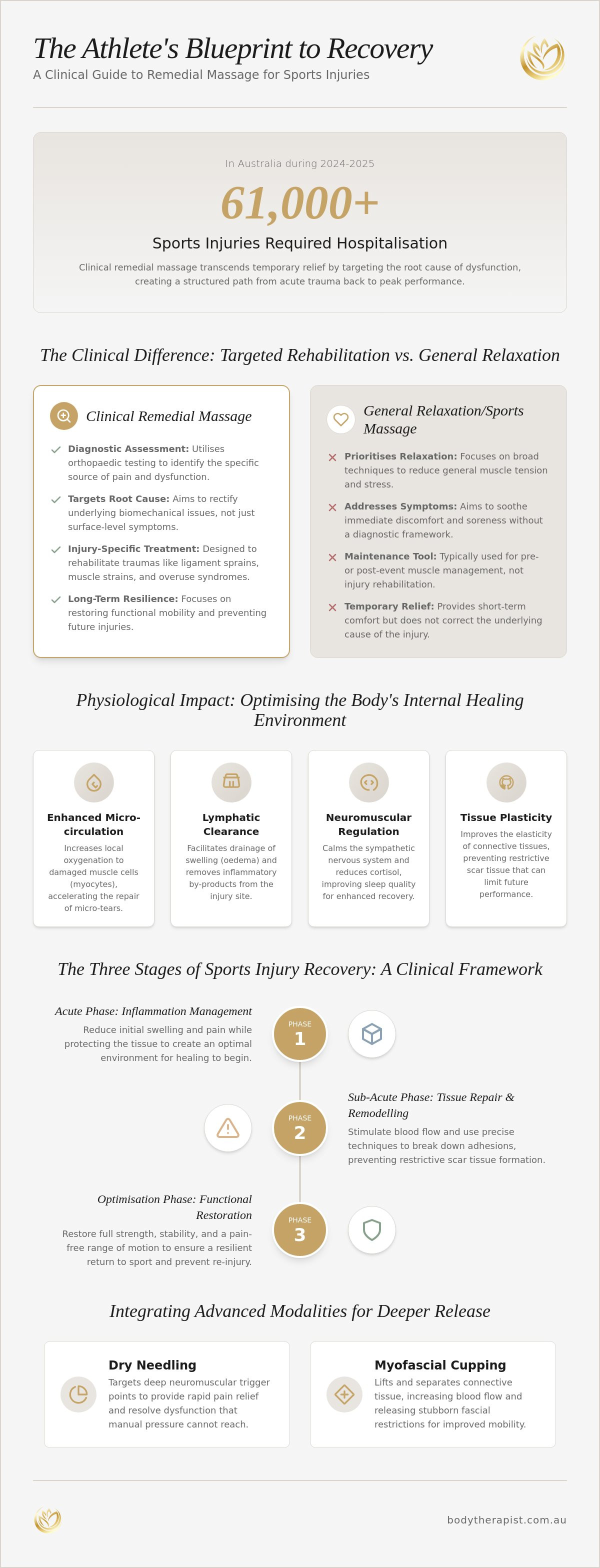
With over 61,000 sports injuries requiring hospitalisation in Australia during the 2024-2025 period, the path from acute trauma back to peak performance is rarely a straight line. You’ve likely experienced the frustration of recurrent muscle tightness that hampers your training or the disappointment of a standard relaxation rub that fails to address the underlying biomechanical dysfunction. It’s exhausting when slow recovery times keep you on the sidelines while your fitness goals feel increasingly out of reach. This is where clinical remedial massage for sports injuries transcends simple soft tissue work, moving into the realm of precise, evidence-based rehabilitation.
We understand that an athlete’s body requires more than just superficial relief; it demands a methodical approach to tissue repair and structural integrity. This guide explores how clinical remedial techniques and advanced modalities, such as dry needling and myofascial cupping, accelerate the healing of micro-tears and restore functional mobility. You'll gain a clear understanding of the physiological recovery process, from reducing acute inflammation to achieving a full, pain-free range of motion. We will outline the specific protocols used to transition your body from a state of injury to a condition of physical optimisation and long-term resilience.
Table of Contents
Understanding Remedial Massage for Sports Injuries and Performance
Remedial massage for sports injuries is a targeted, clinical intervention designed to identify and rectify specific musculoskeletal dysfunctions. Unlike general massage, which often prioritises broad relaxation, remedial therapy relies on a rigorous assessment of the body's structural integrity. Remedial massage is a systematic assessment and treatment of the muscles, tendons, and connective tissues of the body. By focusing on the underlying pathology rather than just the immediate discomfort, this approach ensures that the recovery process is both efficient and sustainable for athletes.
While many use the terms interchangeably, there is a distinct clinical boundary between a general sports massage and remedial therapy for injury rehabilitation. A standard sports massage is typically a maintenance tool used to manage pre- or post-event muscle soreness. In contrast, remedial massage for sports injuries involves a diagnostic framework. It addresses specific traumas such as ligament sprains, muscle strains, or chronic overuse syndromes. This methodical approach allows the practitioner to restore joint symmetry by balancing muscle tone and tension across the entire kinetic chain.
The Clinical Difference: Remedial vs. Relaxation
A clinical massage therapy session begins with objective testing, such as range-of-motion analysis and orthopaedic assessments. Relaxation techniques simply don't provide the mechanical stimulus required to break down adhesions or realign muscle fibres following a structural injury. A master practitioner looks beyond the point of pain to find the source. For example, chronic knee pain might actually stem from dysfunction in the hip flexors or gluteal complex. Identifying these root causes is what prevents the injury from recurring during high-intensity training.
Physiological Benefits for the Modern Athlete
The impact of manual therapy extends deep into the cellular level. This Massage Therapy Overview highlights the broad applications of the practice, but in a sports context, we focus on mechanotherapy. This process involves using mechanical pressure to stimulate cellular-level healing and tissue repair. The physiological response includes:
Enhanced Micro-circulation: Increasing local oxygenation to damaged myocytes helps accelerate the repair of micro-tears.
Lymphatic Clearance: Manual techniques facilitate the drainage of oedema, removing metabolic waste and inflammatory by-products from the injury site.
Neuromuscular Regulation: Targeted pressure helps reduce systemic cortisol levels while calming the sympathetic nervous system to improve sleep and recovery.
Tissue Plasticity: Improving the elasticity of connective tissues prevents the formation of restrictive scar tissue that can limit future performance.
By manipulating these physiological processes, remedial massage creates the optimal internal environment for recovery. It doesn't just mask pain; it actively facilitates the biological stages of repair, ensuring that the athlete returns to their sport with improved functional capacity and a reduced risk of future setbacks.
Advanced Modalities: Integrating Dry Needling and Kinetic Release
While manual techniques form the bedrock of recovery, complex athletic trauma often requires a more sophisticated, multi-modal strategy. Integrating advanced clinical tools with remedial massage for sports injuries allows for a deeper level of structural release than traditional methods alone. This synthesis ensures that every layer of tissue, from the superficial fascia to the deep musculature, is addressed through a specific, evidence-based lens. By combining these modalities, we can create a comprehensive treatment plan that moves beyond symptom management to address the root cause of dysfunction.
Neuromuscular Pain Relief with Dry Needling
Many athletes seeking dry needling near me require a solution for deep trigger points that manual therapy cannot access. This technique involves inserting fine needles to elicit a "local twitch response," which resets muscle spindles and interrupts chronic pain cycles. It's a safe, sterile procedure that's essential for elite-level recovery from stubborn muscular knots. You can expect a deep, dull ache or a brief muscle twitch, followed by a significant release in tension and improved tissue health.
Restoring Movement with Kinetic Release Techniques
Kinetic Release focuses on restoring functional mobility by integrating movement with structural remedial work. Unlike static stretching, this method addresses joint range of motion and dysfunctional movement patterns in real-time. By training the body to move correctly, we prevent the recurrence of common sports injuries like hamstring strains or hip impingement. Success with these complex releases requires a master practitioner who understands the intricate relationship between anatomical structure and dynamic performance.
To further enhance the healing environment, we often incorporate myofascial silicone cupping and Low Level Laser Therapy (LLLT). Cupping uses negative pressure to lift the fascia and increase nutrient-rich blood flow to stagnant areas, facilitating the removal of metabolic waste. LLLT, or photobiomodulation, uses specific wavelengths of light to stimulate mitochondrial activity, which is crucial for accelerating cellular repair in acute injuries. Research into the Effectiveness and safety of massage for athletic injuries suggests that these integrated approaches provide a superior framework for recovery compared to isolated treatments.
This integrated approach is a hallmark of high-quality remedial massage for sports injuries, ensuring that no aspect of the recovery process is left to chance. If you're struggling with a stubborn injury that isn't responding to standard care, a tailored clinical consultation can help identify the ideal combination of these advanced modalities for your specific needs.
The Three Stages of Sports Injury Recovery: A Clinical Framework
Recovery is a biological progression, not a single event. Effective remedial massage for sports injuries must adapt to the specific physiological state of the tissue at every point in the healing timeline. Applying deep pressure too early can disrupt fragile new cellular bridges; conversely, failing to apply it late enough can result in a permanent loss of mobility. A methodical framework ensures that each intervention supports the body’s natural repair cycle without causing secondary trauma. This strategic evolution of care allows athletes to move safely from initial protection to full functional restoration.
Managing Inflammation and Scar Tissue
The Acute Phase, typically lasting 48 to 72 hours, is defined by inflammation and protection. During this window, aggressive manual work is contraindicated because the primary goal is to manage fluid and protect damaged structures. We utilize gentle Manual Lymphatic Drainage (MLD) to facilitate the clearance of oedema and reduce pressure on nociceptors, which effectively lowers pain levels. If you are experiencing significant swelling, a targeted lymphedema drainage massage can effectively manage fluid accumulation, creating a calmer environment for the Sub-Acute Phase to begin. As you transition into this second stage, the focus shifts to promoting early tissue repair and preventing the formation of restrictive, non-functional scar tissue through controlled structural release.
Functional Rehabilitation and Return to Sport
The Remodelling Phase is the final and often longest stage of recovery. Here, the primary goal is restoring full strength and functional range of motion. We use specific remedial techniques to "re-educate" muscles that may have become inhibited or weakened during a period of disuse. This process is vital for restoring proprioception, which is the body's ability to sense its position and movement in space. Without this neurological feedback, athletes face a significantly higher risk of re-injury upon returning to the field. Understanding how to prepare for remedial massage can help you maximise the benefits of these late-stage sessions, ensuring your body is primed for the demands of high-performance activity.
By synchronising treatment with these three stages, we ensure that remedial massage for sports injuries acts as a catalyst for genuine structural repair. It's a clinical evolution that moves from gentle fluid management to robust functional restoration, tailored to the specific biological needs of your recovering tissues. This methodical approach ensures that when you return to your sport, you do so with a body that's not just "healed," but physically optimised for the challenges ahead.
Addressing Specific Sports-Related Conditions and Muscle Dysfunction
Sports injuries often manifest as localised pain, but their origin is frequently found elsewhere in the kinetic chain. Clinical remedial massage for sports injuries involves a deep understanding of these anatomical connections. We don't just treat the site of discomfort; we look for the biomechanical failures that led to the injury in the first place. This methodical approach is essential for restoring functional mobility and ensuring that athletes can return to peak performance without the risk of immediate relapse. By targeting specific muscle groups and their associated connective tissues, we can correct the structural imbalances that drive chronic pain.
Specific conditions require highly specialised protocols. For rotator cuff and shoulder impingement, the focus is on restoring scapular stability. This often involves releasing the pectoralis minor and subscapularis to allow the shoulder blade to move freely. In cases of ITB syndrome and runner's knee, we address lateral chain tension. Since the iliotibial band is a non-contractile structure, we focus on the Tensor Fasciae Latae (TFL) and gluteal complex to reduce the lateral pull on the knee joint. Similarly, chronic lower back pain is frequently a result of gluteal inhibition or hip flexor tightness, while tennis and golfers elbow require precise release of the forearm extensors and flexors at their common tendon origins.
Trigger Point Therapy for Chronic Tension
Trigger points are hyper-irritable spots located within taut bands of muscle fibres. These "knots" are common in athletes and often create complex referral patterns where pain is felt far from the actual source. For instance, chronic calf tightness is a frequent driver of heel pain or plantar fasciitis. Our clinical method involves applying sustained, ischaemic pressure to these points to encourage the muscle to "reset" and release. This process improves local blood flow and reduces the neurological sensitivity that keeps the muscle in a state of constant contraction.
Myofascial Release for Connective Tissue Health
Fascia is the continuous web of connective tissue that envelopes every muscle and organ, acting as a primary transmitter of force across the body. When fascia becomes "stuck" or dehydrated due to repetitive strain, it limits athletic performance and causes unexplained, diffuse pain. We use long-hold myofascial stretching techniques to slowly melt these restrictions and restore tissue elasticity. This structural release is vital for athletes who feel "tight" despite regular stretching, as it addresses the connective tissue framework that manual pressure alone cannot always reach.
If you're experiencing recurrent tightness that limits your training or performance, you can book a clinical assessment to identify the root cause of your dysfunction and begin a tailored recovery programme.
The Body Therapist Approach: Tailored Clinical Care
Effective rehabilitation requires more than just technical skill; it demands a deep, anatomical understanding of how disparate bodily systems interact under the stress of athletic performance. At Body Therapist, Lee Carnegie provides a sophisticated synthesis of myotherapy and kinetic release to address complex musculoskeletal issues. This master practitioner approach ensures that remedial massage for sports injuries isn't merely a passive treatment but a targeted, results-oriented intervention. We move beyond simple symptomatic relief to focus on long-term structural health and physical optimisation, ensuring every athlete receives a plan as unique as their biomechanical profile.
Our philosophy is grounded in the belief that proactive body maintenance is the most effective way to prevent the 61,000 sports-related hospitalisations seen annually across Australia. By identifying minor dysfunctions before they escalate into acute trauma, we help you maintain a state of readiness. This methodical problem-solving approach is what distinguishes a clinical environment from a general wellness centre. We're dedicated to helping you understand the "how" and "why" of your recovery, empowering you to take an active role in your own physical resilience.
A Methodical Approach to Physical Optimisation
Your journey begins with a comprehensive initial assessment where we scrutinise biomechanical imbalances and movement patterns. We look for the subtle compensations that often lead to recurrent injuries, using objective data to inform our clinical decisions. By integrating multiple modalities, such as Dry Needling and Low Level Laser Therapy, we ensure your recovery is comprehensive and evidence-based. This commitment to clinical excellence is balanced by empathetic care, creating a professional space where your specific athletic goals are the primary focus of every session.
Booking Your Clinical Session
We've streamlined our processes to ensure your focus remains entirely on your recovery. Our clinic provides HICAPS facilities for immediate, on-the-spot private health insurance rebates. As of 2026, most major Australian funds, including Medibank, Bupa, HCF, and NIB, offer rebates for remedial massage for sports injuries under their "extras" cover. This professional recognition is further reflected in the 2026 Australian Census, which now recognises "Remedial Massage Therapist" as a distinct clinical occupation (OSCA Code 441233), acknowledging the specialised qualifications required for this level of care.
To prepare for your initial sports injury assessment, please bring any relevant imaging reports, such as X-rays or MRI scans, and wear comfortable clothing that allows for a full range of motion testing. We'll work together to establish a clear timeline for your return to sport, backed by a methodical treatment plan designed for your specific needs. When you're ready to move past temporary fixes and embrace a clinical standard of recovery, book your clinical remedial session with Body Therapist.
Securing Your Path to Peak Performance
Navigating the complexities of athletic recovery requires a transition from passive relief to active, structural restoration. We've examined how a methodical framework, synchronised with your body's biological healing stages, ensures that tissue repair is both durable and functional. By integrating advanced modalities like dry needling and low-level laser therapy, we address the deep-seated dysfunctions that often keep dedicated athletes sidelined. This clinical approach ensures that every session contributes to a measurable improvement in your physical output.
Under the expert guidance of Lee Carnegie, a specialist in myotherapy and kinetic release, our clinic prioritises a results-oriented focus on functional mobility and pain management. Choosing professional remedial massage for sports injuries means you aren't just managing symptoms; you're investing in a proactive strategy for long-term health. It's time to move beyond temporary fixes and embrace a clinical standard of care that respects the intricate demands of your training schedule. We're here to support your journey back to the field with precision and expertise.
Optimise your recovery with a clinical remedial massage at Body Therapist
Frequently Asked Questions
What is the difference between sports massage and remedial massage?
Remedial massage is a clinical, assessment-based therapy targeting specific muscle dysfunctions, whereas sports massage is often a maintenance tool for managing pre- or post-event soreness. Remedial massage for sports injuries focuses on diagnostic testing and structural rehabilitation to fix the underlying cause of pain. It involves a systematic approach to treating damaged tendons and connective tissues, moving beyond the superficial relief provided by standard sports rubs.
Can remedial massage help with old, chronic sports injuries?
Yes, remedial massage is highly effective for chronic injuries where restrictive scar tissue or compensatory movement patterns have developed over time. We use techniques like myofascial release and trigger point therapy to break down long-standing adhesions and restore functional mobility. By addressing the "stuck" fascia and re-educating the nervous system, we can often resolve pain and stiffness that has persisted for months or even years.
How many sessions will I need to see an improvement in my injury?
The number of sessions required depends entirely on the severity and duration of your injury, but most athletes notice a functional improvement within three to five treatments. Acute strains may resolve quickly, while chronic biomechanical issues require a more sustained approach to ensure long-term stability. We provide a methodical treatment plan after your initial assessment, outlining the expected timeline for your specific recovery and return to sport.
Will I be sore after a clinical remedial massage session?
Post-treatment soreness, often described as a "good ache," is a common physiological response to deep structural work and usually subsides within 24 to 48 hours. This sensation occurs as the body clears metabolic waste and initiates the repair process in newly released tissues. We recommend staying hydrated and performing gentle movement post-session to facilitate lymphatic clearance and minimise any temporary discomfort following your clinical remedial session.
Is remedial massage covered by Australian private health funds?
Yes, remedial massage is covered by most major Australian private health funds under their "extras" cover, provided the therapist is a registered member of a professional association. At Body Therapist, we provide HICAPS facilities for immediate, on-the-spot claims. As of 2026, funds like Medibank, Bupa, and NIB continue to offer rebates for sessions that involve the clinical assessment and treatment of musculoskeletal conditions.
Should I get a sports massage before or after a competition?
A light sports massage is beneficial before a competition to stimulate circulation and prime the nervous system, but deep remedial work should be reserved for the post-event recovery phase. Deep tissue manipulation can temporarily alter muscle tone and proprioception, which may affect performance if performed too close to an event. Post-competition sessions focus on reducing inflammation and accelerating the clearance of metabolic by-products to speed up recovery.
How does dry needling complement a remedial massage for athletes?
Dry needling allows us to reach deep trigger points and neuromuscular junctions that manual pressure cannot always access effectively. By eliciting a local twitch response, dry needling "resets" the muscle, making the subsequent remedial massage for sports injuries more effective and less invasive. This combination is particularly powerful for treating stubborn "knots" and restoring range of motion in elite athletes who require rapid, high-level structural release.
Do I need a referral from a GP or Physio to see a remedial therapist?
No, you don't generally need a referral from a GP or physiotherapist to book a remedial massage session in Australia. Most clients self-refer to address pain or performance issues directly. However, if you are claiming through the Victorian Workers' Compensation Scheme or ReturnToWorkSA, a referral from a medical practitioner is required to access funded sessions under their specific fee schedules as of July 2026.


Comments