

Functional Mobility Assessment: Tests, Scoring and Next Steps

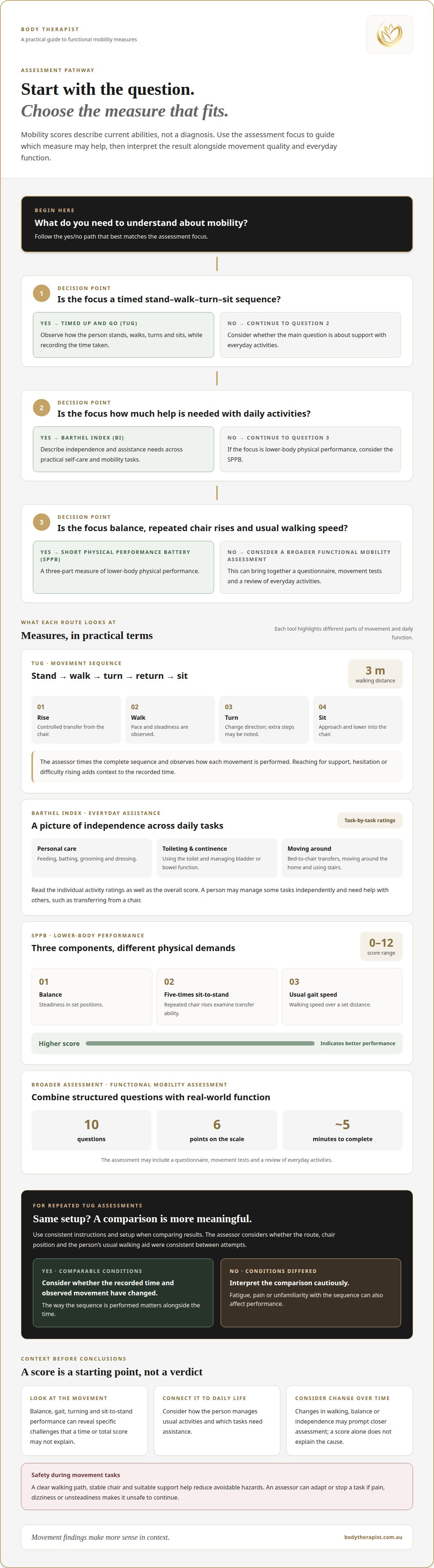
A mobility score is a starting point, not a verdict. A functional mobility assessment can include a questionnaire, movement tests and a review of everyday activities; the Functional Mobility Assessment has 10 questions on a six-point scale and takes about five minutes to complete. The Timed Up and Go test observes how a person stands, walks, turns and sits, while the Barthel Index considers independence with daily activities.
It’s understandable to want a clear answer about what assessment results mean for fall risk or changes in function. Scores describe current abilities, but clinicians interpret them alongside how a person moves and manages daily tasks, not as a diagnosis on their own. This article explains how a functional mobility assessment works, what the TUG and Barthel Index measure, and how clinicians use the findings to identify areas that may need attention. It also outlines possible next steps, from discussing functional goals to considering appropriate therapy and follow-up.
Table of Contents
Timed Up and Go (TUG) test
The Timed Up and Go (TUG) test is a timed check of how someone stands, walks, turns and sits. It gives an assessor a practical view of movement during a short, everyday sequence. The person starts seated in a chair, walks 3 metres, turns 180 degrees, returns and sits down. The assessor records the time and observes how each movement is completed.
The test makes several movement demands visible in one sequence. Standing requires a controlled transfer from sitting; walking shows pace and steadiness; turning requires a change of direction; and sitting involves approaching and lowering into the chair. An assessor may notice, for example, that someone takes extra steps to turn, reaches for support or has difficulty rising. These observations add context to the recorded time.
Administration depends on clear, consistent instructions. The assessor explains the route and task, positions the chair and marks the 3-metre walking distance. The person begins seated, then stands, walks to the marker, turns, returns and sits. The assessor times the complete sequence and notes movement quality. Comparing results is more meaningful when the same route, instructions and setup are used each time.
Test-retest reliability describes how consistently a test produces results when repeated under comparable conditions. Repeating the TUG can help show whether a change in recorded time reflects altered mobility or differences in testing conditions. The assessor considers whether the chair position, route, instructions and the person’s usual walking aid were consistent between attempts. Fatigue, pain or unfamiliarity with the sequence can also affect performance.
A TUG result is one part of a broader picture of mobility, not a standalone diagnosis. The assessor considers both timing and observed movement, then relates the findings to the person’s usual activities and changes over time. Slower performance, hesitation during the turn or difficulty rising may prompt closer assessment of particular movement challenges. The test helps identify what to explore next, rather than explaining every cause of difficulty.
Barthel Index (BI)
The Barthel Index (BI) is a rating tool that describes how much assistance a person needs with everyday activities. It focuses on practical self-care and mobility tasks, rather than measuring walking speed alone. An assessor reviews each activity and records the person’s level of independence. The score provides a structured summary of daily support needs.
Activities covered include feeding, bathing, grooming, dressing, using the toilet, and managing bladder or bowel function. The BI also considers transfers between a bed and chair, moving around the home, and using stairs. For example, someone may eat independently but need help transferring from a chair. Recording these differences gives a more detailed picture than a single general description.
Assessment considers what the person can do in their usual circumstances. The assessor reviews each task, including whether the person completes it independently or needs help. For dressing, this means recording the support actually required, rather than simply noting that the person gets dressed. The same approach applies to transfers, toileting and moving between locations.
Scoring summarises functional independence across the activities. Each activity contributes according to the assistance required, so difficulty in one area remains visible alongside abilities in others. The result is most useful when read together with the individual activity ratings. For instance, an overall score may not make clear that transfers are the person’s main support need.
The BI can help describe changes in daily function over time when assessments use comparable information about the person’s abilities. A change in independence with bathing, for example, may matter even if other activities remain stable. The score does not explain why a task has become harder. Pain, reduced strength, balance concerns or environmental barriers may affect performance, so activity-level findings need context.
Use the BI alongside other observations, such as how a person walks or rises from a chair. The TUG examines a timed movement sequence, while the Barthel Index focuses on everyday assistance needs. Together, they can clarify which activities are affected and where further assessment may help. Understanding these daily support requirements is also essential when coordinating long-distance travel or repatriation for individuals with reduced independence, where commercial airline escort services like RN MEDflights assist non-emergency patients with transfers and in-flight care.
Fall risk and functional decline
Fall risk describes the possibility of losing balance and falling during everyday movement. Functional decline means a reduced ability to manage activities such as standing, walking or transferring. An assessment can identify movement changes that deserve closer attention, but a score alone does not explain their cause. For example, slower walking may occur alongside difficulty rising from a chair.
The Short Physical Performance Battery (SPPB) is a three-part measure of lower-body physical performance. It combines balance assessment, a five-times sit-to-stand test and usual gait speed. Scores range from 0 to 12, with higher scores indicating better performance. The components show different demands: repeated chair rises examine transfer ability, while balance tasks examine steadiness in set positions.
Gait speed assessment measures how quickly someone walks over a set distance. The walking distance ranges from 3 to 8 metres. A clinician interprets the result alongside other observations, such as balance and repeated sit-to-stand performance. If walking appears slower while chair rises also become difficult, the combined pattern can indicate broader changes in mobility.
During an assessment, key safety concerns include losing balance or becoming fatigued while completing a movement task. A clear walking path, stable chair and suitable support help reduce avoidable hazards. The assessor can adapt or stop a task if pain, dizziness or unsteadiness makes it unsafe to continue.
Results are most useful when they prompt closer attention to specific activities, rather than being treated as a prediction of an individual fall. A change in SPPB performance can prompt review of which component has shifted, such as balance, chair rises or walking speed. The assessor can relate those findings to daily tasks and changes over time. For instance, difficulty standing from a chair may affect transfers even when walking remains steady. This distinction helps direct follow-up towards the movement challenge that matters most.
Purpose and administration of the Functional Mobility Assessment
A functional mobility assessment gathers information about a person’s movement and daily function. Its purpose is broader than a falls risk or gait assessment, which focuses more specifically on factors related to falling or walking performance.
Who can perform the assessment
A trained health professional can administer the assessment using the questionnaire and its scoring method. In Australia, physiotherapists and occupational therapists may assess mobility as part of their clinical work. The appropriate practitioner depends on the person’s needs and the purpose of the assessment.
Administration involves presenting each question clearly and recording the person’s response without influencing it. The assessment has 10 questions, each scored on a six-point Likert scale, and takes about five minutes to complete. If a question needs clarification, the administrator can explain its wording while allowing the person to choose their own response.
This distinction matters when selecting a tool. A gait assessment observes walking, while a falls risk assessment considers factors related to falling. A functional mobility assessment, by contrast, records the person’s reported experience across the questions.
Interpreting assessment scores
Score interpretation means considering the total and individual responses in relation to a person’s reported mobility. Scores range from 10 to 60 points, summarising responses across all 10 questions.
Individual answers can reveal reported difficulty or reduced satisfaction that an overall score may obscure. Clinicians consider these responses alongside goals, daily activities and other findings. For example, difficulty with one activity can guide a focused discussion, even when other responses are more positive. A functional mobility assessment describes reported function; it does not identify the cause of a limitation or determine fall risk by itself.
For support discussing movement-related concerns, discuss your mobility goals.
Body Therapist
When assessment findings point to discomfort, swelling or movement-related concerns, Body Therapist offers hands-on therapy that may be relevant. The assessment describes function; therapy can address related physical concerns through an individualised approach.
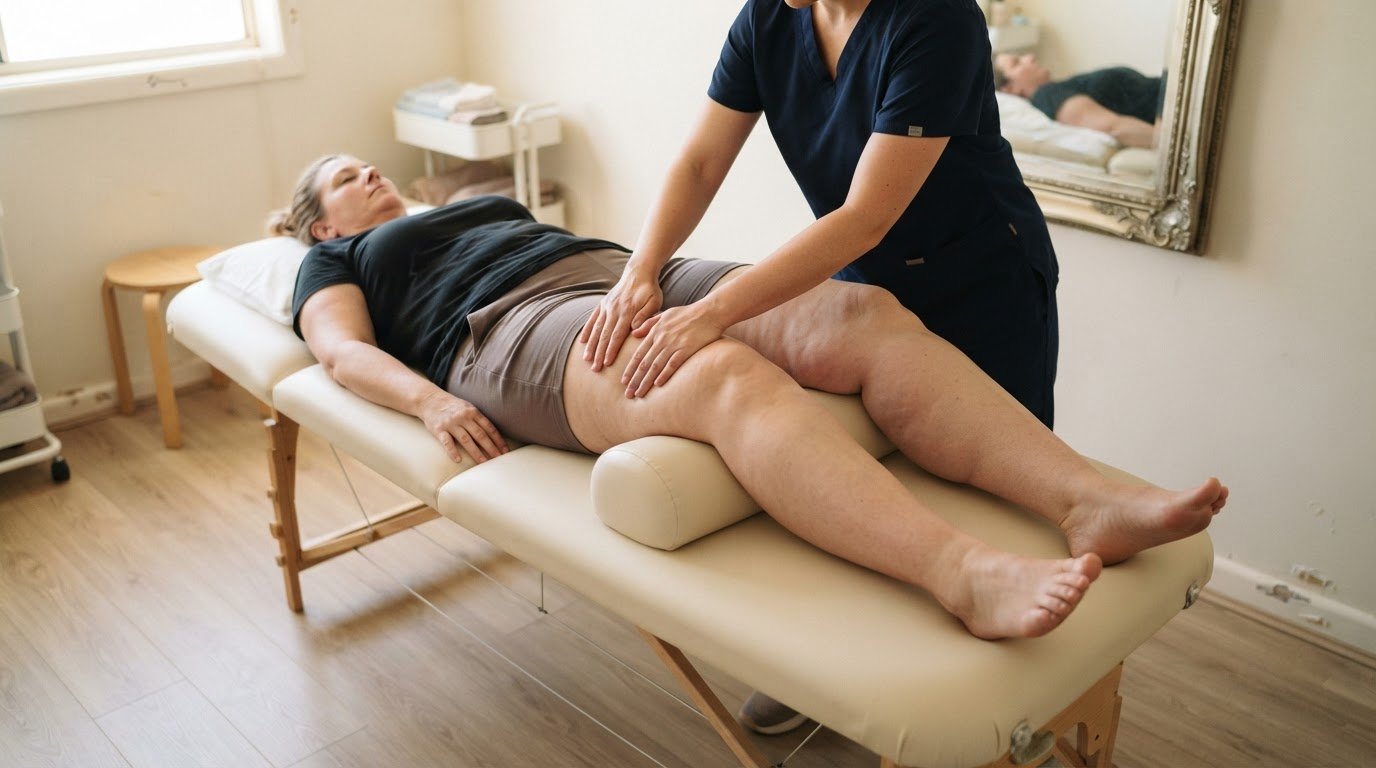
Depending on your needs, options include Remedial Massage, Manual Lymphatic Drainage Massage, Lymphedema Therapy or Oncology Massage. These services address different needs, so the right conversation starts with your symptoms, health context and goals. For example, swelling may call for a different therapeutic approach than muscular discomfort. Assessment scores can help frame that discussion, but they don’t determine a treatment plan on their own.
If you’d like to discuss your needs and possible next steps, contact Body Therapist.
Turn assessment findings into a practical next step
A score is more useful when it supports a clear conversation about what feels difficult in everyday movement. Consider which activities matter most to you, what has changed and what you would like to manage more easily. These priorities can connect a functional mobility assessment with goals that matter in your daily routine.
Assessment results do not need to dictate the whole plan. They can provide a starting point for discussing movement concerns, physical comfort and appropriate support. Body Therapist can discuss how your concerns relate to its hands-on therapy options and help you consider a suitable next step based on your needs.
If you’re ready to talk through your movement concerns, contact Body Therapist. A considered conversation is a constructive way to move from assessment findings towards goals that matter to you.
Frequently Asked Questions
What Happens After the Mobility Assessment?
After the assessment, the clinician discusses the findings and identifies which movement goals matter most to you. The next step may be agreeing on a practical focus, such as improving confidence during transfers or reviewing a task that has become harder. If the results raise questions beyond the assessment’s scope, the clinician can explain what further evaluation or follow-up may help.
What does a functional mobility assessment involve?
A functional mobility assessment is a clinical process for examining how a person moves and manages activities relevant to daily life. The term can describe the overall assessment, rather than one specific test. A clinician may combine the person’s account of their abilities with observed movement tasks. Different tools can explore related concerns from distinct perspectives, depending on the person’s needs and the reason for assessment.
What does this assessment measure?
It examines practical movement abilities, including changing position, maintaining balance and managing everyday tasks. The focus depends on the selected tool and the question being explored. For example, a clinician may assess transfers or consider how a movement limitation affects a person’s routine. Results describe performance and reported ability; they do not identify the underlying cause on their own.
Which tests may be included?
Options include the Timed Up and Go test, the Barthel Index and the Short Physical Performance Battery. Each offers a different perspective: one observes a movement sequence, another records assistance with daily activities, and another examines lower-body performance. A functional mobility assessment may use one or more suitable tools, selected according to the person’s abilities and the clinical question.
How is the assessment carried out step by step?
The clinician first clarifies the reason for assessment and which activities are causing concern. They then select suitable questions or movement tasks, explain what’s involved and record the person’s responses or observed performance. Next, they interpret the findings in light of relevant daily demands. The discussion can then identify practical goals and whether further assessment or follow-up would be useful.
Comments