

Remedial Massage for Back Pain: Clinical Buyer's Guide

What if the persistent ache in your lumbar region isn't actually a "back problem," but a failure of your body's integrated kinetic chain? For many Australians, the frustration of disrupted sleep and the inability to exercise becomes a daily burden that generic treatments fail to resolve. You've likely tried various quick fixes, only to find the stiffness returns within hours, leaving you trapped in a cycle of short-term relief and recurring discomfort.
A clinical approach to remedial massage for lower back pain breaks this cycle by treating the body as a complex, functional system. By utilising a methodical "assess-treat-reassess" model, we can identify the specific structural causes and postural triggers behind your symptoms. This guide explains how specialised manual therapies restore range of motion to your hips and spine, providing a clear pathway to long-term recovery and physical optimisation. You'll discover how a deep understanding of human anatomy can transform your mobility and help you reclaim a life free from chronic pain.
Table of Contents
Understanding Remedial Massage for Lower Back Pain
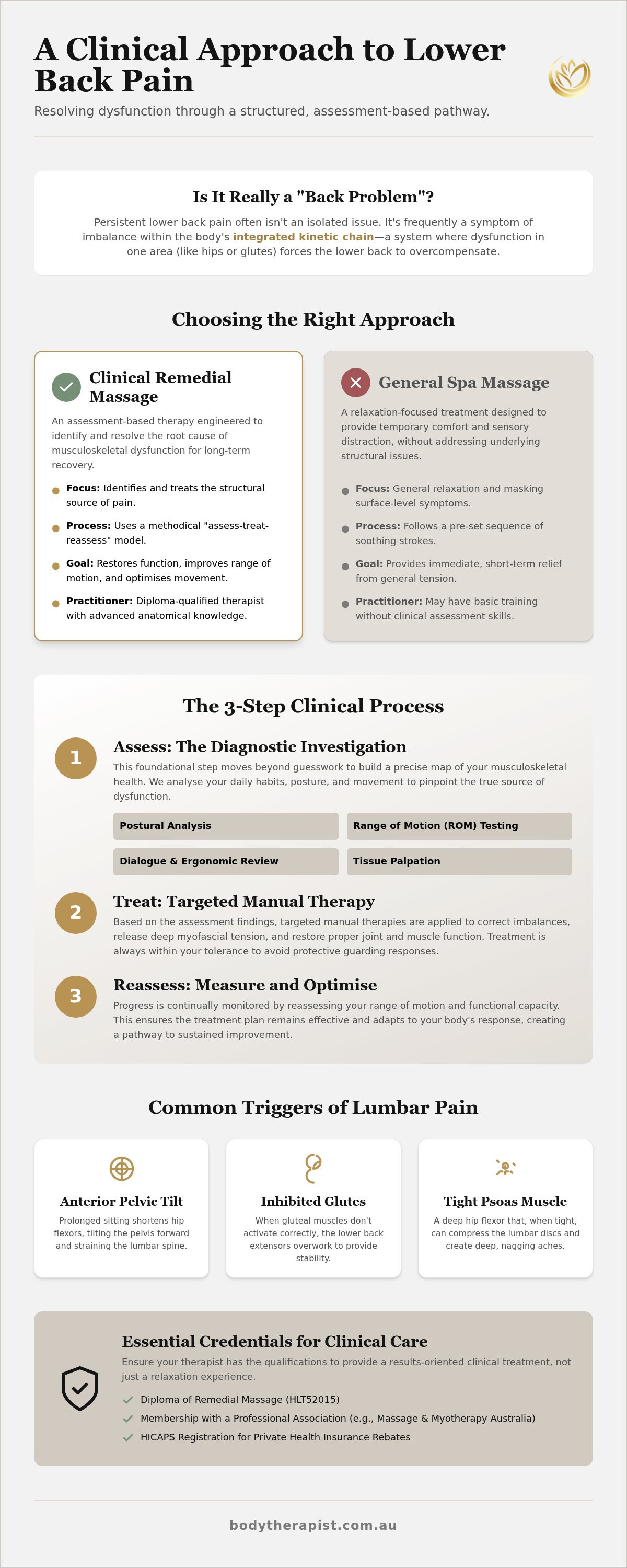
Remedial massage is not merely a sequence of soothing strokes; it is a clinical, assessment-based therapy specifically engineered to address musculoskeletal dysfunction. When applying remedial massage for lower back pain, the practitioner focuses on the intricate relationship between the lumbar spine, the pelvis, and the supporting soft tissue structures. Unlike standard treatments that prioritise immediate comfort, the primary objective here is to isolate the underlying cause of the pain. Whether the issue stems from prolonged sitting or a sudden structural strain, we look for the source rather than just masking the symptoms.
Many clients hold the belief that effective treatment must be excruciating. This "no pain, no gain" mentality is a common misconception that can actually hinder recovery. While clinical pressure is often firm and deep, it must remain therapeutic and within your tolerance levels to prevent the body from tensing up. If the pressure is too aggressive, the nervous system may trigger a protective guarding response, which counteracts the goal of muscle lengthening and structural release.
The Biological Mechanism of Pain Relief
The efficacy of this modality relies on specific physiological responses that occur deep within the tissue. When a therapist applies targeted pressure, it stimulates essential blood flow to ischaemic muscle tissues, which are areas deprived of oxygen due to chronic tension or poor posture. This influx of nutrients facilitates cellular repair and metabolic waste removal. Simultaneously, the nervous system begins to "down-regulate," shifting from a state of high-alert pain signalling to a more parasympathetic, restorative state. In this Massage Therapy Overview, the broad historical context of these techniques is explored, yet the clinical application remains highly specific to your unique anatomy. Myofascial release is the manipulation of connective tissue to restore sliding surfaces.
Why a General Spa Massage Won’t Fix Your Back
A common mistake is seeking a general spa treatment for a structural issue. Choosing remedial massage for lower back pain over a relaxation treatment ensures you receive care from a practitioner with advanced anatomical knowledge and a Diploma of Remedial Massage. This qualification is required to practice clinically in Australia, allowing the therapist to interpret complex physiological signals and maintain detailed clinical case notes to track your functional progress. A spa environment often ignores structural imbalances, such as an anterior pelvic tilt or a tight psoas muscle, which are frequently the true drivers of lumbar discomfort. By choosing a clinical setting, you ensure that every technique is chosen to correct these imbalances rather than simply providing a temporary sensory distraction.
The Clinical Assessment: How Specialists Target Lumbar Dysfunction
A clinical session begins with a rigorous investigation into your daily physiological habits. We don't just look at where the pain manifests; we examine the environmental factors that contribute to it. Your desk ergonomics, the quality of your sleep, and even your preferred resting positions dictate the cumulative load placed on your lumbar spine. This data, integrated with a formal What is Remedial Massage assessment, allows us to construct a precise map of your musculoskeletal health.
Postural analysis follows this dialogue. We observe for an anterior pelvic tilt or subtle spinal deviations that suggest the body is using compensatory patterns to maintain upright stability. We then move into Range of Motion (ROM) testing to pinpoint functional blockages where movement is restricted. Finally, palpation allows the therapist to detect specific trigger points and changes in tissue density that indicate chronic ischaemia or hypertonicity. This methodical "assess-treat-reassess" model ensures that every manual intervention is based on objective findings rather than guesswork.
Tracing the Kinetic Chain
Your lumbar discomfort is rarely an isolated anatomical event. Often, the lower back is the victim of dysfunction elsewhere in the kinetic chain, such as shortened hip flexors or inhibited gluteal muscles. When the glutes fail to fire correctly, the lumbar extensors must overwork to provide stability. Effective remedial massage addresses these distant tension points to ensure the spine is supported by a balanced muscular framework. This holistic view prevents the recurring "relapse" often seen with more localised treatments.
Identifying Your Specific Back Pain Trigger
We must distinguish between muscular strain, ligamentous stiffness, and referred pain to apply the correct therapeutic pressure. The Quadratus Lumborum (QL) is a frequent culprit in chronic lower back gripping, often acting as a secondary stabiliser when the core is weak. Functional mobility tests reveal real-world movement limitations by observing how your joints interact during active tasks. This clarity allows us to target the specific tissue types causing your restriction. If you're ready to uncover the mechanical drivers of your discomfort, booking a clinical consultation is the first step toward functional recovery.
Comparing Modalities: Remedial Massage vs. Dry Needling vs. Laser
Effective resolution of lumbar dysfunction often requires a diverse therapeutic toolkit. While remedial massage for lower back pain serves as the foundation for correcting broad myofascial tension, specific clinical scenarios demand more targeted interventions. Remedial massage excels at restoring balance to large muscle groups and correcting the postural deviations identified during your initial assessment. According to Musculoskeletal Health Australia on Remedial Massage, this manual approach is vital for managing the systemic tension and guarding patterns that frequently accompany chronic lumbar issues.
When a "knot" or trigger point becomes fibrotic and unresponsive to manual pressure, we may transition to dry needling. This technique involves the insertion of fine, sterile filament needles into myofascial trigger points to elicit a local twitch response. This mechanical stimulation is designed to reset the neuromuscular junction, effectively "rebooting" the muscle's resting tone. For those searching for dry needling near me, it's important to understand that this is a clinical procedure allowing us to reach tissue depths that manual palpation cannot access. We often complement these methods with Low Level Laser Therapy (LLLT), a non-invasive modality that utilises specific light wavelengths to stimulate cellular repair and mitigate inflammation without generating heat.
The fastest results are typically achieved through a multi-modality strategy. By combining the structural release of massage with the neurological reset of dry needling and the biological support of laser therapy, we address pain from three distinct physiological angles. This integrated approach ensures that we aren't just soothing a symptom but are actively facilitating the body's natural recovery processes.
When to Choose Dry Needling
If your symptoms return shortly after treatment or specific areas feel "locked" despite deep tissue work, dry needling is the indicated response. The local twitch response is a brief, involuntary contraction that signals the release of accumulated acetylcholine, which is often responsible for persistent muscle shortening. It's a safe, evidence-based method for breaking the cycle of chronic muscle guarding, providing a window of opportunity to introduce more functional movement patterns.
The Role of Myotherapy and Kinetic Release
Myotherapy elevates standard treatment by providing a comprehensive, evidence-informed assessment of the entire musculoskeletal system. Rather than relying on static stretching, which can sometimes aggravate an unstable lumbar spine, we utilise kinetic release techniques. These involve active movement patterns designed to restore sliding surfaces between tissue layers and improve joint mechanics. Integrating these methods into a long-term strategy ensures that your immediate relief translates into sustainable, functional recovery.
Buying Guide: Choosing a Results-Oriented Clinical Therapist
Selecting a practitioner for remedial massage for lower back pain requires more than a simple search for proximity. It demands a verification of clinical standards and specialised expertise. In Australia, the industry is self-regulated, meaning the burden of due diligence often falls on the client. You should prioritise therapists who maintain membership with peak professional bodies, such as Massage & Myotherapy Australia or the Association of Massage Therapists. These organisations mandate strict continuing professional education (CPE) requirements and adherence to a clinical code of ethics, ensuring your therapist remains current with evidence-based musculoskeletal research.
A results-oriented therapist operates in a clinical environment designed for functional assessment rather than a spa aesthetic focused on sensory distraction. When seeking relief for complex lumbar pathologies, ask specifically about their experience with conditions like sciatica, disc bulges, or spondylolisthesis. A qualified specialist understands the specific structural releases required to avoid aggravating sensitive neural pathways. The clinical application of remedial massage for lower back pain relies on this technical precision to move beyond temporary relief toward genuine physical optimisation.
What to Ask Before Your First Appointment
Transparency is a hallmark of clinical excellence. Before your initial consultation, enquire whether the therapist provides a written treatment plan that outlines the suspected drivers of your dysfunction. You should also ask how they measure progress over multiple sessions. Do they use objective markers, such as improved degrees of hip flexion or reduced pain scales during specific movements? Understanding their approach to preparing for remedial massage will also ensure you arrive ready for a high-intensity clinical session rather than a passive relaxation experience.
Understanding Private Health Rebates
Most Australian private health insurers categorise remedial massage under "extras" cover, but eligibility depends entirely on the therapist's credentials. To claim a rebate, your practitioner must hold a Diploma of Remedial Massage and possess a valid Provider Number for your specific fund. Always ensure the clinic offers HICAPS facilities for on-the-spot processing. It's important to distinguish that relaxation or "Swedish" sessions are typically not rebateable, as they lack the clinical assessment component required by insurers for therapeutic intervention. If you are ready to experience a methodical, assessment-driven approach to recovery, book your clinical consultation today.
The Body Therapist Approach: Beyond the Massage Table
At Body Therapist, our methodology transcends the conventional massage experience. Founder Lee Carnegie, a qualified remedial and dynamic movement therapist, integrates clinical myotherapy with a rigorous movement philosophy to create a results-oriented framework for recovery. We recognise that while remedial massage for lower back pain provides the necessary structural release, long-term spinal health requires a deliberate transition from passive intervention to active recovery. This shift ensures the neurological and physical gains achieved on the table are reinforced through sustainable, functional movement patterns.
Our focus remains steadfastly on non-surgical interventions. By restoring the body's natural kinetic balance and addressing the root causes of musculoskeletal dysfunction, we provide a viable pathway for those seeking to avoid invasive medical procedures. It's a methodical approach to physical optimisation that treats you as an active participant in your own health journey. This "master practitioner" model moves beyond simple symptom management, instead focusing on the cellular processes and structural release needed for biological impact. We don't just aim for relief; we aim for a permanent improvement in your physical capacity.
Integrated Care for Complex Cases
We frequently manage complex clinical cases where standard manual therapy is insufficient. For instance, combining remedial work with lymphatic support is essential for post-surgical back pain to manage oedema and facilitate faster tissue repair. Specialised services like AVIAN Care demonstrate how professional home nursing and physiotherapy can support recovery in these complex cases. We also utilise specialised tools like myofascial silicone cupping to achieve deep tissue decompression, creating space between fascial layers that traditional manual pressure cannot always replicate. Functional mobility exercises are critical to maintain the structural gains made during your hands-on treatment sessions. This synthesis of modalities ensures that every aspect of your musculoskeletal health is addressed with clinical precision.
Your initial clinical assessment is a thorough, collaborative process that mirrors a professional medical consultation. We recommend wearing flexible, athletic clothing that allows for comprehensive range of motion testing and postural analysis without restriction. During this first encounter, we move through a logical, step-by-step progression to identify your specific triggers and functional blockages. Together, we establish a clear roadmap, setting realistic 4-week or 8-week mobility goals tailored to your specific lifestyle and recovery needs. This structured programme ensures you're never guessing about your progress or the "why" behind your treatment. If you're ready to move beyond temporary fixes, it's time to organise your clinical remedial massage today and begin your journey toward functional recovery.
Restoring Your Path to Functional Recovery
Sustainable recovery from lumbar dysfunction requires moving beyond temporary symptomatic relief toward a methodical, structural intervention. By prioritising a clinical assessment that identifies the precise physiological drivers of your pain, you can successfully transition from passive treatment to active, functional health. Choosing a qualified practitioner who integrates myotherapy and kinetic release expertise ensures that your therapy is grounded in anatomical precision and a deep understanding of the human kinetic chain.
At Body Therapist, we provide a results-oriented approach to remedial massage for lower back pain, focusing on long-term physical optimisation rather than short-term fixes. Our clinical sessions are supported by HICAPS for on-the-spot private health rebates, ensuring that specialised care remains accessible and professional. It's time to stop merely managing your discomfort and start addressing the mechanical causes of your physical restriction. Book your clinical remedial massage assessment at Body Therapist to begin your recovery journey today. We're dedicated to helping you restore your range of motion and return to the activities you love with confidence.
Frequently Asked Questions
How many sessions of remedial massage will I need for my lower back pain?
Most clients require an initial block of three to five sessions to establish functional change. The exact number depends on whether the dysfunction is acute or a chronic, long-term postural habit. Following a clinical assessment, your therapist will outline a specific treatment programme tailored to your mobility goals. This structured approach allows us to monitor progress and adjust techniques as your tissue density and range of motion improve over time.
Can remedial massage help with sciatica or pinched nerves?
Remedial techniques effectively address sciatica by decompressing the soft tissues that may be impinging on the nerve. Often, hypertonicity in the piriformis or deeper hip rotators creates referred pain down the leg. By applying targeted myofascial release and neuromuscular techniques, we can reduce this mechanical pressure. This clinical approach provides a non-surgical option for managing the muscular components of nerve-related discomfort and restoring normal neural gliding.
Is it normal to feel sore after a clinical remedial massage session?
Experiencing mild tenderness for 24 to 48 hours following a session is a standard physiological response. This sensation, often compared to post-exercise muscle soreness, occurs as the body processes metabolic waste and initiates cellular repair in previously ischaemic tissues. When receiving remedial massage for lower back pain, this brief period of sensitivity often precedes a significant increase in functional mobility and a reduction in chronic resting muscle tension levels.
What should I wear to my remedial massage appointment for back pain?
You should wear flexible, comfortable clothing such as athletic wear or loose-fitting cotton garments. This is essential because a clinical session involves more than just table work; it includes a thorough postural analysis and range of motion testing. Your therapist needs to observe how your joints move through space to identify functional blockages. Wearing restrictive clothing like jeans can impede these assessments and limit the accuracy of the initial musculoskeletal diagnostic process.
Can I get a remedial massage if I have a diagnosed slipped disc?
Treatment is generally safe and beneficial for individuals with a diagnosed slipped or bulging disc once acute inflammation has subsided. The focus is not on the disc itself but on the secondary muscle guarding that occurs to protect the spine. By releasing the surrounding hypertonic muscles, we can reduce the global load on the lumbar region. Always provide your therapist with your medical imaging reports to ensure a safe, targeted clinical approach.
How does remedial massage differ from physiotherapy for back issues?
The primary difference lies in the therapeutic focus and the level of manual intervention. While physiotherapy often emphasises joint mobilisation and specific exercise prescription, remedial massage focuses on the soft tissue and myofascial systems. Our clinical approach utilises intensive manual techniques to resolve tissue density changes and trigger points. Both modalities are complementary; remedial massage prepares the soft tissues, making the corrective exercises prescribed by a physiotherapist more effective and less painful.
Will my private health insurance cover the cost of the treatment?
Most Australian private health insurance policies with "extras" cover include rebates for remedial massage. To ensure you can claim, your therapist must hold a valid Provider Number and be a member of a recognised professional association. We provide HICAPS facilities for on-the-spot processing, which significantly reduces your out-of-pocket expenses. Always check with your specific fund to confirm your annual limits and the exact rebate amount per clinical session.
Is remedial massage safe for lower back pain during pregnancy?
Specialised remedial massage for lower back pain is safe and highly effective during pregnancy when performed by a qualified therapist. As the centre of gravity shifts, the lumbar spine and pelvis experience increased mechanical load and ligamentous laxity. Clinical manual therapy addresses these specific gestational changes, reducing discomfort and improving sleep quality. We use specialised positioning and bolsters to ensure the safety and comfort of both the mother and the baby throughout.


Comments