

Radio Frequency Skin Tightening Cost Australia: The 2026 Clinical Price Guide

If you're seeing quotes for skin tightening that range from the price of a boutique dinner to the cost of a luxury holiday, how do you distinguish a clinical-grade investment from a high-priced placebo? It's a common dilemma for those seeking visible results without the risks of surgery. Calculating the radio frequency skin tightening cost Australia clinics charge requires more than looking at a per-session rate; it demands an understanding of collagen remodelling cycles and specific device capabilities.
It's understandable to feel overwhelmed by the vast price discrepancies between local providers, especially when the line between a relaxing spa treatment and a targeted physiological intervention is often blurred. You deserve clarity on what your investment actually buys in terms of safety and structural skin changes. This guide provides a transparent framework to help you evaluate clinic quality and the genuine return on investment of a non-surgical lift.
We'll break down the market factors for 2026, incorporating the latest AHPRA regulatory standards and state-specific safety requirements. You'll learn how to calculate the total cost of a full treatment course and identify the technical markers of a practitioner who understands human anatomy. By the end, you'll have the confidence to choose a treatment path based on clinical evidence rather than marketing hype.
Table of Contents
Understanding the Investment in Radio Frequency (RF) Skin Tightening
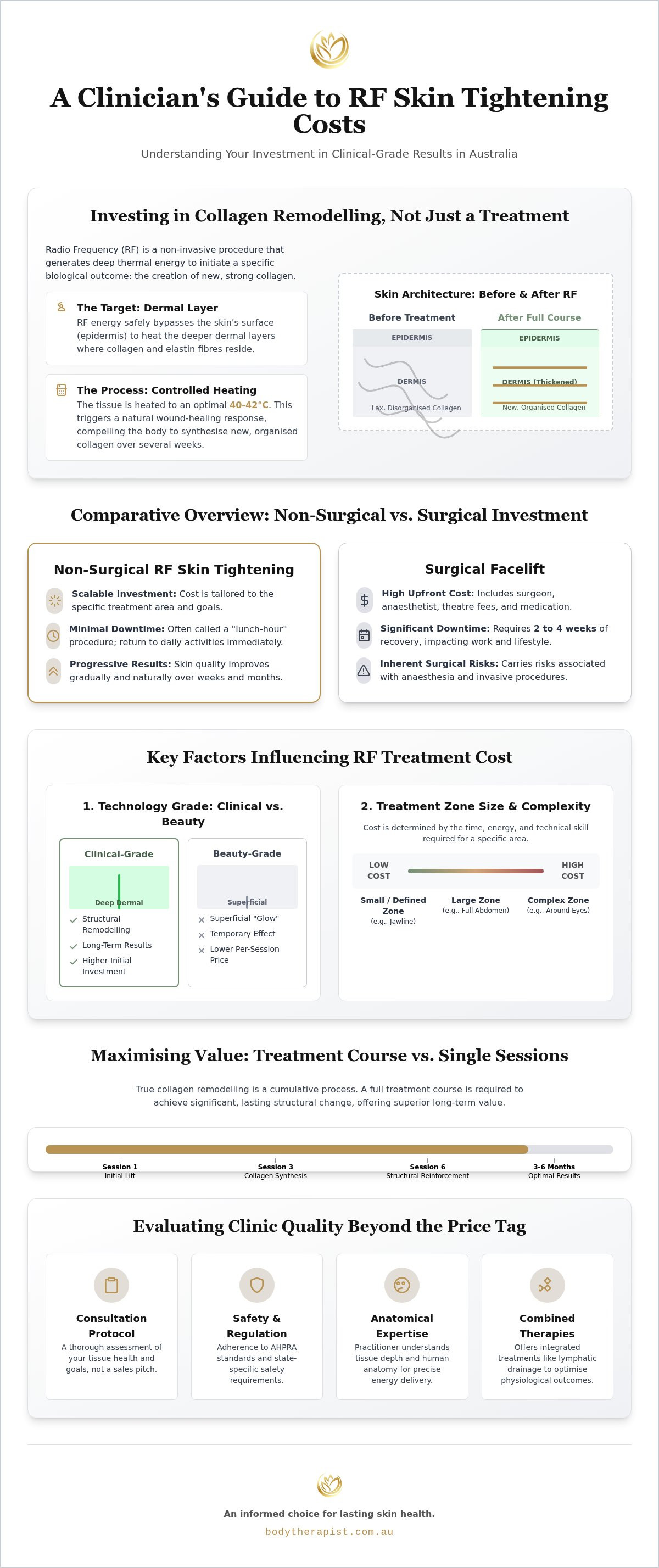
Radio frequency (RF) skin tightening is a sophisticated, non-invasive procedure that utilises targeted electromagnetic waves to generate deep thermal energy within the dermal layers. In the 2026 Australian clinical landscape, this technology has transitioned from a niche aesthetic luxury to a foundational element of remedial tissue health. When you analyse the radio frequency skin tightening cost australia practitioners provide, it's essential to recognise that you're funding a specific biological outcome rather than a generic service. The investment is dictated by your unique physiological goals, whether that involves tightening lax skin after weight loss or addressing age-related structural decline. What is Radio Frequency Skin Tightening? This clinical approach ensures that energy is delivered at the precise depth required to initiate cellular change without damaging the epidermis.
The Biological Mechanism: Why You Are Paying for Collagen
The efficacy of RF depends on its ability to create a controlled wound-healing response. By heating the dermis to approximately 40 to 42 degrees Celsius, the treatment causes immediate shortening of collagen cross-links, providing a temporary lifting effect. However, the true clinical value lies in the subsequent inflammatory cascade. Over the following weeks, the body's repair mechanisms synthesise fresh collagen and elastin, gradually thickening the skin's architecture from within. This is not a superficial mask; it's a structural reinforcement of the dermal matrix. Collagen induction serves as the primary driver of treatment value and long-term tissue integrity.
Non-Surgical vs. Surgical Costs: A Comparative Overview
Surgical interventions like a traditional rhytidectomy (facelift) carry substantial overheads that extend far beyond the surgeon's skill. Theatre fees, anaesthesia, and post-operative medications contribute to a high entry price that remains static regardless of the area's size. Beyond the initial invoice, surgery carries the significant "hidden" cost of downtime. Patients often face two to four weeks of lost productivity and restricted movement. RF skin tightening removes these barriers. It offers a scalable investment that fits into a lunch hour, with no need for recovery time or specialised post-operative garments. When assessing the radio frequency skin tightening cost australia market, the cumulative value of maintaining skin elasticity through non-invasive means often outweighs the singular, high-risk expense of surgical correction. To help manage these clinical costs, some individuals choose to liquidate unused assets through services like Gold Buyers Sydney CBD, which provides a transparent way to turn unwanted gold jewellery into liquid capital for aesthetic treatments.
Key Factors Influencing RF Skin Tightening Cost in Australia
The radio frequency skin tightening cost australia patients encounter fluctuates based on several clinical variables that extend far beyond the clinic's postcode. While a standard beauty salon might offer a flat rate for a generic session, a clinical remedial practice calculates the investment based on the physiological requirements of the target tissue. The size and complexity of the treatment zone serve as the primary baseline. Treating a defined jawline requires less time and energy than a full abdomen or a complex thigh region where tissue density varies. Precise energy delivery around bony landmarks or delicate periorbital areas demands a higher level of technical control, which is reflected in the clinical fee.
Clinical-Grade vs. Beauty-Grade Technology
The grade of technology utilised is a significant cost driver. Medical-grade devices, such as those employing Monopolar or advanced Multipolar RF, are engineered to reach the deep dermal layers where collagen synthesis occurs. A Clinical Study on RF Efficacy confirms that maintaining consistent thermal energy at specific depths is essential for structural change. High-end clinical machines feature integrated cooling systems and real-time impedance monitoring to prevent epidermal burns while maximising internal heat. In contrast, low-powered "beauty-grade" or home devices often lack the wattage to penetrate the dermis effectively. They typically provide a superficial, temporary glow rather than the long-term structural remodelling achieved through professional-grade equipment.
The Value of Practitioner Expertise
Technical proficiency is as vital as the machine itself. A therapist with a background in clinical massage therapy possesses a superior understanding of tissue response and fascial planes. This anatomical knowledge allows the practitioner to target the correct dermal depths while avoiding sensitive underlying structures. Specialists trained in myotherapy or kinetic release bring a unique perspective to skin tightening, often identifying how muscular tension or poor lymphatic flow might be impacting the skin's appearance. Professional qualifications ensure that the treatment is not only effective but safely tailored to your specific skin health history. When you invest in a qualified clinician, you're paying for a methodical problem-solver who prioritises your physiological safety. For those seeking a results-oriented approach to tissue health, exploring the specialised services at Body Therapist ensures your investment is backed by deep anatomical expertise.
Treatment Packages vs. Single Session Pricing
Achieving a visible, structural shift in skin laxity is a physiological marathon rather than a sprint. When evaluating the radio frequency skin tightening cost australia clinics present, it's vital to distinguish between a maintenance session and a transformative protocol. A single treatment can provide a temporary "glow" due to immediate collagen contraction and increased localised circulation, but this effect is transient. Long-lasting results require a cumulative biological response. Professional clinics structure their pricing to reflect this reality, often offering tiered packages that align with the natural 21 to 28-day skin cell turnover and the longer collagen maturation cycle.
Committing to a multi-session program is the standard clinical recommendation for those seeking significant dermal thickening. In the Australian market, practitioners typically provide a reduced per-session rate when patients prepay for a block of six or ten treatments. This approach ensures the patient adheres to the necessary frequency, which is critical for maintaining the thermal tension required to trigger fibroblast activity. However, caution is necessary when encountering "unlimited" session offers or extremely low-cost bundles. Clinical-grade RF technology involves significant consumable costs and rigorous maintenance; prices that seem too good to be true often indicate underpowered equipment that cannot sustain the temperatures needed for genuine remodelling.
Typical Treatment Protocols for 2026
Standard protocols have become more refined as our understanding of tissue response evolves. For facial rejuvenation, a series of 6 to 8 sessions spaced one to two weeks apart is generally the baseline for 2026. Body zones, such as the abdomen or posterior thighs, often possess thicker dermal layers and larger surface areas, frequently requiring up to 10 sessions to achieve uniform tightening. Once the initial transformative phase is complete, a maintenance phase begins. This usually involves a single "top-up" session every six months to sustain the newly synthesised collagen and counteract the ongoing natural ageing process.
Calculating Your Total Investment
To accurately forecast your expenditure, multiply the clinic's per-session rate by the full length of the recommended protocol. This provides a realistic "total investment" figure rather than a misleading entry price. It's also helpful to frame this cost against your broader aesthetic objectives. If your goal is a comprehensive non-surgical facial rejuvenation, a structured package is the only evidence-based path to success. High-pressure sales for "unlimited" sessions are a red flag; professional clinical practices focus on specific, measurable outcomes within a defined timeframe. By investing in a structured course, you're not just buying time on a machine; you're funding a supervised biological transformation of your skin's architecture.
Evaluating Clinic Quality Beyond the Price Tag
While the radio frequency skin tightening cost australia remains a primary consideration for most patients, price should only be viewed as a proxy for the level of clinical oversight provided. A professional clinical environment differs fundamentally from a general beauty spa in its ability to monitor and respond to physiological tissue changes. In a clinical setting, practitioners use calibrated equipment to maintain the precise thermal window required for collagen induction without risking epidermal damage. Generic, high-pressure "one-size-fits-all" settings often prioritise throughput over patient safety, which can lead to inconsistent results or thermal injury.
This commitment to clinical-grade protocols is shared by leading international providers; for instance, Cosmetic Facial offers a range of medical skin treatments that adhere to high safety standards, ensuring that patients receive results-driven care in a professional environment.
One common question involves the discrepancy between professional treatments and home-use wands. The physics of dermal heating explains this price gap. Professional-grade machines operate with significantly higher wattage and advanced safety sensors to reach the 40 to 42-degree Celsius threshold needed to trigger cellular remodelling. Home devices are intentionally underpowered for consumer safety, meaning they rarely reach the depths or temperatures required for structural change. Investing in a professional treatment ensures you are paying for the energy density necessary to achieve a measurable biological response.
The Consultation: A Non-Negotiable Step
A thorough initial assessment is the hallmark of a safe clinical practice. Your practitioner must conduct a detailed review of your medical history, specifically screening for contraindications such as metal implants, pregnancy, or active skin conditions. This step is vital for managing expectations; a methodical therapist will be honest about the limitations of RF for severe skin sagging that may require surgical intervention. Clinics that offer "walk-in" treatments without a formal consult are skipping a critical safety protocol. This oversight increases the risk of adverse reactions and often indicates a sales-led rather than a results-led business model.
Evidence of Results: Portfolios and Reviews
When evaluating a clinic, look beyond the marketing imagery for genuine before-and-after portfolios. Realistic results show gradual improvements in skin texture and contour rather than overnight transformations. A practitioner's broader knowledge of tissue health is also a reliable indicator of quality. For example, a clinic that demonstrates expertise in manual lymphatic drainage massage understands how the body’s waste-clearance systems support the skin's recovery after thermal stimulation. This integrated approach to health ensures that your skin tightening journey is physiologically supported. To ensure your investment is backed by deep anatomical expertise and a commitment to safety, schedule an assessment with Body Therapist to discuss your specific skin goals.
The Body Therapist Approach: Maximising Your RF Investment
At Body Therapist, we view the radio frequency skin tightening cost australia residents pay as a clinical investment in physiological architecture rather than a surface-level cosmetic expense. Our philosophy bridges the gap between aesthetic rejuvenation and clinical remedial science. Led by Lee Carnegie, a practitioner with deep expertise in myotherapy and kinetic release, our approach prioritises tissue health and functional mobility. We understand that skin laxity is often symptomatic of broader structural issues within the fascial and muscular layers. By addressing the body as a cohesive unit, we ensure that the thermal energy delivered during your RF session translates into meaningful, long-term structural reinforcement.
Maximising the return on your investment requires more than just high-end technology; it requires a practitioner who understands the "how" and "why" behind tissue repair. While generic salons might offer a standardised protocol, we tailor every pulse of energy to your specific dermal thickness and recovery capacity. This methodical problem-solving ensures that every session moves you closer to your goals without unnecessary expenditure on ineffective treatments. We focus on the biological impact of the procedure, ensuring your skin’s fibroblasts are optimally stimulated to produce high-quality type I collagen.
Integrated Modalities for Superior Outcomes
True clinical results are rarely achieved through a single modality in isolation. We often combine RF skin tightening with other evidence-based therapies to enhance the body's natural regenerative processes. For example, lymphatic drainage plays a vital role in clearing the metabolic waste products generated during thermal stimulation and fat cavitation. If the lymphatic system is sluggish, the inflammatory response required for collagen synthesis can be hindered, potentially diminishing your results. By supporting fluid health, we accelerate the recovery phase and ensure the treated area remains vibrant and healthy. This synergy between skin tightening and remedial tissue work allows us to provide a level of care that goes far beyond the capabilities of a traditional beauty setting.
Booking Your Clinical Assessment
The journey toward firmer, healthier skin begins with a results-oriented mindset. Rather than choosing a provider based solely on a per-session price point, we encourage you to evaluate the clinical depth of the practice. A bespoke treatment plan is essential because no two bodies respond to radio frequency in exactly the same way. During your initial assessment, we analyse your skin laxity, tissue volume, and overall health history to determine the most effective frequency and intensity for your sessions. This transparent, evidence-based approach removes the guesswork and provides a clear roadmap for your transformation. To begin your journey with a master practitioner who prioritises your physiological safety and aesthetic outcomes, Contact Body Therapist for a clinical skin tightening consultation today.
Investing in Structural Skin Health
Deciphering the radio frequency skin tightening cost australia clinics present requires a shift from viewing the procedure as a surface-level beauty treatment to understanding it as a deep physiological intervention. A successful outcome relies on clinical-grade technology that can consistently reach the dermal layers to trigger genuine collagen induction. While single sessions serve as maintenance, the most significant structural changes occur through a cumulative, evidence-based treatment course. Choosing a practitioner who integrates aesthetic goals with remedial health ensures that your skin's architecture is supported by sound anatomical knowledge and precise tissue targeting.
At Body Therapist, we combine clinical-grade RF technology with specialised expertise in myotherapy and kinetic release to deliver measurable results. Our comprehensive care model often incorporates lymphatic drainage to optimise fluid health and metabolic clearance, ensuring your skin has the best possible environment for remodelling. This integrated approach prioritises your long-term tissue integrity over temporary fixes. It's time to move beyond the confusion of fluctuating market rates and invest in a bespoke plan designed for your unique physiology. Book a Clinical Skin Tightening Assessment with Body Therapist today to begin your journey toward firmer, more resilient skin.
Frequently Asked Questions
How much does radio frequency skin tightening cost in Australia on average?
Market rates for the radio frequency skin tightening cost australia practitioners charge fluctuate based on the technology tier and the anatomical zone being treated. Generally, facial protocols are priced differently than extensive body contouring due to the time and precision required. Clinical packages often provide a more sustainable rate than one-off sessions, reflecting the cumulative nature of collagen remodelling and the necessity of multiple treatments for a visible structural shift.
Is RF skin tightening worth the investment compared to a surgical lift?
RF skin tightening offers a high return on investment for those with mild to moderate laxity who wish to avoid the high entry price and downtime of surgery. While a surgical lift provides more dramatic correction for significant sagging, RF serves as a preventative and maintenance-oriented modality. It bypasses theatre fees and anaesthesia costs while stimulating the body's natural regenerative processes, making it a viable functional alternative for non-invasive rejuvenation.
How many sessions of RF skin tightening will I need to see results?
Most patients require a series of 6 to 10 sessions to achieve optimal collagen maturation and visible tissue contraction. While some immediate tightening occurs due to heat-induced fibre shortening, the structural transformation happens over several months as fresh collagen synthesises. Facial areas typically respond within a shorter course, whereas denser body tissues might necessitate the full 10-session protocol to reach the desired dermal depth and density.
Does private health insurance cover the cost of RF skin tightening in Australia?
Private health insurance in Australia generally doesn't cover RF skin tightening as it's classified as a cosmetic procedure. However, if the treatment is part of a broader remedial or rehabilitative plan managed by a qualified therapist, you should check with your specific provider regarding extras cover. Typically, these sessions are considered elective and are funded entirely by the patient as a personal clinical investment in their skin health.
Why is there such a large price difference between various skin tightening clinics?
Discrepancies in the radio frequency skin tightening cost australia clinics offer usually stem from the quality of technology and the practitioner's clinical training. Medical-grade devices that offer precise thermal monitoring and deeper dermal penetration involve higher operational overheads than lower-powered "beauty-grade" machines. Additionally, clinics led by specialists in human anatomy and remedial science often charge more to reflect the superior safety and efficacy of their targeted approach.
What are the hidden costs of choosing a cheap skin tightening provider?
Choosing a low-cost provider often leads to hidden expenses such as the need for more sessions due to underpowered equipment or, worse, the cost of treating thermal skin damage. Cheap devices frequently lack consistent energy delivery, which can result in patchy results or ineffective collagen stimulation. You also risk the lack of a thorough clinical assessment, which is essential for identifying contraindications and ensuring your physiological safety during the procedure.
How long do the results of a skin tightening treatment course last?
The results of a complete treatment course typically last between 12 and 18 months, depending on your biological ageing rate and lifestyle factors. Because the procedure triggers the production of your own natural collagen, the improvements are long-lasting but not permanent. We usually recommend a maintenance session every six months to sustain the dermal thickness and counteract the gradual decline in elastin production that occurs naturally over time.
Can I combine RF skin tightening with other treatments like fat cavitation?
Yes, combining RF skin tightening with ultrasonic fat cavitation is a highly effective strategy for comprehensive body contouring. Cavitation targets and breaks down localised adipocytes, while the subsequent RF application ensures the skin tightens as the underlying volume decreases. Integrating these modalities with lymphatic drainage further assists the body in processing metabolic waste, maximising the physiological impact and the overall aesthetic outcome of your clinical program.


Comments