

Preparing for Your First Body Contouring Session: A 2026 Checklist

What if the best preparation for your first body contouring appointment isn’t a strict food or drink rule, but knowing which treatment you’re having and what information to share? It’s understandable to wonder what to wear, bring or expect, and whether you should change your routine beforehand. But preparing for your first body contouring session isn’t a one-size-fits-all checklist: ultrasonic fat cavitation and RF skin tightening use different technologies, so preparation advice may differ too.
At Body Therapist, the first step is discussing your goals and relevant health information, then explaining the treatment options and proposed approach. This guide covers what to clarify before you arrive, what information and items may be useful, and what to expect during an initial appointment. You’ll also learn why general tips shouldn’t replace treatment-specific instructions, and how to discuss comfort, privacy and realistic outcomes. The aim is to arrive informed, without unnecessary restrictions or guesswork.
Table of Contents
Preparing for your first body contouring session starts with knowing what is being treated
Ultrasonic cavitation and RF skin tightening: why preparation can differ
Your body contouring preparation checklist: what to clarify before the appointment
What happens on the day of your first body contouring session?
Preparing for your first body contouring session starts with knowing what is being treated
Feeling unsure before a first appointment is normal. Start by identifying the treatment being discussed, the area you want assessed and the change you hope to see. Non-surgical body contouring describes a category of treatments, not one procedure with a universal preparation routine or identical outcomes. The broad range of fat removal procedures includes different approaches. Body Therapist offers non-surgical options including ultrasonic fat cavitation and RF skin tightening.
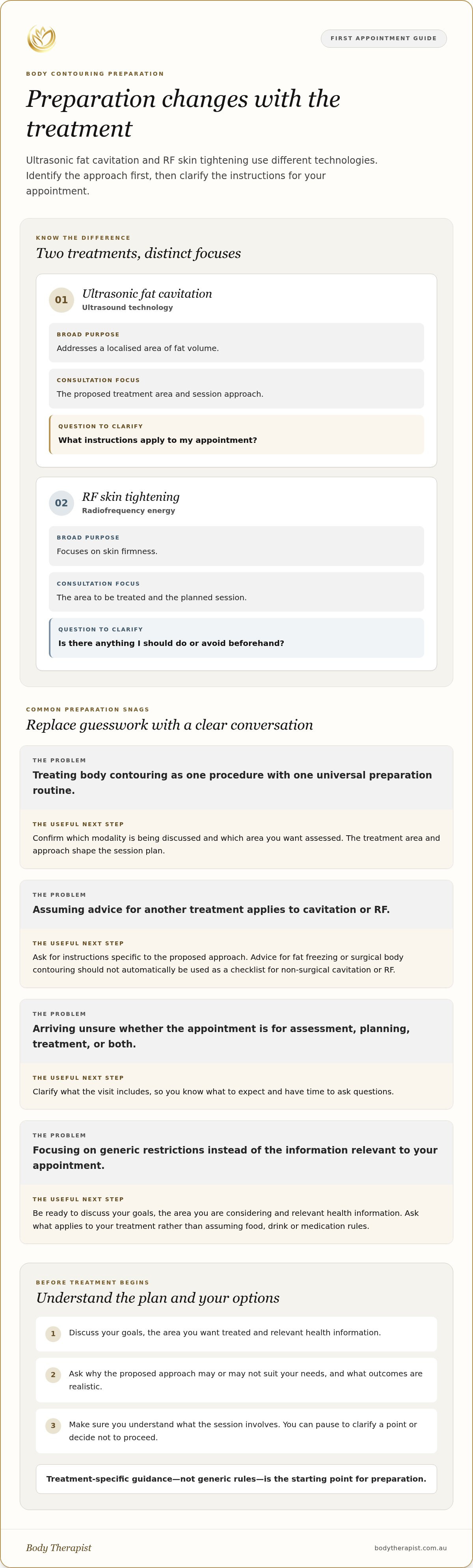
These modalities aren’t interchangeable. Ultrasonic fat cavitation uses ultrasound technology, while RF skin tightening uses radiofrequency energy and focuses on skin firmness. The treatment area and the approach selected shape the session plan, so advice for one modality shouldn’t automatically be applied to the other.
What counts as a first body contouring appointment?
An initial visit may include a discussion of your goals, the area you’re considering and the proposed treatment. The practitioner reviews relevant health information, explains why an approach may or may not suit your needs, and discusses realistic expectations before proceeding. Depending on the appointment, the focus may be assessment and planning, treatment, or both. Clarify what your visit includes so you know how to prepare and have time to ask questions.
Before treatment begins, make sure you understand what will happen, what the session involves and what outcomes are realistic. You can pause to clarify a point or decide not to proceed. Making an informed decision is part of preparation, not an obstacle to it.
Which body contouring treatment are you preparing for?
Identify the modality planned for your appointment. Ultrasonic fat cavitation and RF skin tightening use different technologies and address different concerns. For example, you might want to discuss a specific area in relation to fat volume, or ask about skin firmness. Explain your goal so the proposed treatment, its suitability and its limitations can be discussed in context.
Manual lymphatic drainage is a separate therapeutic service, not another name for body contouring. To understand its distinct purpose, read the clinical guide to manual lymphatic drainage massage. Knowing which service you’re attending for keeps the conversation focused on your goals and the relevant preparation.
Preparing for your first body contouring session begins with a clear conversation about the treatment, your health context and what you can reasonably expect. Once you understand those points, you can follow guidance specific to the proposed approach rather than relying on generic rules.
Ultrasonic cavitation and RF skin tightening: why preparation can differ
Preparation depends partly on the technology being used and the area being treated. Ultrasonic fat cavitation and RF skin tightening are both non-surgical body contouring options, but their treatment aims differ. Use the comparison below to prepare questions, not to decide your suitability on its own.
This table is an orientation tool, not a substitute for an individual suitability discussion. Preparation details can depend on the proposed modality, treatment area and your health information. Don’t transfer instructions you’ve read about fat freezing to ultrasonic cavitation or RF. They’re different technologies, and advice for one doesn’t automatically apply to another.
What to understand about ultrasonic fat cavitation
Body Therapist offers ultrasonic fat cavitation. Before proceeding, discuss the area being considered and the proposed session approach, along with relevant health information and expectations. Ask which instructions apply to your appointment. Avoid assuming that general advice about food, drink or medication is appropriate for this treatment.
What to understand about RF skin tightening
RF skin tightening uses radiofrequency technology, which differs from the ultrasound used in cavitation. The practitioner can explain the intended treatment area and planned session so you know what the appointment involves. Don’t assume the sensation, duration or aftercare will be the same as for another modality. Ask for guidance that relates to your proposed treatment.
Some online preparation guidance concerns surgery. For example, the American Society of Plastic Surgeons explains how patients can prepare for body contouring, including surgical preparation. Those instructions shouldn’t be treated as a checklist for non-surgical cavitation or RF. Focus on the treatment discussed with you and its individual instructions. You can explore Body Therapist’s body contouring options to learn about the two distinct modalities.
Your body contouring preparation checklist: what to clarify before the appointment
A little preparation can make the first discussion more useful. You don’t need to arrive with a prescribed diet or a long list of restrictions. Instead, prepare information that helps the practitioner discuss the proposed treatment and explain what to expect. The American Society of Plastic Surgeons provides an overview of body contouring procedures. Preparation advice varies by procedure, so surgical guidance shouldn’t be assumed to apply to non-surgical treatments.
Information to have ready for your first session
Before the appointment, jot down your goals and the area you’d like assessed. Be ready to discuss relevant health conditions, medications, pregnancy and any recent procedures. This information supports an individual suitability discussion; it doesn’t guarantee that a particular treatment will be recommended.
Bring questions that will help you make an informed decision, such as:
Which treatment and area are being considered, and why?
What steps are involved in the proposed session?
What outcomes are realistic, and what limitations should I understand?
Do my health history, medications or recent procedures affect suitability or preparation?
Share information accurately, even if you’re unsure whether a detail is relevant. The practitioner can explain how it relates to the assessment and what the next step should be.
What to confirm about the appointment itself
Review your appointment information and any individual instructions. Clarify whether the visit is for discussion, treatment or both, what clothing is suitable for the planned area, and whether there’s anything specific to do beforehand. Don’t assume you need to fast, increase your water intake or change medication based on generic online advice. Follow the instructions for your proposed treatment, and raise any uncertainty before the appointment.
Allow enough time to arrive and complete the initial discussion without feeling rushed. Note down any health details or questions that come to mind beforehand. Manual lymphatic drainage is a separate therapeutic service, not a required preparation step for body contouring; the clinical guide to optimising lymphatic drainage explains that distinct topic.
Preparation means sharing relevant information and following treatment-specific guidance. For preparing for your first body contouring session, that’s a more reliable starting point than applying blanket rules about food, drink or medication.
What happens on the day of your first body contouring session?
A clear explanation can make the appointment feel more manageable. The format can vary depending on the treatment and your circumstances, but you should have time to discuss the plan before treatment begins. Preparing for your first body contouring session also means knowing you can ask questions, raise concerns and decide whether you’re comfortable proceeding.
From initial discussion to treatment plan
The appointment may move through these steps:
Arrival: Settle in and allow time for the initial conversation.
Discussion: Talk through your goals, the area you’d like assessed and relevant health information.
Suitability review: Your information is considered in relation to the proposed treatment. Mention any changes since you shared your details.
Treatment explanation: The practitioner outlines the modality, proposed area and what the session will involve.
Your decision: Ask questions, take time to consider the explanation and choose whether to proceed.
This isn’t a fixed script. The discussion should reflect your circumstances, and the proposed approach should be explained clearly before treatment starts. If the plan or terminology isn’t clear, ask for an explanation in plain language. You don’t need to agree to treatment before you understand what’s proposed.
During the session: communication and comfort
Ultrasonic fat cavitation and RF skin tightening use different technologies, so don’t assume the session will feel or unfold the same way for both. The practitioner can explain what to expect for your specific treatment rather than offering a universal description of sensation, duration or sequence.
Speak up if you feel uncomfortable, uncertain or concerned at any point. You can ask for clarification or request a pause. Tell the practitioner if relevant health information changes before or during the appointment, as it may affect the discussion about proceeding. Your comfort and understanding matter throughout, not just during the initial consultation.
Before you leave, make sure you understand any instructions that apply after your treatment and whom to contact with questions about them. Keep this guidance specific to the modality and session you received, rather than relying on advice intended for a different treatment.
Explore the two distinct options offered by Body Therapist through Body Therapist’s body contouring services.
Choose an informed next step with Body Therapist
A considered treatment discussion starts with your goals, not a promise of a particular result. Explain the change you hope to see and the area you’d like assessed. The practitioner can discuss whether ultrasonic fat cavitation or RF skin tightening relates to that goal, explain how their purposes differ, and consider your health information when discussing suitability. These are distinct options, not interchangeable steps in a standard plan.
Match your goals to a considered treatment discussion
At Body Therapist, qualified therapist Lee Carnegie brings a clinical, movement-informed approach that draws on myotherapy, kinetic release and functional mobility techniques. For body contouring, the conversation focuses on the proposed modality, your treatment area and relevant health context. Suitability and preparation are individual matters to discuss with the practitioner, and no treatment can guarantee a specific outcome.
Use the discussion to check that you understand what the proposed session involves and what expectations are realistic. If the plan doesn’t address your concern, or you’re unclear about a step, ask for more explanation before deciding. You’re not expected to know which technology is appropriate before the conversation begins.
Make your first appointment feel more straightforward
Before you attend, keep this short checklist handy:
Goals: What change would you like to discuss?
Health details: Which relevant conditions, medications or recent procedures should the practitioner know about?
Questions: What do you want clarified about suitability, the session and realistic expectations?
Instructions: Have you reviewed the guidance for your specific appointment?
Preparing for your first body contouring session doesn’t mean following a generic routine. It means sharing relevant information, understanding the proposed approach and reviewing the instructions that apply to you. Proceed when you’re comfortable with the plan and understand what to expect. If you’re still unsure, keep asking questions until the discussion is clear.
For a considered next step, explore Body Therapist’s treatment options and note any questions you’d like to bring to your appointment.
Take your next step with clarity
Preparing for your first body contouring session is less about following a universal routine and more about arriving ready for an informed conversation. Be clear about the area and goals you want to discuss, share relevant health information, and follow instructions specific to the proposed treatment. Ultrasonic fat cavitation and RF skin tightening are distinct options, so understand the approach and expectations before deciding whether to proceed.
At Body Therapist, qualified therapist and owner-operator Lee Carnegie brings a clinical, movement-informed approach that integrates myotherapy, kinetic release and functional mobility techniques. Your discussion can focus on your goals and the differences between the body contouring options, without assuming they suit everyone or promise a particular result.
Explore the treatment information and note any questions you’d like to raise before your appointment. Explore Body Therapist’s treatment options and take the next step at a pace that feels right for you. Arriving informed can help you feel more confident asking questions and making a considered decision.
Frequently Asked Questions
How should I prepare for my first body contouring session?
Clarify the area you’d like assessed, the change you hope to see and which treatment is planned. Note relevant health conditions, medications and recent procedures, and bring questions about suitability, session steps and realistic expectations. Follow the instructions for your specific appointment rather than applying generic rules about food, drink or medication. The aim is to arrive ready for an informed discussion, not to follow a one-size-fits-all routine.
What should I wear to a body contouring appointment?
Choose comfortable clothing that lets you move easily, and follow any clothing guidance provided for your appointment. The area being assessed or treated may influence what’s practical, so don’t assume every session calls for the same clothing. If you’re unsure, refer to your appointment instructions. You can also ask how the treatment area will be accessed and what to expect, so you feel prepared before the session begins.
Can I eat or drink before body contouring?
Don’t assume you need to fast or change how much you drink before a non-surgical body contouring appointment. Preparation advice can vary by treatment, and generic online recommendations may not apply to ultrasonic fat cavitation or RF skin tightening. Follow the instructions for your appointment. If you’re unsure what the guidance means, raise the question before the session rather than changing your routine based on general advice.
Is ultrasonic fat cavitation the same as RF skin tightening?
No. Ultrasonic fat cavitation and RF skin tightening are distinct non-surgical body contouring modalities with different technologies and treatment aims. Body Therapist offers both, but they aren’t interchangeable, and instructions for one shouldn’t automatically be applied to the other. Your goals and proposed treatment area help shape the discussion. Ask the practitioner to explain which modality is being considered, what the session involves and what expectations are realistic for your circumstances.
What happens at a first body contouring appointment?
A first appointment may begin with a discussion of your goals and relevant health information, followed by a suitability review and an explanation of the proposed treatment. The practitioner outlines the modality, area and session approach before treatment starts, giving you the opportunity to ask questions and decide whether to proceed. Appointment formats can vary, so clarify whether your visit is for discussion, treatment or both, and speak up if anything is unclear.
Should I disclose medication or a health condition before body contouring?
Yes. Share relevant health conditions, medications, pregnancy and recent procedures before treatment so the practitioner can consider them when discussing suitability and preparation. Don’t stop, skip or alter medication based on general body contouring advice. If your health information changes before your appointment, mention it during the discussion. This information helps the practitioner explain the proposed approach in context, but suitability should be assessed individually rather than assumed from a general checklist.


Comments