

Non-invasive mummy makeover Australia: 2026 guide

Can a non-surgical plan address post-pregnancy changes without surgery? A non-invasive mummy makeover Australia may suit people with specific concerns, such as localised fat or mild skin laxity. It cannot remove significant excess skin or repair separated abdominal muscles. A staged treatment plan is not an equivalent to surgery.
It’s understandable to want options with less recovery time, while still needing clear answers about safety, suitability and realistic outcomes. This guide compares non-surgical body-contouring approaches, including ultrasonic fat cavitation and radiofrequency (RF) skin tightening, and explains how they differ from surgery. You’ll also find questions to ask about risks, treatment timing and practitioner qualifications. Body Therapist offers both modalities as non-surgical options, but whether either is appropriate depends on your goals and health. An individual conversation can help you weigh the options without pressure or promises of a standard “mummy makeover” result.
Table of Contents
What does a non-invasive mummy makeover in Australia actually involve?
“Non-invasive mummy makeover” is an informal label, not one standardised treatment or guaranteed package. It usually refers to a plan using non-surgical body-contouring modalities for selected post-pregnancy concerns. The right approach depends on what you want addressed, the modality being considered, your health history and an individual assessment.
Non-surgical body contouring uses treatments applied without an operation. Surgery involves an invasive procedure, such as abdominoplasty or liposuction. These approaches aren’t interchangeable. A plan should be based on the concern you want addressed, not the broad “mummy makeover” label. For a general overview of different fat removal procedures, including non-surgical and surgical approaches, see this reference.
Which post-pregnancy concerns might non-surgical body contouring address?
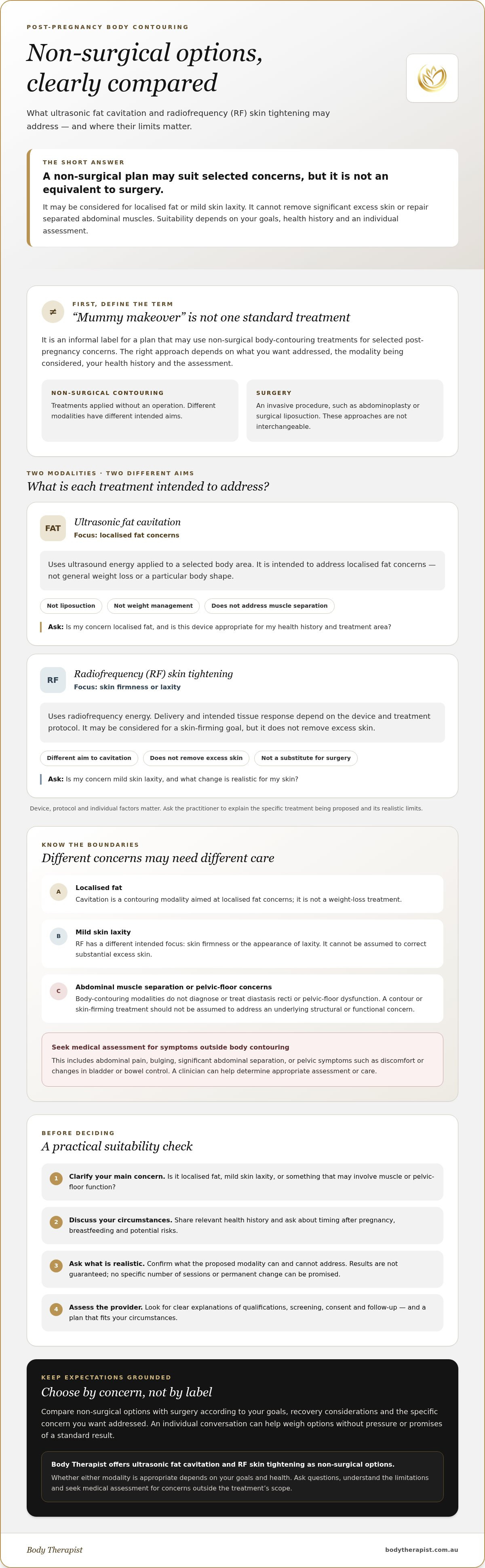
Ultrasonic fat cavitation is a body-contouring modality used with the aim of addressing localised fat concerns. It isn’t a weight-loss treatment or a way to achieve a particular body shape. RF skin tightening is a separate modality with a different intended focus: skin firmness or laxity. The device and proposed protocol matter, so ask the practitioner to explain exactly what treatment is being considered and what it may realistically address.
Localised fat, loose skin and abdominal muscle changes involve different tissues and may need different assessment or care. Body Therapist offers ultrasonic fat cavitation and RF skin tightening. Whether either modality suits your goals requires individual consideration.
What non-invasive treatments cannot do
Non-surgical body-contouring modalities aren’t substitutes for abdominoplasty or surgical liposuction. They don’t diagnose or treat abdominal muscle separation, also called diastasis recti, or pelvic-floor dysfunction. A treatment focused on contour or skin firmness can’t be assumed to address an underlying structural or functional concern.
Don’t rely on a body-contouring consultation to assess symptoms outside its scope. Seek medical assessment if you have abdominal pain, bulging, significant abdominal separation or pelvic symptoms, such as discomfort or changes in bladder or bowel control. A clinician can help determine what assessment or care is appropriate.
If you’re considering a non-invasive mummy makeover Australia option, keep expectations realistic. Results aren’t guaranteed, and no specific number of sessions or permanent change can be promised. Clarify your main concern, share relevant health information and ask what the proposed modality can and can’t do before deciding whether to proceed.
How do fat cavitation and RF skin tightening differ?
Both are non-surgical modalities, but they have different intended aims. Ultrasonic fat cavitation focuses on localised fat concerns, while RF skin tightening focuses on skin firmness. Neither should be assumed to address every post-pregnancy change, and neither is a substitute for surgery to remove substantial excess skin.
In brief: fat cavitation aims to contour a localised area; RF skin tightening aims to improve the appearance of skin laxity. Use the comparison below to frame questions for a practitioner. Suitability and response depend on individual factors, the specific device and the treatment protocol.
What should you know about ultrasonic fat cavitation?
Ultrasonic fat cavitation is a body-contouring option, not liposuction or a general weight-management treatment. Avoid broad claims about how it changes fat tissue unless they’re supported for the specific device being used. Ask which area is being treated, what information supports the proposed protocol, what outcomes are realistic and what limitations or risks apply. Before suggesting a treatment plan, a practitioner should consider your goals and health history.
What should you know about RF skin tightening?
RF skin tightening has a different focus from fat cavitation. It’s intended for skin firmness, not removal of excess skin. A visible change can’t be guaranteed, and substantial loose skin may need a surgical assessment rather than a non-surgical approach. For further general information, the US Food and Drug Administration offers guidance on assessing non-invasive body contouring safety.
Body Therapist offers ultrasonic fat cavitation and RF skin tightening. If you’re considering a non-invasive mummy makeover Australia option, compare the treatment’s intended aim with your specific concern, and ask about the device, protocol and suitability. You can review Body Therapist’s body-contouring options as a starting point for that discussion.
Can a non-invasive makeover achieve the same results as surgery?
No. Non-invasive treatments shouldn’t be described as equivalent to surgery. They have different levels of invasiveness, aims and limitations. Non-surgical body contouring may be worth discussing for a specific appearance concern, but it can’t be relied on to produce the changes possible when a surgical procedure removes tissue. Neither option is automatically right for everyone.
Compare the approach with the concern you want addressed. Non-surgical modalities don’t involve an operation, but suitability, possible side effects and the appointment plan depend on the treatment and your circumstances. Surgery involves an operation and recovery, which your surgeon should explain. If excess skin is your main concern, ask an appropriately qualified surgeon whether a procedure such as abdominoplasty is relevant. A surgeon can also discuss surgical liposuction if you’re considering fat removal through surgery.
For some people, a non-surgical approach may be worth exploring. Outcomes vary, more than one appointment may be proposed, and the change may be limited or not match your expectations. Ask what outcome is realistic for your concern, what the treatment won’t address and what options you have if you decide not to proceed. The Medical Board of Australia guidelines for non-surgical cosmetic procedures can help inform questions about practitioner conduct and patient-centred care.
When might a non-surgical option be worth exploring?
If you’re focused on a specific, localised appearance concern and prefer to consider a non-surgical approach, ask whether the available modality is intended to address it. Set a clear, modest goal rather than expecting a complete post-pregnancy transformation. An individual assessment should consider your health history, the treatment area and the limits of the proposed approach. Body Therapist offers ultrasonic fat cavitation and RF skin tightening, but their suitability depends on your goals and assessment.
When should you seek medical or surgical advice?
A body-contouring appointment isn’t a medical diagnosis. Seek medical advice for symptoms, suspected abdominal separation or concerns affecting function. If you have substantial excess skin or questions about surgical procedures, consult an appropriately qualified surgeon. This helps ensure the decision starts with the right assessment, rather than expecting a cosmetic treatment to resolve a medical or structural concern.
Choosing a non-invasive mummy makeover Australia option is about matching a realistic goal to a suitable treatment, not finding a like-for-like replacement for surgery. Take time to compare the proposed plan with your priorities and health context, and ask for clear answers before deciding.
How to assess safety, timing and suitability after pregnancy
There isn’t one waiting period after birth that suits everyone or every modality. Recovery, breastfeeding, health history and the specific device or protocol can all affect whether treatment is appropriate. Don’t assume a treatment is suitable simply because it’s non-surgical. Discuss timing with an appropriate clinician, and ask the practitioner to explain their screening process before booking.
Use this checklist to prepare:
Share your health history. Disclose pregnancy, breastfeeding, how recently you gave birth, any surgery, diagnoses and relevant medicines. Raise health concerns with an appropriate health professional.
Define your goal. Describe the specific concern you want addressed, such as a localised appearance concern or skin laxity. Ask whether the proposed modality is intended to address it.
Ask about timing. Discuss your recovery and breastfeeding status with a clinician. Ask the practitioner what information they need to assess suitability for the particular treatment.
Check the device and evidence. Ask which device would be used, what information supports its intended use and where you can verify relevant Australian TGA information and advertising guidance.
Understand the trade-offs. Ask about contraindications, device-specific risks, expected discomfort, aftercare, alternatives and how progress will be reviewed before continuing.
What should you disclose before treatment?
Be open about relevant changes in your health, including recent birth, pregnancy or breastfeeding, surgery, diagnoses and medication. This helps the practitioner consider whether the modality and treatment area may be appropriate, but it doesn’t replace advice from your doctor or another suitable health professional. Suitability should be assessed for you and the specific treatment, not assumed from a general “post-pregnancy” category.
What questions belong in a consultation?
Ask what concern the treatment targets, what outcome is realistic for you and what it cannot address. Clarify the proposed schedule, possible risks, alternatives and aftercare, including when to seek medical advice. Find out how the practitioner will review your response and reassess suitability before further treatment. Clear answers should help you make an informed choice, not leave you feeling pressured.
If you’re considering a non-invasive mummy makeover Australia option, use these questions to compare the proposed plan with your health context and goals. For an individual discussion of Body Therapist’s available modalities, ask about ultrasonic fat cavitation and RF skin tightening.
Choosing a non-invasive mummy makeover provider and next steps
A suitable provider should help you understand whether a treatment matches your specific concern, not fit you into a standard “mummy makeover” plan. Compare the proposed approach with your goals and health context, and take time to consider the information before deciding. You’re entitled to ask questions and decline treatment.
How to compare providers and treatment plans
Use this checklist to assess whether the explanation is clear and individualised:
Qualifications: Ask about the practitioner’s training and experience relevant to the modality. If they claim registration with a regulated Australian health profession, check that status independently.
Screening: Find out what health information they ask for and how it affects suitability. A plan should account for your circumstances, rather than assume one treatment suits everyone.
Scope and limitations: Ask what the treatment is intended to address, what it can’t address and whether another type of assessment may be more appropriate.
Device and evidence: Request the device details and ask what evidence supports claims about its use. Confirm information directly with the provider before booking.
Consent and follow-up: Check that risks, alternatives, expected discomfort, aftercare and review arrangements are explained before you agree to proceed.
Be cautious of guaranteed results, pressure to purchase a package before you’ve had time to consider it, or promises of an effortless transformation. A responsible explanation should make room for uncertainty and help you weigh potential benefits against limitations and alternatives.
What a first conversation with Body Therapist can clarify
Body Therapist is a remedial massage and body-contouring clinic operated by qualified therapist Lee Carnegie. Its relevant body-contouring modalities are ultrasonic fat cavitation and RF skin tightening. A discussion can help clarify whether either option may align with your goals, what the proposed treatment is intended to address and what further questions you may need to ask. It shouldn’t be treated as a diagnosis of medical or functional concerns.
Body Therapist doesn’t provide surgical liposuction or cosmetic surgery. If your concern involves substantial excess skin or you’re considering surgery, seek advice from an appropriately qualified surgeon rather than expecting a non-surgical modality to provide the same outcome.
If you’re exploring non-invasive mummy makeover Australia options and your goals may suit the available modalities, explore Body Therapist’s treatment options and raise your questions before making a decision.
Choose your next step with clear expectations
A non-invasive mummy makeover in Australia isn’t one standard treatment, and non-surgical body contouring shouldn’t be viewed as equivalent to surgery. The right next step depends on the concern you want addressed, your health context and whether a modality’s aims match your expectations. If you’re experiencing symptoms or suspect abdominal separation, seek appropriate medical advice rather than relying on a body-contouring assessment.
Body Therapist is operated by qualified therapist Lee Carnegie and offers ultrasonic fat cavitation and RF skin tightening. An individual discussion can help clarify whether these modalities may suit your goals, without promising a particular result or replacing medical or surgical advice where needed.
Take your time, ask direct questions and choose a provider who explains limitations as clearly as potential benefits. Explore Body Therapist’s non-surgical treatment options as a starting point for an informed conversation. A thoughtful, well-matched decision is a positive step, whatever you choose.
Frequently Asked Questions
What is a non-invasive mummy makeover?
A non-invasive mummy makeover is an informal term for a plan using non-surgical treatments to address selected post-pregnancy appearance concerns. It isn’t one standardised procedure or a guaranteed package. Depending on the concern and assessment, options may include ultrasonic fat cavitation for localised fat concerns or RF skin tightening for skin firmness. These modalities have different aims, and neither is intended to address every change after pregnancy.
Can non-invasive treatments remove loose skin after pregnancy?
No. Non-invasive body-contouring treatments shouldn’t be expected to remove loose or excess skin. RF skin tightening may be considered for a skin-firming goal, but visible tightening isn’t guaranteed and it isn’t equivalent to surgically removing tissue. If you have substantial excess skin or want to understand surgical options, discuss your concerns with an appropriately qualified surgeon. A practitioner can explain a non-surgical treatment’s intended scope and limitations.
Is a non-invasive mummy makeover as effective as a tummy tuck?
No. A non-invasive mummy makeover isn’t equivalent to a tummy tuck, or abdominoplasty. Non-surgical modalities are intended for specific concerns and don’t remove tissue through an operation. Surgery may be more relevant when a concern involves tissue removal, but suitability, risks and recovery need to be discussed with an appropriately qualified surgeon. The right option depends on your goals and health context, not a universal ranking of treatments.
Can I have body-contouring treatment while breastfeeding?
How do I choose between fat cavitation and RF skin tightening?
Choose based on the concern, not the name of a “makeover”. Ultrasonic fat cavitation is used for localised fat-contouring aims, while RF skin tightening has a skin-firming focus. Neither is a general weight-loss treatment or a solution for every post-pregnancy change. Ask a practitioner to assess your goals and health history, explain the device and protocol, and clarify realistic outcomes and limitations before you decide.
How many sessions does a non-invasive mummy makeover require?
There’s no standard number of sessions for a non-invasive mummy makeover. The proposed schedule may depend on the modality, device, treatment area, your goals and how you respond. Ask the provider to explain why they recommend a particular plan, when progress and suitability will be reviewed, and what happens if the change is limited. Be cautious of pressure to commit to a package before you understand the plan and its limitations.
Is body contouring a treatment for abdominal separation after pregnancy?
No. Body contouring doesn’t diagnose or treat abdominal muscle separation, also called diastasis recti. It’s a structural concern, not the same as localised fat or skin laxity. If you suspect separation, notice abdominal bulging, have pain or experience concerns affecting function, seek assessment from an appropriate health professional. A body-contouring appointment isn’t a substitute for medical diagnosis or advice about treatment options.


Comments