

Massage Therapist Near Me: Choosing Clinical Excellence Over Basic Relaxation

A "massage" is often sold as a commodity, but clinical body therapy is a targeted medical intervention designed for profound physiological change. When you search for a massage therapist near me, you're likely seeking relief from persistent dysfunction or support for a complex health journey, yet many practitioners offer little more than a temporary sensory escape. It's frustrating to spend your resources on a session where your specific health history is ignored or your chronic pain remains unchanged.
We understand that true recovery requires more than just a firm touch; it demands a master practitioner who integrates technical anatomical knowledge with empathetic, evidence-based care. In this article, you'll discover how to identify a qualified clinical therapist who provides targeted results for recovery and specialised health needs. We'll explore the benchmarks of clinical excellence, from lymphedema management to oncology protocols, and explain how a structured treatment plan can transform your mobility and long-term well-being. By the end, you'll have the tools to ensure your next appointment is a step toward functional optimisation rather than just another "fluff" massage.
Table of Contents
Beyond Relaxation: Why Your Search for a Massage Therapist Near Me Requires Clinical Discernment
Targeted Modalities: From Remedial Techniques to Specialist Lymphatic Care
Navigating Specialist Needs: Oncology, Pregnancy, and Post-Surgical Recovery
The Evaluation Framework: What Defines a High-Quality Australian Therapist?
Integrating Recovery and Aesthetics: The Modern Approach to Body Therapy
Beyond Relaxation: Why Your Search for a Massage Therapist Near Me Requires Clinical Discernment
A quick search for a massage therapist near me typically presents a digital map saturated with options, yet proximity is often the least important factor for long-term recovery. Convenience shouldn't dictate your healthcare decisions. While a local day spa might offer a serene environment and basic relaxation, it often lacks the diagnostic rigor required to treat chronic dysfunction or complex medical histories. Clinical discernment means looking past the scented candles to find a practitioner who understands the intricate relationship between muscle, fascia, and the nervous system.
Effective therapy targets the root cause of pain rather than just the symptoms. If you're managing a condition like lymphedema or recovering from surgery, a general approach isn't just ineffective; it's potentially hazardous. You need a therapist who prioritises clinical outcomes over atmospheric comfort and aesthetic fluff. High-level anatomical expertise is the only way to ensure your treatment avoids further injury while providing the targeted release your body requires.
The Limitations of General Wellness Massage
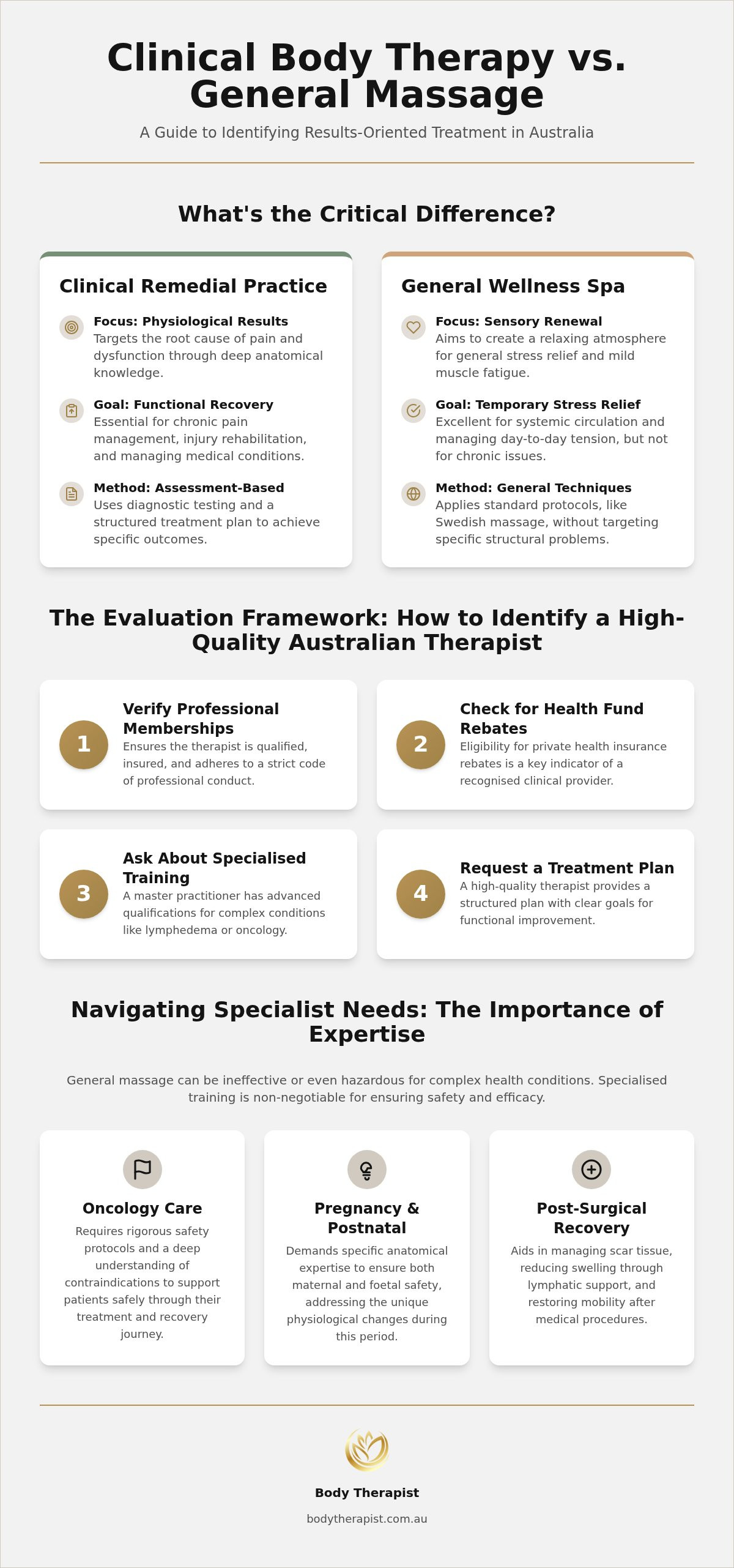
General wellness massage, such as standard Swedish techniques, primarily focuses on the superficial layers of skin and muscle. It's excellent for temporary stress relief and increasing systemic circulation. However, it rarely resolves chronic tension or deep-seated postural issues. There's a profound physiological difference between surface-level stimulation and the deep tissue manipulation found in a clinical setting.
Spa Environment: Focused on sensory renewal, mild muscle fatigue, and general stress management.
Clinical Setting: Essential for chronic pain, injury rehabilitation, and managing pathological conditions through functional assessment.
Choosing a spa when you actually require remedial massage is like taking a nap when you need surgery. It feels pleasant, but the underlying structural problem remains untouched.
The Master Practitioner: Why Professional Qualifications Matter
A master practitioner views the human body through a lens of functional mobility and kinetic release. They don't simply apply pressure; they assess how your body moves and identify compensatory patterns that lead to pain. This high-level application of Medical massage requires years of formal training in anatomy and physiology. Without this expertise, a therapist might inadvertently aggravate an existing injury or overlook a serious contraindication.
Clinical massage therapy is a science-backed approach to neuromuscular health. It integrates various complex modalities to restore balance to the body's internal systems. When you find a massage therapist near me who holds advanced qualifications, you aren't just buying a service. You're investing in a methodical, results-oriented treatment plan designed to optimise your physical health and functional range of motion.
Targeted Modalities: From Remedial Techniques to Specialist Lymphatic Care
Searching for a massage therapist near me often leads to a crossroad between general wellness and clinical necessity. While relaxation is a valid goal, targeted modalities are required when the objective is physiological restoration. A master practitioner employs a sophisticated toolkit, ranging from deep tissue manipulation to delicate fluid management, ensuring every session serves a specific rehabilitative purpose. This methodical approach ensures that your treatment isn't just a temporary escape, but a step toward long-term structural health.
Remedial Massage and Chronic Pain Management
Clinical remedial massage is an assessment-based intervention designed to identify and treat muscular dysfunction. By targeting specific trigger points and breaking down fibrous adhesions, this modality restores structural integrity to overloaded tissues. Unlike a generic rub-down, each session follows a rigorous treatment plan where progress is tracked through objective range-of-motion testing. Understanding how to prepare for remedial massage, such as documenting your pain patterns and wearing appropriate clothing, ensures your body is primed for these deep physiological changes.
Manual Lymphatic Drainage (MLD): More Than Just a Light Touch
A manual lymphatic drainage massage differs significantly from traditional techniques in both pressure and intent. MLD utilises precise, rhythmic strokes to stimulate the lymphatic system, facilitating the removal of metabolic waste and excess interstitial fluid. It's a critical tool for managing lymphedema, reducing post-surgical swelling, and supporting the immune system's cellular detoxification processes. This gentle yet powerful approach is often the only safe option for patients whose systems are too compromised for heavy pressure, making it a cornerstone of clinical care.
To achieve comprehensive results, clinical therapy often integrates complementary tools like dry needling and myofascial silicone cupping. Dry needling targets deep muscular knots that manual pressure cannot reach, while cupping uses negative pressure to lift the fascia and enhance local blood flow. These techniques, combined with kinetic release strategies, help restore natural movement patterns and eliminate compensatory habits that lead to recurring pain. For those seeking a higher standard of care from a massage therapist near me, exploring the specialised options at Body Therapist can provide the clinical expertise necessary for genuine recovery.
Navigating Specialist Needs: Oncology, Pregnancy, and Post-Surgical Recovery
Navigating specialist health requirements demands a level of clinical discernment that transcends standard remedial techniques. When your search for a massage therapist near me involves complex medical histories, the priority shifts from general muscle release to specific pathological management. This is particularly vital in post-surgical environments, where lymphatic drainage plays a decisive role in recovery. After procedures like liposuction or major surgery, the body's natural fluid transport systems are often compromised. A clinical practitioner uses targeted manual techniques to mitigate post-operative oedema and prevent the formation of seromas, ensuring a smoother transition through the rehabilitative phases.
A therapist who understands medical contraindications is essential for patient safety. They must be able to interpret medical reports and adjust their approach based on the specific stage of your recovery. This methodical assessment ensures that the therapy supports the body's healing processes without placing undue stress on vulnerable systems. In these high-stakes scenarios, the practitioner acts as a bridge between acute medical care and long-term physical optimisation.
Oncology Massage: Empathetic Care Grounded in Science
This level of clinical coordination is especially important for patients with systemic conditions. For those managing chronic illnesses such as diabetes while undergoing rehabilitative therapy, Everest Peak Home Health Care serves as an example of the specialised in-home clinical care required to ensure all aspects of a patient’s health are addressed.
Oncology massage is a highly specialised discipline that requires a deep understanding of cancer pathology and treatment side effects. Identifying the oncology massage benefits for a patient involves more than just a gentle touch; it requires the modification of pressure, speed, and positioning to account for fragile tissues, medical devices, or compromised lymphatic nodes. Practitioners work as part of an integrated medical team, ensuring that every session respects the specific contraindications of chemotherapy, radiation, or surgery. This science-backed approach provides symptomatic relief from pain and fatigue while maintaining the highest standard of patient safety.
Prenatal and Post-Natal Therapeutic Support
Expectant mothers often face unique physiological challenges, from shifting centres of gravity to significant fluid retention. A qualified massage therapist near me specialising in this field will offer more than just comfort; they provide clinical relief for pelvic girdle pain and pregnancy-induced oedema. Utilising pregnancy massage near me ensures access to safe positioning techniques, such as side-lying protocols or specialised cushions that protect both mother and child.
Post-natal support is equally critical for structural restoration. The repetitive movements of infant care often lead to "mum-posture", a pattern of upper-crossed syndrome and lower back strain. Remedial techniques target these specific postural deviations, facilitating a faster recovery of functional mobility and core stability. Whether managing prenatal discomfort or post-natal realignment, specialist care ensures the body remains supported throughout every stage of the maternal journey.
The Evaluation Framework: What Defines a High-Quality Australian Therapist?
When you filter through results for a massage therapist near me, your primary objective should be identifying a practitioner who operates within a regulated professional framework. In Australia, the industry is largely self-regulated, meaning the burden of vetting falls on the consumer. A high-quality therapist isn't defined by the pressure they apply, but by the anatomical science underpinning their technique. You should look for practitioners who maintain active membership with peak bodies such as Massage & Myotherapy Australia or the Association of Massage Therapists (AMT). These associations mandate strict continuing professional education (CPE) requirements, which as of late 2026, have shifted to a rigorous hours-based model to ensure ongoing clinical competency and safety.
A professional treatment room should feel like an allied health centre rather than a "mood-lit" sanctuary. While a spa focuses on sensory escape, a clinical environment prioritises functional space, hygiene, and diagnostic equipment. This clinical setting reinforces the practitioner's role as a methodical problem-solver who is dedicated to your physical optimisation and long-term recovery.
Health Fund Rebates and Professional Accreditation
Private health insurance eligibility serves as a critical marker of professional standing in the Australian market. To be "provider eligible" for remedial massage rebates, a therapist must hold at least a Diploma of Remedial Massage and be registered with a recognised association. This ensures the practitioner has completed extensive supervised clinical practice and understands the complexities of neuromuscular health. When a clinic is recognised by major Australian health funds, it confirms their protocols meet the national standards required for rehabilitative care. This accreditation acts as a safety net, guaranteeing your therapist possesses the formal education necessary to manage medical conditions without causing systemic harm.
The Clinical Consultation Process
A professional session begins long before you reach the table. A comprehensive clinical assessment is a non-negotiable first step. This involves a detailed health history form that covers past injuries, current medications, and specific pathologies. Following this, the therapist should conduct a physical evaluation, including postural analysis and active range of motion testing. This diagnostic phase allows the practitioner to identify the root cause of your dysfunction rather than simply chasing pain.
From this initial data, the therapist creates a structured treatment plan with clear milestones, moving away from "one-off" fixes toward sustainable recovery. This methodical progression mirrors a professional medical consultation, building trust through detail and transparency. For those seeking this level of diagnostic excellence, you can book a clinical consultation to begin your targeted recovery journey with a qualified massage therapist near me.
Integrating Recovery and Aesthetics: The Modern Approach to Body Therapy
Modern body therapy transcends the traditional boundary between rehabilitative health and aesthetic optimisation. While many consider these fields distinct, a master practitioner understands that physical function and form are deeply interconnected. When you search for a massage therapist near me, you may find that clinical excellence in muscle recovery provides the ideal foundation for advanced body sculpting. By integrating anatomical knowledge with non-surgical technology, it is possible to achieve physiological restoration alongside visible physical refinement.
This integrated approach treats the body as a whole system. Rather than addressing skin laxity or stubborn fat in isolation, clinical body therapy ensures the underlying structures are healthy and the metabolic pathways are clear. This synergy ensures that aesthetic changes are supported by a body that functions at its peak, resulting in long-term, sustainable outcomes.
The Science of Non-Invasive Body Sculpting
Ultrasonic fat cavitation offers a science-backed method for reducing stubborn adipose tissue without the risks associated with surgical intervention. This technology uses low-frequency sound waves to create micro-bubbles within fat cells, causing them to rupture and liquefy. However, the treatment's success relies entirely on the body's internal filtration systems. The lymphatic system must process and eliminate the resulting metabolic waste through the liver and kidneys.
Understanding lymphatic draining is essential for body contouring results. Without efficient fluid transport, the broken-down lipids can remain stagnant, diminishing the efficacy of the cavitation. Clinical integration ensures that:
Metabolic Clearance: The lymphatic system is primed to expel liquefied fats effectively.
Inflammation Reduction: Manual techniques manage any temporary swelling post-treatment.
Tissue Health: Improved circulation supports the regeneration of healthy cells in the treated area.
RF Skin Tightening: Stimulating Dermal Integrity
Radiofrequency (RF) skin tightening focuses on dermal integrity by delivering precise thermal energy into the deep layers of the skin. This process triggers a natural wound-healing response, stimulating the production of new collagen and elastin fibres. It is a highly effective solution for managing laxity after significant weight loss or pregnancy. For a truly holistic approach, combining RF treatments with dry needling near me can address both the superficial tissue health and the underlying neuromuscular tension. This ensures that while the skin is tightened, the musculature beneath is released from chronic strain.
Body Therapist represents the logical evolution of this integrated approach. By positioning the clinic as a centre for both recovery and aesthetic optimisation, we ensure every client receives a treatment plan that respects their biological complexity. Choosing a massage therapist near me who understands the relationship between cellular processes and physical appearance allows you to achieve results that are both functional and transformative.
Elevate Your Recovery with Clinical Precision
Choosing a practitioner based on their anatomical expertise rather than just a search for a massage therapist near me ensures your treatment is safe, evidence-based, and results-oriented. We've explored how a strategic approach to body therapy moves beyond the superficial to address deep-seated dysfunction, from specialised lymphatic care to neuromuscular realignment. True recovery requires a methodical treatment plan that integrates technical skill with a deep understanding of human physiology and kinetic release.
Body Therapist, led by Lee Carnegie, a specialist in myotherapy and kinetic release, provides this high-level clinical care. Our practice is qualified in specialised oncology and lymphedema protocols, ensuring every session respects your unique medical history and safety requirements. As a provider-eligible clinic for major Australian health fund rebates, we maintain the professional standards necessary for rehabilitative excellence and functional optimisation.
Book your clinical assessment at Body Therapist today to begin your journey toward physical restoration. Your well-being is too important to settle for anything less than a master practitioner's expertise. We look forward to supporting your path to better health and mobility.
Frequently Asked Questions
How do I know if I need a remedial massage or a relaxation massage?
Choose remedial massage if you have a specific injury, postural dysfunction, or chronic pain that requires a functional assessment. Relaxation massage focuses on general stress reduction and systemic circulation through superficial techniques. A clinical massage therapist near me will use diagnostic testing to identify the root cause of your discomfort, whereas a relaxation session prioritises sensory comfort without a structured treatment plan for physiological change.
Can I claim my massage session on my private health insurance?
You can claim your remedial massage session if your therapist is provider-eligible and holds a Diploma of Remedial Massage. Most major Australian health funds provide rebates under "extras" cover for clinical services. It's essential to verify your therapist's registration with professional associations like Massage & Myotherapy Australia. Relaxation massage is generally not covered by private health insurance as it is classified as a wellness service rather than a medical intervention.
Is lymphatic drainage massage painful?
Clinical lymphatic drainage is a gentle, non-invasive technique that should never be painful. It utilises light, rhythmic pressure to stimulate the lymphatic vessels located just beneath the skin's surface. Unlike deep tissue work, the intent is to move interstitial fluid rather than manipulate muscle fibres. If you experience discomfort, your therapist will adjust their technique to ensure the treatment remains safe and effective for your specific physiological needs.
How many sessions of fat cavitation are typically required for results?
Most clients require between six and ten sessions of ultrasonic fat cavitation to achieve visible, long-lasting results. These appointments are typically spaced one week apart to allow the lymphatic system sufficient time to process and eliminate the liquefied adipose tissue. The exact number of sessions depends on your individual metabolic rate and the specific body zones being treated. Combining these sessions with manual lymphatic drainage can often accelerate the clearance of metabolic waste.
What should I wear to a clinical remedial massage appointment?
Wear comfortable, loose-fitting clothing that allows for easy movement during the initial physical assessment. For the treatment itself, you will typically be required to undress to your underwear, but professional clinical draping is always used to ensure your privacy and comfort. If your session involves specific modalities like dry needling or kinetic release, wearing flexible attire ensures the therapist can perform range-of-motion testing accurately before and after the manual therapy.
Can I receive a massage if I am currently undergoing cancer treatment?
Yes, you can receive oncology massage while undergoing cancer treatment, provided the practitioner is specifically qualified in oncology protocols. This specialised therapy involves rigorous modifications to pressure, positioning, and site selection to account for medical devices, fragile tissues, or compromised lymph nodes. A clinical massage therapist near me will work in conjunction with your medical team to provide symptomatic relief from pain and fatigue while ensuring the highest level of safety.
What is the difference between myotherapy and remedial massage?
Myotherapy is an extension of remedial massage that includes a broader range of clinical assessment and rehabilitative techniques. While both focus on musculoskeletal dysfunction, a myotherapist often integrates advanced modalities like dry needling, joint mobilisation, and specific corrective exercises into a comprehensive treatment plan. Remedial massage primarily utilises manual soft-tissue manipulation to treat identified pathologies. Both disciplines require high-level anatomical knowledge to restore functional mobility and reduce chronic pain.
How often should I see a therapist for chronic back pain?
For chronic back pain, an intensive initial phase of one session per week for three to four weeks is often recommended to break the pain-tension cycle. Once functional mobility improves and acute symptoms subside, the frequency typically shifts to a maintenance schedule of once every four to six weeks. This proactive approach prevents the recurrence of muscular adhesions and ensures your postural alignment remains supported throughout your daily activities and work requirements.


Comments