

Lymphatic Massage for Swollen Ankles: Clinical Guide

Vigorously rubbing a swollen ankle to force fluid away often causes more harm than good. When tissues become congested with interstitial fluid, aggressive deep pressure risks damaging delicate superficial vessels and exacerbating local inflammation. Applying clinical lymphatic massage for swollen ankles demands an entirely counterintuitive strategy: clearing proximal lymph pathways higher up the leg before gently decongesting the joint itself.
You likely know the exhausting frustration of heavy, rigid ankles that resist routine elevation and make your footwear feel painfully restrictive by mid-afternoon. It's disheartening when short-term fixes fail to stop recurrent pooling, especially when you're left guessing whether you're managing simple dependent oedema or a deeper lymphatic compromise.
This clinical guide reveals how specialised manual lymphatic drainage clears stubborn lower-extremity fluid, reduces joint puffiness, and restores pain-free mobility. We'll examine the exact anatomical mechanisms of nodal drainage, identify key clinical red flags, and provide an objective framework to help you choose between professional therapy and supportive self-care protocols.
Table of Contents
Understanding Ankle Oedema: The Pathophysiology of Lower-Limb Fluid Stasis
The Physiological Mechanisms of Manual Lymphatic Drainage for Ankle Swelling
Evaluating Intervention Options: Professional MLD vs. Home Care and Devices
Clinical Implementation: What to Expect During Lower-Limb Lymphatic Treatment
Sustaining Results: Multimodal Strategies for Long-Term Ankle Fluid Balance
Understanding Ankle Oedema: The Pathophysiology of Lower-Limb Fluid Stasis
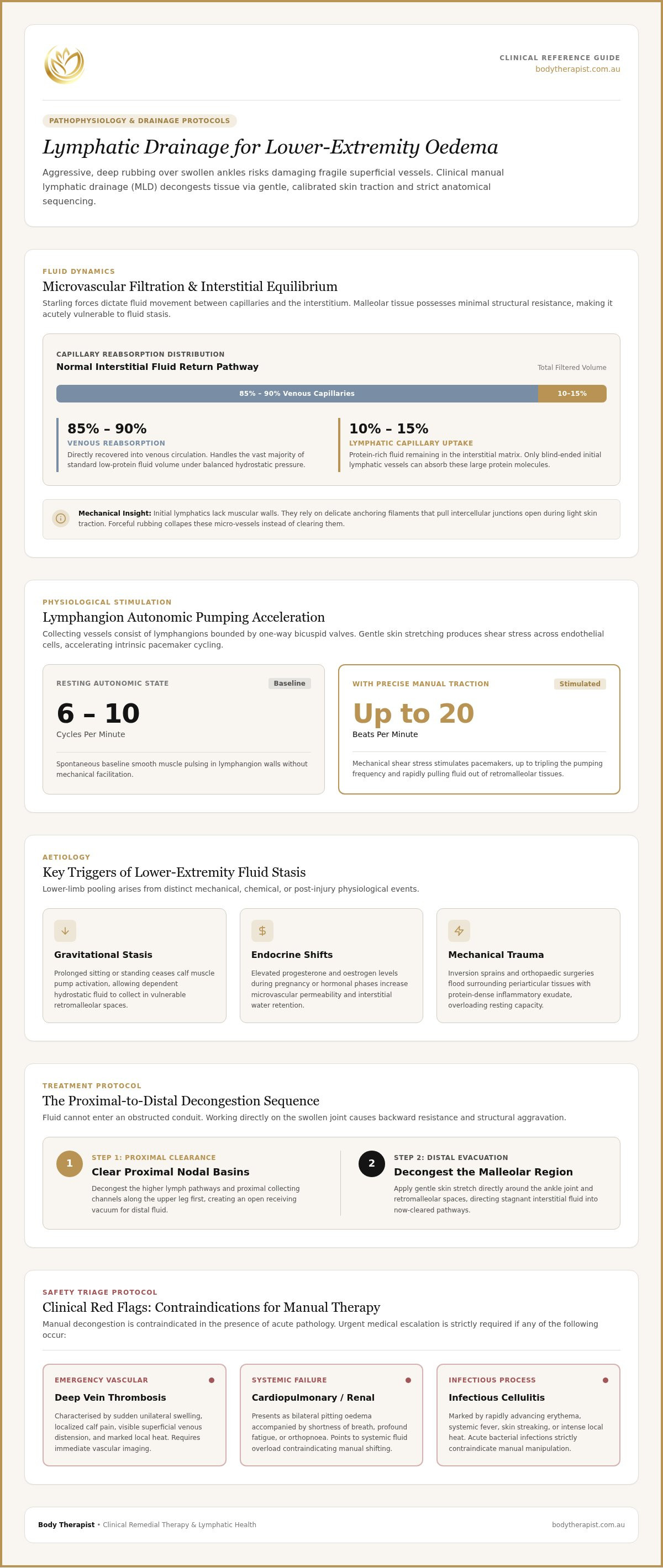
Peripheral oedema represents an imbalance between microvascular filtration and lymphatic resorptive capacity. Under normal physiological conditions, Starling forces maintain equilibrium between capillary hydrostatic pressure pushing fluid into the interstitium and plasma oncotic pressure drawing it back. Gravity constantly elevates hydrostatic pressure in the lower limbs. The malleolar region, surrounded by dense fibrous retinacula and thin subcutaneous tissue, possesses little structural resistance against pooled fluid. Applying targeted lymphatic massage for swollen ankles requires a clear appreciation of these underlying tissue mechanics.
Microvascular Filtration and Lymphatic Capillary Overload
Venous capillaries reabsorb roughly 85 to 90 percent of filtered fluid, leaving protein-rich fluid behind in the interstitial matrix. Only the blind-ended initial lymphatic vessels can absorb these large protein molecules. When filtration outpaces drainage capacity, fluid stasis takes hold. A grounded look at lymphedema pathophysiology explains why forceful rubbing fails; initial lymphatics lack muscular walls and rely on delicate anchoring filaments. These microscopic tethers pull intercellular junctions open during light skin traction. That's why clinical lymphatic massage for swollen ankles relies on gentle, precise skin stretch rather than deep tissue pressure.
Common Triggers: Prolonged Stasis, Hormonal Shifts, and Trauma
Diverse physiological events trigger lower-extremity fluid stasis, each presenting distinct mechanical challenges:
Gravitational stasis: Prolonged sitting or standing halts the calf muscle pump, letting dependent fluid collect in the retromalleolar spaces.
Endocrine shifts: Elevated progesterone and oestrogen during pregnancy or cyclical hormonal phases boost microvascular permeability and interstitial water retention.
Mechanical trauma: Inversion ankle sprains and orthopaedic procedures flood the surrounding tissues with protein-dense inflammatory exudate, rapidly overwhelming resting lymphatic capacity.
Clinical Red Flags: When Swollen Ankles Require Urgent Care
Manual decongestion supports non-compromised physiological pathways, but certain acute pathologies present severe contraindications. Immediate medical triage is essential if you observe any of the following symptoms:
Deep vein thrombosis (DVT): Sudden unilateral swelling, calf pain, visible superficial venous distension, and local heat demand emergency vascular imaging.
Cardiopulmonary or renal failure: Bilateral pitting oedema accompanied by shortness of breath, fatigue, or orthopnoea points to systemic fluid overload.
Infectious cellulitis: Rapidly advancing erythema, systemic fever, skin streaking, or intense local heat signals acute bacterial infection, which strictly contraindicates manual manipulation.
The Physiological Mechanisms of Manual Lymphatic Drainage for Ankle Swelling
Manual lymphatic drainage operates as an active physiological catalyst rather than a passive mechanical squeeze. Applying clinical lymphatic massage for swollen ankles directly targets the microscopic neuromuscular architecture of the lymphatic system, converting stagnant interstitial fluid into active, circulating lymph.
Lymphangion Autonomic Pumping and Tissue Decompression
Collecting lymphatic vessels consist of distinct functional units called lymphangions, bounded by one-way bicuspid valves. Under resting conditions, vascular smooth muscle in lymphangion walls pulses spontaneously at six to ten cycles per minute. Precise, gentle skin stretching generates physiological shear stress across the endothelial lining. This mechanical stimulus stimulates pacemaker cells, accelerating contraction rates up to twenty beats per minute. This accelerated cycling rapidly pulls fluid out of congested malleolar tissues, lowering interstitial pressure and restoring cellular metabolic exchange.
The Proximal-to-Distal Decongestion Sequence
Fluid cannot move into an already obstructed conduit. Effective drainage follows an unyielding anatomical sequence:
Central clearance: Stimulation begins at the venous angles and abdominal basins to lower central systemic resistance.
Regional nodal prep: Gentle stationary circles decompress the deep inguinal nodes in the groin, creating an empty reservoir.
Descending pathway work: Mobilisation travels down the thigh to the popliteal nodes behind the knee before addressing the lower leg.
This systematic staging creates a negative pressure siphon. Opening proximal collectors first ensures that mobilised lower-extremity fluid flows smoothly toward central circulation rather than forming a bottleneck at the malleolus.
Light Skin Stretch vs. Deep Tissue Compression
A common misconception assumes swollen, rigid tissues demand heavy physical force. In reality, superficial lymphatic pre-collectors lie mere millimetres beneath the epidermis. Applying pressure above 30 to 40 mmHg collapses these delicate structures, instantly shutting down fluid uptake and potentially damaging anchoring filaments. Medical literature detailing what lymphatic drainage massage is confirms that light, directional skin traction is what stimulates collector fill-and-empty cycles without causing vascular trauma.
Slow, repetitive strokes also trigger a parasympathetic nervous system response, reducing systemic sympathetic tone and promoting vasodilation. To explore these foundational mechanisms in depth, consult The Clinical Guide to Manual Lymphatic Drainage Massage. When dealing with persistent lower-limb tightness, booking professional care with Body Therapist provides structured treatment aligned with your specific anatomical fluid dynamics.
Evaluating Intervention Options: Professional MLD vs. Home Care and Devices
Managing fluid stasis often leads individuals to automated gadgets, from pneumatic compression boots to percussive massage guns. While commercial devices promise effortless decongestion, managing malleolar pooling requires understanding how mechanical tools compare to hands-on clinical therapy across precision, tissue safety, and physiological outcome.
Clinical Manual Therapy vs. Automated Mechanical Devices
Automated pneumatic sleeves deliver broad, sequential compression, but they lack palpatory sensitivity. A machine cannot gauge tissue turgor, identify localised induration, or detect delicate surgical incisions. High-frequency percussion guns present an even greater hazard. Aggressive vibration triggers reactive hyperaemia, expanding local capillaries and driving more fluid into congested tissue spaces. In contrast, an experienced practitioner adjusts skin traction to the exact elasticity of your tissues. When muscular hypertonicity contributes to circulatory restriction, targeted modalities like dry needling can release deep kinetic chains without traumatising superficial lymphatic pathways.
Targeted Self-Care vs. Professional Clinical Decongestion
Gentle self-care plays an important role in managing daily fluid fluctuations. For mild, transient retention after a long flight, light effleurage combined with leg elevation offers welcome relief. However, post-surgical oedema, tissue fibrosis, and persistent dependent pooling require specialist intervention. Professional lymphatic drainage massage clears central trunk reservoirs before addressing the limb, ensuring mobilised fluid has an open exit route. Clinical care also pairs manual work with correctly measured gradient compression garments to prevent gravitational backflow once you stand.
Treatment Longevity and Secondary Fluid Dynamics
Mechanical devices typically deliver short-lived relief because they simply push fluid upward without clearing proximal nodal basins. Within hours, gravity pulls that displaced volume back into the malleolar region. Clinical lymphatic massage for swollen ankles provides enduring change by stimulating intrinsic lymphangion contractility and encouraging the formation of collateral drainage pathways over time. If your ankles consistently feel tight, heavy, or resistant to simple elevation, review these 5 Signs Your Body Needs Clinical Support to determine whether your circulatory system requires formal clinical decompression.
Clinical Implementation: What to Expect During Lower-Limb Lymphatic Treatment
Attending a clinical appointment for lower-extremity fluid stasis is fundamentally different from receiving a routine relaxation massage. A professional session follows a structured protocol designed to measure fluid shifts, protect vascular health, and systematically unload congested joint capsules.
Comprehensive Clinical Assessment and Tissue Palpation
Every session begins with a rigorous medical screening to rule out cardiovascular, hepatic, or renal contraindications. Your practitioner inspects skin integrity, evaluates pitting depth, and tests the Stemmer sign at the second toe to distinguish lymphatic insufficiency from uncomplicated venous pooling. Using a flexible, non-elastic tape, the clinician records circumferential measurements across the forefoot, the malleolar line, and the calf belly. These baseline metrics provide objective data to track real volumetric tissue changes across consecutive visits.
Session Architecture: From Deep Abdominal Clearance to Distal Unloading
Treatment commences with deep diaphragmatic breathing and gentle stimulation of the supraclavicular nodes, lowering pressure at the thoracic duct terminus. The practitioner then sequentially clears deep abdominal collectors and the ilio-inguinal nodal clusters before touching the leg.
Once proximal pathways are receptive, focused manual techniques begin at the thigh, move down through the popliteal space behind the knee, and finally reach the lower extremity. The therapist applies specialised stationary circles and rhythmic scoop techniques across the retromalleolar spaces, gently softening dense, indurated fluid pockets around the Achilles tendon. Administering clinical lymphatic massage for swollen ankles using this disciplined sequence channels stagnant fluid upward without creating localised vascular backpressure.
Post-Treatment Physiological Responses and Self-Care Protocols
As excess interstitial fluid returns to systemic circulation and passes through renal filtration, expect noticeable polyuria over the next several hours. Most clients experience immediate joint lightness and improved dorsiflexion, though mild systemic fatigue can occur as the parasympathetic nervous system settles. To support clearance, drink plenty of water and incorporate gentle ankle pumps to engage the calf musculature. While acute traumatic swelling may stabilise in two to four sessions, chronic insufficiency benefits from a structured multi-week plan followed by periodic maintenance.
If persistent fluid pooling is limiting your daily movement, book a specialised lymphatic drainage session to start your clinical recovery plan.
Sustaining Results: Multimodal Strategies for Long-Term Ankle Fluid Balance
Maintaining clear, mobile joints after clinical decongestion requires ongoing mechanical synergy. While professional therapy unloads acute fluid reservoirs, sustaining optimal interstitial fluid balance relies on consistent daily movement, smart resting habits, and targeted restorative support.
Biomechanics of the Gastrocnemius-Soleus Muscle Pump
The lower extremity lacks an autonomous central pump like the heart. Instead, deep venous and lymphatic clearance depends on the contraction of the gastrocnemius and soleus muscles. When these calf muscles contract against unyielding deep fascia, they mechanically compress the intramuscular collecting vessels, propelling fluid upward through one-way bicuspid valves. Sedentary postures deactivate this mechanism, allowing fluid to pool around the ankles.
Sedentary individuals can preserve fluid velocity with simple non-weightbearing drills:
Seated plantar-dorsiflexion pumps: Actively alternating between pointing your toes and pulling them upward for twenty repetitions every hour.
Peritendinous ankle circles: Slow, full-range articular rotations that stretch the retinacular bands and stimulate local initial lymphatics.
Supported gravitational drainage: Elevating the lower legs 15 to 20 centimetres above the heart for twenty minutes in the evening, keeping knees slightly bent to avoid compressing the popliteal fossa.
Pairing these movement patterns with sensible hydration is equally critical. Drinking adequate water supports microvascular clearance, whereas high dietary sodium shifts osmotic equilibrium, pulling excess water into the interstitial matrix.
Complementary Restorative Modalities
Chronic swelling rarely exists in isolation; it frequently breeds soft tissue tightness throughout the posterior kinetic chain. Persistent malleolar oedema can lead to fibrotic thickening and reduced fascial glide around the Achilles tendon. Incorporating structured Clinical Massage Therapy releases hypertonic calves and restores functional range of motion. For expectant mothers experiencing increased pelvic venous pressure and hormonal water retention, specialised Clinical Pregnancy Massage delivers safe, targeted circulatory relief without placing undue strain on maternal physiology.
Partnering with Qualified Clinical Practitioners
Home management tools and generic habits can only achieve so much when dealing with stubborn, recurrent pooling. Receiving periodic lymphatic massage for swollen ankles ensures that central abdominal and inguinal nodal basins remain clear and functional over the long term. A certified clinician continuously monitors objective circumferential measurements, adjusting manual pressure to keep tissues soft and responsive. Take the definitive step toward lasting lower-extremity comfort and schedule your clinical lymphatic consultation today.
Restoring Lower-Limb Mobility and Lasting Fluid Balance
Persistent malleolar swelling doesn't have to dictate your physical comfort or restrict your daily movement. Lasting relief relies on an anatomically sound sequence: decompressing proximal trunk pathways first, protecting fragile initial capillaries with sub-40 mmHg skin stretch, and activating the calf muscle pump to sustain interstitial clearance. Aggressive rubbing and generic mechanical devices often fall short because they bypass these fundamental fluid dynamics.
Clinical practice under therapist Lee Carnegie bridges the gap between acute relief and long-term joint rehabilitation. By combining Vodder-derived decongestive protocols with functional mobility and myotherapy principles, treatment delivers measurable lower-limb fluid reduction tailored to your unique tissue architecture. When you're ready to eliminate persistent heaviness, receiving specialised lymphatic massage for swollen ankles provides the precise physiological pathway forward.
Book a clinical manual lymphatic drainage session with Body Therapist to restore your lower-extremity function today.
Frequently Asked Questions
How quickly will I notice a reduction in ankle swelling following a lymphatic drainage session?
Most clients observe measurable circumferential reductions and improved ankle mobility immediately after a single session. Tissues feel noticeably softer and footwear fits more comfortably as interstitial fluid re-enters vascular circulation. Optimal fluid balance continues over the subsequent 24 to 48 hours as your kidneys filter and excrete the mobilised volume. Combining your treatment with post-session hydration and light walking helps maintain this newly restored joint definition.
Can deep tissue massage or vigorous foam rolling help disperse swollen ankle fluid?
No, aggressive deep tissue rubbing and firm foam rolling should never be used on fluid-congested ankles. Initial lymphatic capillaries are delicate micro-vessels situated directly beneath the epidermal skin layer. Heavy compressive force crushes these fragile channels and provokes reactive inflammation, which increases capillary permeability and worsens oedema. Decongesting lower-limb tissue requires light, directional skin traction rather than forceful muscular compression.
Is manual lymphatic drainage safe for swollen ankles during pregnancy?
Yes, specialised pregnancy massage incorporating manual lymphatic drainage is safe and effective during gestation. Fluid volume expands significantly across the second and third trimesters, while pelvic venous compression impedes lower-limb return. Qualified clinicians adapt positioning with supportive side-lying cushions and avoid deep abdominal stimulation to safely unload the legs. Always confirm that your swelling isn't accompanied by sudden hypertension or visual disturbances, which requires immediate medical clearance.
What is the difference between regular foot oedema and secondary lymphoedema?
Regular dependent oedema typically stems from prolonged standing or venous insufficiency, presenting as soft swelling that temporarily improves after overnight elevation. Secondary lymphoedema arises from structural damage or blockage within the lymphatic vessels themselves. It produces protein-dense fluid retention, progressive fibrotic tissue hardening, and a positive Stemmer sign, where skin at the base of the second toe cannot be pinched. Unlike simple dependent pooling, lymphoedema does not resolve with elevation alone.
How many lymphatic drainage sessions will I need to resolve persistent ankle swelling?
Acute post-injury or post-operative swelling often resolves within two to four targeted appointments. Managing chronic dependent pooling or venous insufficiency usually calls for an initial course of four to six weekly treatments to establish clear drainage pathways. Once circumferential metrics stabilise, monthly maintenance sessions help prevent recurrent fluid accumulation. Your practitioner will tailor a structured plan based on your tissue responsiveness and occupational demands.
Can I use commercial percussion massagers or vibration plates on my swollen ankles?
Applying percussive massagers or high-intensity vibration directly to swollen ankles is strongly discouraged. Rapid mechanical pulses generate tissue shear stress that can rupture fragile initial lymphatics and induce local micro-trauma. This trauma triggers reactive vasodilation, flooding the interstitium with additional inflammatory exudate. While whole-body vibration plates may offer general circulatory benefits for some, direct mechanical impact on oedematous malleolar tissues risks worsening fluid retention.
Are there medical conditions where lymphatic massage for swollen ankles is strictly prohibited?
Yes, clinical lymphatic massage for swollen ankles is strictly contraindicated in the presence of acute deep vein thrombosis (DVT), active cellulitis, and decompensated congestive cardiac failure. Mobilising lower-extremity fluid into central circulation during acute heart failure risks pulmonary oedema, while massaging over a thrombus or bacterial infection risks systemic embolisation or sepsis. Qualified clinical practitioners screen extensively for these red flags before initiating any hands-on therapy.
Why does my therapist massage my neck and stomach when my swelling is in my ankles?
Lower-extremity fluid drains into the thoracic duct, which empties into the venous system at the base of your neck. If these proximal receiving channels and the central cisterna chyli in the abdomen remain congested, fluid mobilised from the lower leg hits an anatomical bottleneck. Opening these central reservoirs first creates a vacuum effect. This disciplined sequence ensures that clinical lymphatic massage for swollen ankles achieves unimpeded, lasting systemic drainage.


Comments