

How Many Fat Cavitation Sessions Are Needed? A Clinical Guide to Body Contouring

Updated: Sep 11
Most people treat ultrasonic fat cavitation like a magic eraser for stubborn adiposity, but the real transformation happens within your own metabolic pathways rather than just under the transducer. You’re likely searching for a straight answer because you’re tired of the conflicting advice and the fear of investing in a programme that doesn’t deliver. Understanding how many fat cavitation sessions are needed isn't about a one-size-fits-all number; it's about respecting the biological pace of your lymphatic system and its capacity for lipid clearance.
We recognise that impatience is natural when you're committed to physical optimisation, yet a clinical approach is the only way to ensure your results are both visible and permanent. This guide will move beyond the vague promises of general beauty salons to provide a realistic treatment timeline grounded in human anatomy and cellular processes. We'll explore the synergy between ultrasonic disruption and metabolic waste removal, giving you the confidence to plan your journey toward a more functional, contoured physique with absolute precision.
Table of Contents
The Science of Ultrasonic Fat Cavitation: Why Multiple Sessions Are Mandatory
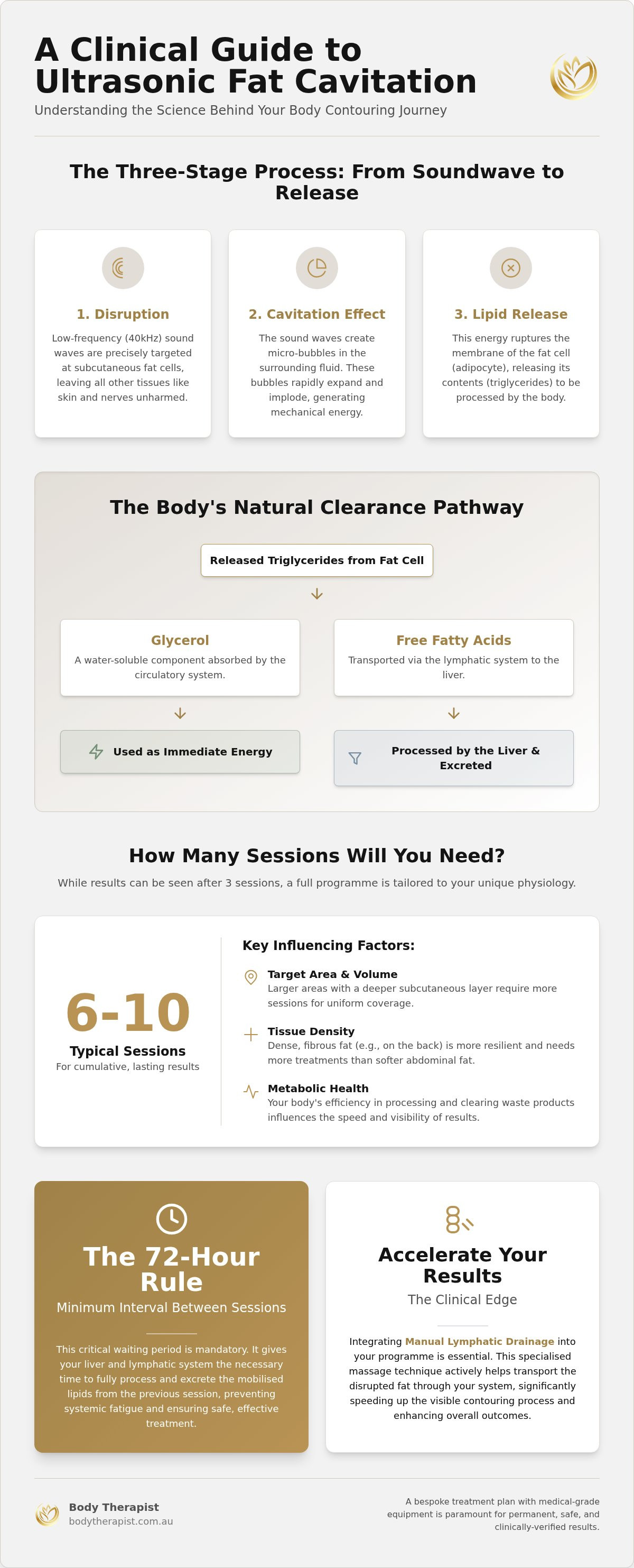
Ultrasonic fat cavitation is a precise, non-invasive lipolysis method that employs low-frequency sound waves to target subcutaneous adipose tissue. It isn't a simple "melting" of fat; rather, it is a complex mechanical disruption of cell membranes. To understand The Science of Ultrasonic Fat Cavitation, one must look at the "cavitation effect." This phenomenon occurs when ultrasound waves create rapid pressure changes within the interstitial fluid, forming microscopic bubbles that eventually implode. This implosion generates enough mechanical energy to rupture the adipocyte (fat cell) membrane, releasing its contents into the surrounding space. Because the body possesses a finite capacity for lipid clearance, this process must be managed in stages rather than all at once.
The Adipocyte Disruption Process
Low-frequency waves, typically calibrated to 40kHz, specifically target low-density adipose tissue while leaving high-density structures like vascular walls and nerve fibres entirely intact. This selectivity ensures a safe, rehabilitative experience without the trauma associated with surgical alternatives. Once the membrane fails, the cell releases its stored energy in the form of triglycerides, which then break down into simpler components for transport. In a clinical context, stable cavitation involves the rhythmic expansion and contraction of bubbles to gently massage tissues, while transient cavitation refers to the sudden collapse of bubbles that provides the necessary force for permanent adipocyte destruction.
Metabolic Clearance Timelines
The body's ability to process these released lipids is the primary reason why multiple treatments are essential. Once the adipocyte ruptures, the contents undergo a specific metabolic conversion to ensure they can be safely removed from the system:
Glycerol: A water-soluble substance that enters the circulatory system for immediate energy use or filtered transport.
Free Fatty Acids: These are transported by the lymphatic system to the liver to be processed as waste or fuel.
The liver then filters these components, preparing them for natural excretion through the urinary and digestive systems. If a practitioner attempts to treat too many areas simultaneously, the liver can face a significant lipid load, potentially leading to systemic fatigue or sluggish detoxification. This biological bottleneck dictates how many fat cavitation sessions are needed, as the body requires specific intervals to clear the cellular debris before the next disruption occurs. Rushing this process doesn't just reduce the efficacy of the treatment; it places unnecessary strain on your internal filtration organs, which is why a staged clinical approach is mandatory for safe body contouring.
Calculating Your Treatment Plan: Factors That Determine How Many Sessions You Need
Generic online advice often suggests a broad range of six to twelve treatments, yet this fails to account for the unique physiological landscape of each client. Determining how many fat cavitation sessions are needed is a clinical exercise in evaluating your body’s specific structural and metabolic constraints. While some individuals may observe a shift after three visits, a series of six to ten sessions remains the clinical standard for achieving cumulative, visible change. This isn't a "one size fits all" modality; it's a bespoke biological intervention designed to transition from simple centimetre loss to refined body sculpting.
Target Area Volume and Tissue Density
The physical characteristics of the target zone dictate the level of ultrasonic energy required for effective disruption. Fibrous fat, frequently found on the back or flanks, possesses a more resilient connective tissue matrix that demands a higher number of sessions compared to softer, more compliant adipose tissue in the abdomen. The Science of Ultrasonic Fat Cavitation demonstrates that the depth of the subcutaneous layer also influences how effectively sound waves penetrate. A larger surface area naturally requires more time to ensure uniform coverage and effective cell disruption across the entire region, making the total session count highly dependent on the initial volume of the site.
Individual Metabolic Rate and Age
Your basal metabolic rate (BMR) functions as the engine for your results. Younger clients or those with higher metabolic activity often see faster clearance because their bodies process and expel the released lipids with greater efficiency. Conversely, as we age, skin elasticity naturally declines. This often necessitates the integration of RF skin tightening to ensure the treated area remains firm as the underlying volume decreases. Hormonal balance, particularly the presence of cortisol or oestrogen dominance, can also influence how stubbornly the body clings to specific fat stores, potentially extending the treatment timeline. A professional consultation is the most reliable way to organise a treatment plan that reflects your actual biological needs rather than an arbitrary industry average.
Frequency and Spacing: Why You Can’t Do Cavitation Every Day
Impatience is a common hurdle in body contouring. When you're eager to see a more defined silhouette, it's tempting to think that daily sessions would accelerate the process. However, the biological reality of fat clearance dictates a much more measured pace. Adopting a daily schedule would not only be ineffective but potentially hazardous to your systemic health. The "72-hour rule" represents the absolute minimum recovery window required for the liver and kidneys to process the initial lipid load released during a single treatment. Without this pause, you risk over-treating the area and inducing metabolic fatigue, which ultimately hinders the very results you're seeking.
Clinical standards suggest an ideal cadence of one session every seven to ten days. This interval allows your body to fully metabolise the disrupted adipocytes and return to a state of homeostasis before the next round of ultrasonic disruption. Determining how many fat cavitation sessions are needed involves calculating these rest periods into a long-term strategy. Rushing the process often leads to diminishing returns, as the body’s filtration systems become overwhelmed and less efficient at clearing waste. This is particularly relevant for those using home-use devices; without professional oversight, the risk of organ strain and poor aesthetic outcomes increases significantly.
The Liver and Kidney Recovery Window
When ultrasonic waves implode fat cell membranes, they release a sudden influx of free fatty acids and glycerol into the interstitial fluid. This internal debris must be transported via the lymphatic system to the liver for filtration and the kidneys for excretion. This creates a temporary but significant spike in physiological stress. Maintaining high levels of hydration is non-negotiable during this window; water facilitates renal clearance and prevents the lymphatic fluid from becoming sluggish. Many people mistakenly believe that increasing ultrasonic intensity or frequency will yield faster results, but "more" is rarely better in a clinical context. Over-treating can lead to systemic inflammation or a heavy, lethargic feeling as your internal organs struggle to keep up with the detoxification demand.
Cumulative Effects vs. Diminishing Returns
Results from fat cavitation are rarely linear. Most clients observe the most dramatic visual shifts during the third and fourth sessions, as the cumulative impact of previous treatments begins to manifest. This "sweet spot" occurs because the body has already established an efficient pathway for lipid removal. Over a typical 12-week programme, your physiology adapts to the treatment, steadily refining the target area. However, it's also vital to recognise the plateau. Once the desired level of contouring is achieved, continuing high-frequency treatments offers little additional benefit. At this stage, your practitioner will transition you into a maintenance phase, allowing the final results to peak, which typically occurs three to four weeks after your final session.
The Clinical Edge: How Manual Lymphatic Drainage Enhances Cavitation Outcomes
While ultrasonic waves are highly effective at disrupting adipocyte membranes, the procedure only completes the first half of the contouring equation. Once the fat is liquefied, it transitions into the interstitial space, where it awaits transport and eventual excretion. This is where manual lymphatic drainage massage becomes an indispensable clinical partner. A common adage in results-oriented therapy is that cavitation "breaks" the fat, but MLD "takes" the fat away. If your lymphatic system is sluggish or overwhelmed, the released lipids can remain stagnant, potentially leading to localised swelling rather than the refined silhouette you desire. Consequently, the answer to how many fat cavitation sessions are needed is often dictated by the efficiency of your lymphatic clearance.
Poor lymphatic flow is a primary reason why some individuals experience a plateau in their results. When the system is congested, the body cannot effectively mobilise the sudden influx of cellular debris, which can lead to post-treatment puffiness or a heavy sensation in the treated area. Engaging a practitioner who is qualified in both advanced body contouring and clinical massage therapy ensures that every session is supported by a deep understanding of anatomical waste removal. This dual approach transforms a simple aesthetic procedure into a comprehensive physiological optimisation programme.
Accelerating Lipid Transport
Clinical MLD employs specific, rhythmic manual techniques designed to stimulate the lymphangions, the tiny muscular units within the lymph vessels. By increasing the frequency of these contractions, a therapist can resolve the biological "bottleneck" that occurs when the volume of released triglycerides exceeds the system's natural transport capacity. This active acceleration moves interstitial fluid toward the regional lymph nodes for filtration and processing. Additionally, manual stimulation reduces the risk of tissue hardening, or fibrosis, which can sometimes occur if cellular proteins and lipids are left to settle in the disrupted zone for too long.
Reducing Post-Treatment Inflammation
It is not uncommon for clients to experience minor puffiness or a sense of fullness immediately following a session. This is a natural inflammatory response to the mechanical energy of the ultrasound waves. Integrating optimising lymphatic drainage protocols provides instant relief by flushing these inflammatory mediators out of the tissue. To support your system at home between clinical visits, we recommend light movement, such as walking, and maintaining a high intake of filtered water to ensure the lymph remains fluid and mobile. For those seeking the most efficient path to permanent contouring, we invite you to book a clinical consultation to discuss an integrated treatment plan.
Navigating Your Body Contouring Journey with Body Therapist
Your journey toward physical optimisation begins with a comprehensive assessment rather than a generic booking. At Body Therapist, we view body contouring as a clinical intervention that requires a deep understanding of your unique anatomy. A professional consultation allows us to establish a bespoke treatment plan that aligns with your specific physiological goals. This roadmap moves methodically from the initial tissue assessment through the active disruption phase, concluding with a tailored maintenance schedule. Determining how many fat cavitation sessions are needed is a collaborative process between you and your practitioner, ensuring that every visit brings you closer to a more functional and defined physique. We look at your body as a whole system, assessing skin laxity and tissue density before the first transducer ever touches your skin.
Professional Assessment vs. Home Devices
The market is currently saturated with home-use cavitation units, yet these devices rarely possess the power or calibration required for genuine adipocyte disruption. Professional 40kHz cavitation is required to reach the deep adipose layer where stubborn fat resides. Uncalibrated equipment often fails to maintain the necessary frequency, increasing the risk of superficial skin burns while delivering negligible results. Choosing a clinical setting ensures the technology is medical-grade and the application is precise. A qualified therapist understands how to prepare your body for treatment by ensuring the lymphatic system is primed and the tissue is hydrated. This professional oversight guarantees both safety and efficacy, protecting your investment in your health.
Sustaining Results Through Functional Wellness
It is vital to recognise that fat cavitation is a tool for contouring, not a primary weight-loss solution. While the procedure permanently destroys targeted fat cells, the remaining adipocytes in the body still possess the capacity to expand if metabolic health is neglected. We integrate principles of myotherapy and functional mobility into our guidance, encouraging a lifestyle that supports long-term rejuvenation. Our therapists focus on how your body moves and recovers, ensuring that your lymphatic system remains active through functional movement. A balanced approach to nutrition and consistent movement prevents the accumulation of new lipid stores, allowing your sculpted results to remain permanent. We encourage you to view this process as one component of a broader health strategy. By combining clinical technology with active recovery and rehabilitative care, you can achieve a level of physical refinement that reflects your dedication to total well-being.
Achieving Precision in Your Body Contouring Programme
Achieving a refined silhouette through ultrasonic technology is a biological process that demands clinical patience and anatomical expertise. We've explored how tissue density, metabolic health, and the critical integration of manual lymphatic drainage all influence your unique results. Understanding how many fat cavitation sessions are needed is less about following a generic estimate and more about respecting your body's specific clearance capacity. By prioritising systemic health and professional oversight, you ensure that every session contributes to a permanent, functional transformation.
Our practitioners bring qualified remedial and myotherapy expertise to every treatment, ensuring your journey is grounded in anatomical science. We specialise in MLD integration to accelerate lipid transport and provide a medical-grade environment dedicated to your physical optimisation. It's time to move beyond the guesswork of general beauty treatments and embrace a results-oriented approach to rejuvenation. Book your clinical body contouring consultation at Body Therapist to begin your bespoke journey toward physical health. Your path to a more contoured, healthy physique is within reach.
Frequently Asked Questions
How many fat cavitation sessions are needed to see results on the stomach?
Most individuals require a series of 6 to 10 treatments to achieve visible refinement on the stomach. The abdomen often contains deeper subcutaneous layers that demand cumulative disruption to see a structural shift. Determining exactly how many fat cavitation sessions are needed for the stomach depends on your initial tissue volume and your body’s specific metabolic efficiency.
Can I do fat cavitation every day if I use a home machine?
Daily treatment is strictly contraindicated because the liver requires a minimum of 72 hours to process the released lipid load. Over-using home machines can lead to systemic fatigue and inflammatory stress without improving your aesthetic outcomes. Professional guidance ensures you maintain the correct clinical cadence for safe, effective waste removal.
What happens if I stop fat cavitation treatments after only two sessions?
Stopping after only two sessions typically results in temporary fluid shifts rather than permanent structural change. The initial treatments begin the adipocyte disruption process, but a full programme is necessary to ensure the fat is fully mobilised and excreted. Incomplete cycles often lead to the body re-storing the released lipids in remaining fat cells.
How long do the results of ultrasonic cavitation actually last?
The destruction of adipocytes during your sessions is permanent, but your remaining fat cells can still expand if your metabolic balance shifts. Long-term results depend on a stable lifestyle and functional movement to prevent new lipid accumulation. Consistent wellness habits ensure the contouring effects of your clinical sessions last indefinitely.
Is there anyone who should not have fat cavitation treatments?
Individuals with hepatic or renal impairment, cardiac conditions, or metal implants in the treatment zone should avoid this procedure. Pregnancy and breastfeeding are also absolute contraindications due to the metabolic load placed on the system during fat clearance. A thorough health screening is essential to ensure your internal organs can safely manage the detoxification process.
Does fat cavitation work better if combined with radiofrequency?
Integrating radiofrequency (RF) typically yields superior aesthetic results, particularly for those concerned with skin laxity. While cavitation reduces adipose volume, RF stimulates collagen synthesis to firm the surrounding tissue. This clinical synergy prevents the "deflated" appearance that can sometimes follow significant volume loss in the target area.
How much water should I drink after a cavitation session?
Consuming 1.5 to 2 litres of filtered water daily after your treatment is vital for assisting renal and hepatic clearance. Water acts as the primary transport medium for the lymphatic system to move triglycerides out of the interstitial space. Poor hydration can lead to stagnant results and a sluggish metabolic recovery.
Will I lose weight on the scales after my cavitation sessions?
Scaled weight loss is rarely the primary outcome because adipose tissue is significantly less dense than muscle or bone. You will notice a reduction in centimetres and a change in how your clothing fits, but the numbers on the scale often remain stable. This is a body sculpting modality focused on anatomical refinement rather than a general weight-loss programme; for those seeking more intensive medical or surgical weight management, Nusbaum Medical Centers provides specialised clinical programmes to support significant scale-based reduction.


Comments