

Does Ultrasonic Fat Cavitation Work? A Clinical Guide to Non-Surgical Body Contouring

Updated: Sep 10
What if the key to eliminating stubborn fat isn't found in more restrictive dieting, but in the precise application of low frequency sound waves to disrupt cellular structures? If you've spent months targeting a specific area only to see no change, you're likely asking: does ultrasonic fat cavitation work, or is it just another aesthetic trend? It's a common frustration to feel stuck between the desire for physical optimisation and a valid fear of surgical risks or lengthy recovery times.
We understand that navigating conflicting online reviews can be exhausting when you simply want an evidence-based solution for localised fat. This clinical guide will help you discover the physiological science behind fat cavitation, provide realistic expectations for your results, and explain why your lymphatic health is the secret to successful body sculpting. We'll explore the biological process of adipose tissue disruption and how a methodical, rehabilitative approach ensures those released lipids are actually processed and eliminated by your body's metabolic pathways.
Table of Contents
What is Ultrasonic Fat Cavitation and How Does the Science Work?
Measuring Effectiveness: Does Ultrasonic Fat Cavitation Actually Work?
The Critical Role of Lymphatic Drainage in Post-Cavitation Success
Determining if You Are an Ideal Candidate for Body Contouring
The Treatment Journey: From First Consultation to Final Result
What is Ultrasonic Fat Cavitation and How Does the Science Work?
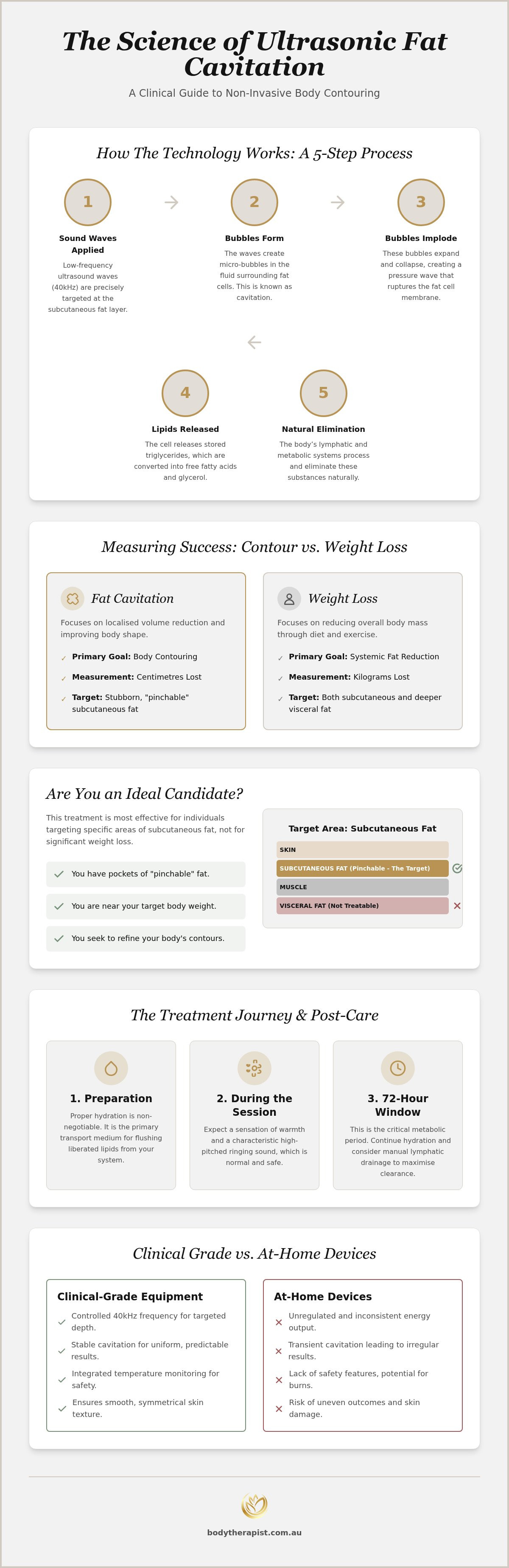
Ultrasonic fat cavitation is a sophisticated, non-invasive procedure that utilises low-frequency sound waves to systematically disrupt adipocyte (fat cell) membranes. This technology relies on the physical principle of cavitation, where acoustic waves create rapid pressure changes within the interstitial fluid surrounding your fat cells. These pressure fluctuations generate microscopic bubbles that expand and contract in rhythm with the frequency of the sound waves. When these bubbles reach a critical size, they implode, releasing a focused energy pulse that compromises the structural integrity of the fat cell wall. To answer the fundamental question, does ultrasonic fat cavitation work, one must look at the measurable transition of solid fat into a liquid state. Once the cell membrane is breached, the stored triglycerides are released and converted into free fatty acids and glycerol, allowing the body to metabolise them through natural pathways.
A common concern involves the safety of surrounding tissues like nerves, blood vessels, and connective fibres. Because adipose tissue has a different density and lower structural resilience compared to muscle or vascular walls, the specific frequency of the ultrasound can be tuned to target only the fat. This ensures that the treatment remains localised and non-destructive to the essential structures of the body. It's this selectivity that makes the process a viable alternative to surgical intervention for those seeking body refinement without the risks of anaesthesia or scarring.
The Biological Process of Adipocyte Disruption
The implosion of the fat cell wall is a precise mechanical event. Clinical-grade equipment typically operates at a frequency of 40kHz, which is the optimal range for penetrating the subcutaneous layer without reaching deeper visceral organs. Lipolysis is the metabolic process induced by cavitation waves where complex lipids are broken down into simpler components for energy use or excretion. This cellular disruption essentially liquefies the fat, turning a stubborn pocket of tissue into a substance the body can finally recognise and process. You can explore the science of fat breakdown to understand how your body handles these released lipids once they enter the bloodstream.
Stable vs. Transient Cavitation in Body Sculpting
There's a significant distinction between the stable cavitation achieved in a clinical setting and the unregulated energy of home devices. Professional equipment provides a controlled thermal and mechanical effect on the subcutaneous layer, ensuring that energy is distributed uniformly across the treatment area. This precision prevents the irregular results often associated with inferior machines. By maintaining stable cavitation, the practitioner can ensure a predictable biological impact, leading to smoother skin textures and more symmetrical contouring. Professional-grade machines also monitor skin temperature to prevent surface burns, a safety feature often lacking in cheaper alternatives.
Measuring Effectiveness: Does Ultrasonic Fat Cavitation Actually Work?
To determine does ultrasonic fat cavitation work for your specific goals, you first need to redefine what "working" actually means in a clinical context. Many individuals mistakenly use a bathroom scale as their primary metric, leading to frustration when the numbers don't shift significantly. Cavitation is a specialised tool for circumferential reduction and body contouring, not systemic weight loss. It targets the volume of subcutaneous fat cells in localised areas. While the weight of the liberated lipids is negligible on a scale, the reduction in the physical space they occupy can be profound. Success is measured in centimetres lost and the visible smoothing of the body's silhouette rather than total body mass.
The efficacy of the treatment relies heavily on the 72-hour metabolic window following your session. During this time, your body is actively working to transport and process the glycerol and free fatty acids released during the procedure. High hydration levels are non-negotiable here; water acts as the primary transport medium for these lipids. If you're dehydrated or have a sluggish metabolic rate, the "liquid" fat may simply be reabsorbed by remaining adipocytes. For a broader look at the safety and general expectations of this technology, WebMD's guide to ultrasonic cavitation provides a helpful overview of the clinical landscape.
Realistic Results: Circumferential Reduction vs. The Scales
Measuring the circumference of the waist, hips, or thighs provides a much more accurate reflection of your progress. A single session can often yield a measurable reduction, but the results are cumulative and require patience. A standard course of 6 to 12 sessions is typically required to see significant structural changes in stubborn adipose tissue. Consistency is key. Spacing appointments 7 to 10 days apart allows the lymphatic system enough time to clear the cellular debris without becoming overwhelmed. If you're looking for a professional environment that prioritises these functional outcomes, you might consider booking a clinical body assessment to see how your tissue density might influence your results.
Clinical Evidence and Success Rates
Clinical studies on non-invasive body contouring consistently show that low-frequency ultrasound is effective for reducing localised fat deposits. However, it's essential to view this as a supplemental procedure rather than a primary weight loss solution. Efficacy is often dictated by tissue density; softer fat typically responds more rapidly than dense, fibrous tissue. If you're asking does ultrasonic fat cavitation work for everyone, the honest answer is that it works best for those already maintaining a stable BMI. The treatment serves as a finishing tool for those pockets of fat that are genetically resistant to diet and exercise.
The Critical Role of Lymphatic Drainage in Post-Cavitation Success
Acoustic disruption of fat cells is only the first half of a successful body sculpting treatment. If you're still questioning does ultrasonic fat cavitation work, the answer depends heavily on what happens after the machine is turned off. The ultrasound waves successfully liquefy the fat, but those lipids are currently suspended in the interstitial space between your cells. They haven't left your body yet. Without active metabolic clearance, this cellular debris can lead to tissue congestion rather than the streamlined contouring you're seeking. To understand how to manage this fluid balance, you may find it helpful to read our article on Optimising Lymphatic Drainage: A Clinical Guide to Fluid Health.
The journey from the treatment area to excretion is a complex biological relay. Liquidated fat travels from the interstitial fluid into the initial lymphatic vessels. From there, it moves through a network of nodes where it's filtered before entering the venous system and eventually reaching the liver. Clinical research regarding the effectiveness of ultrasonic cavitation confirms that this biological clearance is the primary bottleneck for visible results. If the lymphatic system is sluggish, the body may simply re-store these lipids elsewhere.
How Your Body Processes Liquidated Lipids
Once the glycerol and free fatty acids reach the liver, they're either utilised as energy or prepared for excretion as waste. This sudden metabolic workload is the reason some clients report a mild 'detox' sensation or slight fatigue following a session. Your liver is essentially processing a concentrated dose of energy. High hydration levels, specifically at least two litres of water daily, are essential to maintain the fluid pressure required to keep this waste moving through the lymphatic channels. Without adequate water, the lymph fluid becomes viscous, slowing down the entire removal process.
Why Manual Drainage is Superior to Vibration Tools
While many clinics suggest vibration plates for post-cavitation recovery, these devices lack the clinical precision of a therapist's hands. Manual Lymphatic Drainage (MLD) uses specific, rhythmic pressure to direct fluid toward primary lymph nodes in the groin or axilla. Passive methods like vibration tools offer generalised stimulation but cannot address specific areas of congestion with the same rehabilitative accuracy. You can find a deeper breakdown of these techniques in The Clinical Guide to Manual Lymphatic Drainage Massage (MLD). This hands-on approach ensures that the liquefied fat is efficiently cleared, which helps to maximise the visible impact of every cavitation session.
Determining if You Are an Ideal Candidate for Body Contouring
The primary factor in determining does ultrasonic fat cavitation work for your specific needs is the nature of the adipose tissue you wish to target. We utilise a clinical 'pinchable fat' rule to distinguish between subcutaneous fat, which sits directly beneath the skin, and visceral fat, which is stored deeper around the internal organs. Cavitation is specifically engineered to disrupt subcutaneous cells. If the tissue is firm and cannot be grasped away from the abdominal wall, it's likely visceral fat, which does not respond to acoustic waves. This distinction is why the procedure is not a suitable intervention for individuals with a high BMI or those seeking significant weight loss. It's a precise tool for body sculpting, not a systemic metabolic solution.
A successful outcome also depends on your physiological commitment. Because the treatment releases a concentrated dose of lipids into your system, your body must be in a state where it can effectively burn this energy. We recommend a low-carbohydrate diet and light aerobic exercise during the 72-hour window post-treatment to ensure these fatty acids are metabolised rather than re-stored. This is a functional partnership between the therapist and the client. To ensure you're a suitable match for this technology, you can book a clinical body assessment to evaluate your tissue density.
Physical Criteria and Lifestyle Factors
We typically target localised areas that are genetically resistant to traditional exercise, such as the chin, lower abdomen, 'love handles', and the bra-bulge. The quality of your skin elasticity also plays a significant role in the final aesthetic result. While cavitation reduces volume, the skin must have enough structural integrity to retract over the new contour. Additionally, because the liver and kidneys are responsible for filtering the released glycerol, healthy organ function is a non-negotiable prerequisite for the procedure; services like mobile phlebotomy Stockbridge GA from Dyvine Medical & Wellness can help you monitor these vital wellness markers.
Ideal candidates are within 5 to 10 kilograms of their goal weight.
Tissue type must be subcutaneous (pinchable) rather than visceral.
Metabolic health should be stable to allow for efficient lipid clearance.
Hydration habits must be consistent to support lymphatic transport.
Contraindications and Safety Protocols
While non-invasive, cavitation is a powerful biological intervention that is contraindicated for certain individuals. You should avoid this treatment if you're pregnant, have a history of heart disease, or possess metal implants or pacemakers, as the acoustic waves can interfere with these devices. A professional consultation is required to assess your full medical history and ensure the procedure is safe for your specific physiology. It's also vital to ensure your therapist has a background in clinical massage therapy, as this expertise allows for the integration of lymphatic drainage and tissue assessment that a standard beauty salon might overlook.
The Treatment Journey: From First Consultation to Final Result
Your journey toward physical optimisation begins long before the first application of the transducer. To ensure the answer to does ultrasonic fat cavitation work is a definitive yes for your body, preparation is vital. We require all clients to consume at least two litres of water in the 24 hours preceding their appointment. This systemic hydration ensures that the interstitial fluid is sufficiently fluid to allow for the generation of cavitation bubbles and the subsequent transport of released lipids. In our clinical environment, we often integrate RF Skin Tightening alongside cavitation. This multi-modal approach addresses both the subcutaneous fat volume and the structural integrity of the dermal layers, preventing skin laxity as the underlying tissue volume decreases.
While some general beauty sources suggest that only one to three sessions are standard, clinical experience indicates that a more realistic expectation for significant contouring is a series of 6 to 12 treatments. This allows for the cumulative disruption of adipose tissue and gives the lymphatic system adequate time to clear the cellular debris. A methodical, long-term maintenance plan is essential to preserve these results, as the remaining fat cells can still expand if a significant caloric surplus is maintained.
What to Expect During Your Clinical Session
A typical session involves the application of a conductive ultrasound gel followed by the methodical, circular motion of the transducer over the target area. You'll likely experience a distinct high-pitched ringing or buzzing sensation in the ears. This is a normal physiological response to the sound waves vibrating through the skeletal structure. While the treatment is non-invasive and generally comfortable, you may feel a mild thermal warming or a slight tingling as the energy penetrates the subcutaneous layer. To understand how to best prime your body for clinical bodywork, you can review our guide on how to prepare for remedial massage, as many of the same physiological principles apply.
Post-Treatment Protocols for Maximising Outcomes
The 72 hours following your session are the most critical for fat clearance. We enforce a strict 'no alcohol and no refined sugar' rule during this window. Alcohol prioritises liver metabolism over lipid clearance, while sugar can trigger insulin spikes that encourage the re-storage of the very fatty acids we've just liberated. Incorporating 20 minutes of light cardio immediately after your session is also highly recommended. This elevates your metabolic rate and helps burn off the released energy as fuel. Scheduling follow-up sessions every 7 to 10 days helps maintain the momentum of fat clearance, ensuring that the body continues to prioritise the elimination of disrupted adipocytes. This disciplined approach ensures that your investment in non-surgical sculpting yields the most visible and lasting structural changes.
Refining Your Silhouette Through Clinical Science
Achieving a sculpted physique requires more than just high-frequency sound waves; it demands a deep understanding of human anatomy and metabolic function. As we have explored throughout this guide, the answer to does ultrasonic fat cavitation work lies in the synergy between precise acoustic disruption and the efficient clearance of liberated lipids. Success is rarely found in a vacuum. It is the result of proper hydration, specific lifestyle adjustments, and the vital role of the lymphatic system in processing cellular waste.
At Body Therapist, we move beyond the superficial approach of a standard beauty salon. Led by clinical expert Lee Carnegie, our practice focuses on an evidence-based, results-oriented approach that integrates Manual Lymphatic Drainage and RF technology to ensure every session contributes to a smoother, more contoured silhouette. We prioritise your long-term tissue health and functional mobility throughout your aesthetic journey. If you're ready to target those stubborn areas with a methodology grounded in physiological science, we're here to guide your progress. Book your clinical body contouring consultation at Body Therapist today and take the first step toward a more confident version of yourself.
Frequently Asked Questions
Is ultrasonic fat cavitation permanent?
The destruction of specific adipocytes during a session is permanent, as the cell membrane is physically compromised and cannot regenerate. However, the remaining fat cells in the surrounding tissue still have the capacity to expand if you maintain a caloric surplus. Long-term maintenance of your new silhouette requires a stable weight and a balanced lifestyle to prevent the hypertrophy of existing fat stores.
Does the procedure hurt or have any side effects?
The procedure is entirely non-invasive and shouldn't cause pain; most clients report only a warming sensation or mild tingling. Potential side effects are typically transient and include localised skin redness, increased thirst, or a temporary sense of fatigue as the liver processes released lipids. These physiological responses usually resolve within 24 to 48 hours as the body completes its metabolic clearance.
How many sessions will I need to see a difference?
While some clients notice a subtle shift after the first treatment, a series of 6 to 12 sessions is generally required for significant circumferential reduction. This cumulative approach allows for the systematic disruption of denser adipose layers and ensures the lymphatic system isn't overwhelmed. When considering does ultrasonic fat cavitation work for your goals, consistency in scheduling sessions every 7 to 10 days is the most critical factor for success.
Can I lose weight with fat cavitation alone?
No, fat cavitation is a body contouring tool designed for localised volume reduction rather than systemic weight loss. It specifically targets stubborn, subcutaneous fat pockets that are resistant to traditional diet and exercise. You may notice your clothes fit better and your skin appears smoother, but the number on the scale will likely remain stable unless the treatment is paired with a calorie-controlled nutritional plan.
What is the difference between cavitation and liposuction?
The primary difference is that cavitation is a non-surgical, external application of ultrasound, whereas liposuction is an invasive surgical procedure involving anaesthesia and incisions. Cavitation requires no downtime and carries significantly fewer risks of infection or scarring. While liposuction offers more immediate results, cavitation provides a gradual, rehabilitative alternative for those seeking physical optimisation without the trauma of surgery.
Why do I hear a buzzing sound in my ears during treatment?
The high-pitched ringing or buzzing is caused by the ultrasound waves vibrating through the skeletal system, a phenomenon known as bone conduction. Because the frequency is specifically tuned to disrupt fat cells, the sound waves travel through the fluid and bone until they reach the inner ear. It's a completely normal part of the clinical experience and indicates that the transducer is functioning at the correct frequency for adipocyte disruption.
How much water should I drink after a session?
You should aim to consume at least two litres of water daily for the three days following your treatment. This high level of hydration is essential to maintain the fluid pressure required for the lymphatic system to transport liquidated fat to the liver. Without adequate water, the interstitial fluid becomes stagnant, which can significantly hinder the results of your session and leave you feeling sluggish.
Can I have cavitation if I am on my period?
Yes, you can undergo treatment during your menstrual cycle, though it's often recommended to wait if you experience significant bloating or abdominal discomfort. The increased fluid retention common during this time can make it more difficult to measure accurate circumferential loss immediately after the session. Some clients also find they're more sensitive to the warming sensation of the transducer during their period due to hormonal fluctuations.


Comments