

Body Shaping for Special Occasions: A Realistic Guide

The treatment that sounds most dramatic may not be the one that best fits your event date. Planning body shaping for special occasions means matching your concern and timeline to an option’s intended purpose, rather than relying on promises of a last-minute transformation.
It’s understandable to want a noticeable change and to feel unsure when claims about results, recovery and session numbers conflict. Non-surgical options aren’t interchangeable, and body contouring isn’t a substitute for weight loss. Ultrasonic fat cavitation, RF skin tightening and low-level laser therapy each need to be considered in light of your goals, health history and the time available before your event. This guide compares the options, explains what may and may not be realistic, and outlines the questions to ask about suitability, timing and aftercare. The aim is to help you make an informed choice, not to guarantee a particular result by a particular date.
Table of Contents
What Does Body Shaping for Special Occasions Actually Mean?
Body shaping for special occasions is best understood as a discussion about appearance-focused options, not a promise of a particular look by a set date. An upcoming wedding, reunion or celebration can prompt someone to consider a localised concern. That goal is valid, but there’s no requirement to change your body for an event. The right decision may be to explore treatment, wait or do nothing.
Non-surgical body-contouring approaches differ in their intended focus and aren’t suitable for everyone. A consultation should clarify what you hope to address, your health context and whether a particular treatment is appropriate. It should also give you space to ask about expected outcomes, timing, possible aftercare and uncertainties before deciding.
Body contouring versus weight loss: what is the difference?
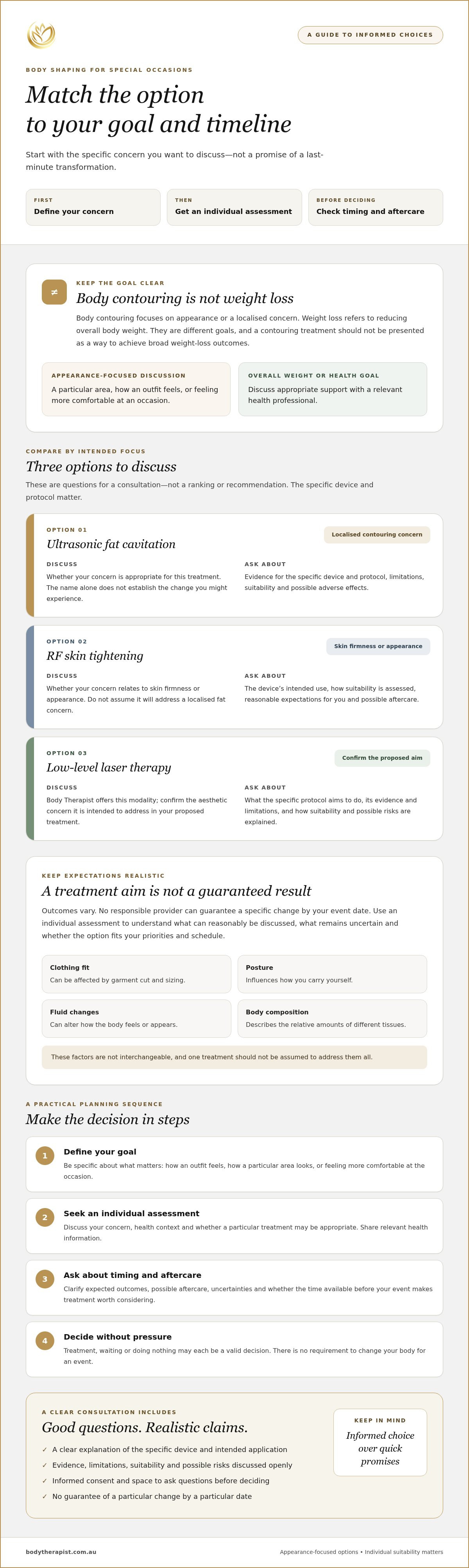
Body contouring focuses on appearance or a localised concern; weight loss refers to reducing overall body weight. The terms aren’t interchangeable. A contouring treatment shouldn’t be presented as a way to achieve broad weight-loss outcomes, replace medical care or take the place of sustainable health support. For a general overview of approaches, including invasive and non-invasive fat removal procedures, see the linked reference. It doesn’t establish what’s suitable for you.
Changes on the scales and changes in how an area looks are different measures. If your main goal relates to overall weight or health, discuss appropriate support with a relevant health professional rather than expecting a body-contouring treatment to meet that goal.
Which event-related goals are realistic to discuss?
Be specific about what matters to you: how an outfit feels, how a particular area looks, or feeling more comfortable at an occasion. These are useful starting points for a consultation, not guaranteed outcomes. Expectations need to reflect both your individual assessment and the intended purpose of any treatment being considered.
Keep distinct factors in view. Clothing fit can be affected by garment cut and sizing; posture influences how you carry yourself; fluid changes can alter how the body feels or appears; and body composition describes the relative amounts of different tissues. These factors aren’t interchangeable, and one treatment shouldn’t be assumed to address them all.
No responsible guide can guarantee a specific change by your event date. Outcomes vary, and the time available may affect whether treatment is worth considering at all. Use the consultation to understand what can reasonably be discussed, what remains uncertain and whether the option fits your priorities without adding pressure to your plans.
Compare Non-Surgical Body-Shaping Options by Goal
Compare these options by the concern you want to discuss and the specific treatment protocol, rather than by the modality name alone. Body Therapist offers ultrasonic fat cavitation, RF skin tightening and low-level laser therapy. A provider should explain the intended application of the device they use, the evidence and limitations, and how they’ll assess whether it may suit your circumstances.
The table is a guide to questions, not a ranking or recommendation. Ask for clear, treatment-specific information before deciding.
When might ultrasonic fat cavitation be discussed?
Ultrasonic fat cavitation is a non-surgical option offered by Body Therapist, not a guaranteed fat-loss method or a substitute for weight management. Ask about your suitability, the evidence for the specific device and protocol, its limitations and possible adverse effects. For a deeper explanation of this modality, read the article on ultrasonic fat cavitation; general information can’t replace an individual assessment.
How do RF skin tightening and low-level laser therapy differ?
RF skin tightening and low-level laser therapy are distinct modalities offered by Body Therapist. A concern about skin firmness may differ from a localised contouring goal, so ask what the specific device and protocol are intended to address. Don’t infer suitability, likely change or treatment sequence from a modality’s name. The provider should explain the rationale for any option discussed in relation to your goals.
For body shaping for special occasions, focus on treatment fit rather than looking for one universally “best” option. You can discuss body-shaping treatment suitability with Body Therapist as part of an informed conversation about your goals and expectations.
What Results Can You Realistically Expect Before a Special Occasion?
No responsible guide can guarantee a specific result by your event date. A treatment’s intended aesthetic focus isn’t proof of the outcome you’ll experience. Response can vary with the modality, the device and protocol used, individual factors, and the practitioner’s assessment. Even with careful planning, a result may be subtle, differ from your hopes or take longer to assess than the time you have available.
Ask the provider to explain what evidence supports the proposed treatment and how closely it relates to the specific device and protocol being considered. Discuss what remains uncertain, any possible discomfort or adverse effects, and the recovery or aftercare you may need. Clear answers should help you weigh potential benefits against limitations, rather than treating general claims as a prediction of your personal result.
A fixed event date can add pressure, but it shouldn’t rush your decision. If you can’t allow time to understand the process or follow treatment-specific advice, consider postponing. Choosing not to proceed is also a valid outcome of an assessment.
Why before-and-after images do not predict your result
Images can illustrate a provider’s explanation, but they can’t show what will happen in your case. Lighting, camera angle, posture, clothing, editing and the interval between treatment and photography can all affect the appearance of a comparison. Individual circumstances and treatment protocols may differ as well.
Ask how images were captured, when they were taken relative to treatment, and whether they represent typical outcomes for the specific procedure. Treat them as examples, not a forecast or guarantee.
When should you reconsider or postpone treatment?
Tell the provider about relevant health conditions, medications and recent procedures during the assessment. If you’re pregnant, have an active health concern or aren’t sure whether treatment is appropriate, speak with an appropriate clinician before proceeding. Suitability guidance can depend on the treatment and device, so avoid relying on a generic online list to make the decision.
Seek medical advice for a health concern rather than relying on an aesthetic treatment to assess or manage it. A considered provider should explain the proposed procedure, ask relevant questions and discuss limitations and possible risks. If those details aren’t clear, pause and get clarification before consenting.
How to Plan Body Shaping Around Your Event Date
Work backwards from the occasion, but don’t treat the date as a deadline for a guaranteed result. A sensible plan leaves room to understand your options, consider suitability and follow any treatment-specific advice. There’s no standard lead time or session count that applies to everyone, so confirm the timing and protocol with the provider.
Define the concern. Describe the area or appearance goal you want to discuss, and separate it from broader weight or health goals.
Seek an assessment. Share relevant health information and ask whether the treatment is appropriate for your concern and circumstances.
Compare options. Ask what each proposed modality is intended to address, what it can’t change, and what alternatives may be available.
Confirm timing. Check when a consultation should occur, whether sessions are recommended, and what recovery or aftercare may involve. Leave flexibility rather than scheduling treatment immediately before an important event.
Decide without pressure. Proceed only if the rationale, limitations and timing make sense to you. Waiting or declining are valid choices.
Questions to ask at a body-shaping consultation
Useful questions include: What concern is this treatment intended to address, and what won’t it change? What evidence supports its use, and what risks, alternatives and aftercare should I understand? How will progress be assessed, and how much uncertainty remains about an event-date result? Also confirm who will perform the treatment and ask about their relevant qualifications and experience.
How to distinguish clinical information from marketing promises
Clear information should explain who may be suitable, what is uncertain and what potential adverse effects to consider. Be cautious of guaranteed outcomes, absolute claims or pressure to buy a package before your questions are answered. You can take written information away and compare it with advice from an appropriately qualified health professional, particularly if you have health concerns.
Body Therapist offers ultrasonic fat cavitation, RF skin tightening and low-level laser therapy for discussion following an individual suitability assessment. If you’re weighing up body shaping for special occasions, discuss your goals with Body Therapist and ask what timing and aftercare would apply to your circumstances.
Choosing a Body-Shaping Provider and Your Next Step
A considered provider discussion should help you understand the treatment, not steer you towards a predetermined choice. For body shaping for special occasions, look for an individual assessment, clear explanations and time to decide. A professional conversation should make it straightforward to ask questions, understand uncertainty and decline or defer treatment if it doesn’t feel right.
What a considered treatment discussion should cover
Bring your event date, the concern you want to address, relevant health information and a list of questions. Before proceeding, check that the provider:
Assesses your circumstances: asks about your goals and relevant health context rather than assuming a treatment is suitable.
Explains the specific option: describes what the treatment is intended to address, its limitations and why it may fit your concern.
Discusses risks and aftercare: explains potential adverse effects, any preparation or aftercare, and what to do if you have concerns.
Sets realistic expectations: acknowledges that outcomes vary and doesn’t promise a particular result by your event date.
Supports informed consent: gives you clear information before asking you to agree, and allows time for questions and a decision.
Is transparent about the practitioner: tells you who will perform the treatment and explains their relevant qualifications and experience.
You should also be able to ask how progress will be assessed and what alternatives, including postponing or not having treatment, might make sense. Take written information away if you need time to consider it. You don’t need to commit during the discussion.
A practical next step with Body Therapist
Body Therapist offers ultrasonic fat cavitation, RF skin tightening and low-level laser therapy. These are options to discuss, not recommendations for every person. Ask whether any may be appropriate for your goals, and request an explanation of the specific treatment’s intended purpose, limitations, possible risks and aftercare. Suitability should be considered individually, rather than inferred from the modality’s name or your event date.
If you’re ready to explore the question without assuming treatment is the right choice, enquire about a body-shaping consultation. Use the conversation to clarify fit and expectations before deciding whether to proceed.
Make a Plan That Fits Your Goals
Thoughtful body shaping for special occasions starts with a clear goal, not a promised event-date transformation. Non-surgical options have different intended focuses, and body contouring isn’t a substitute for weight loss or broader health support. An individual assessment can help you understand whether a treatment may suit your concern, what its limitations are and how timing, possible aftercare and uncertainty fit your plans.
Body Therapist offers ultrasonic fat cavitation, RF skin tightening and low-level laser therapy to discuss after considering your circumstances. You can raise your questions about suitability and expectations with qualified therapist Lee Carnegie. Take time to consider the information, and proceed only if the option feels appropriate for you.
Your occasion can be meaningful without requiring you to change your body. Discuss your body-shaping goals with Body Therapist before deciding whether treatment fits your plans.
Frequently Asked Questions
Can body shaping make a visible difference before a special occasion?
It may, but a visible change by your event date can’t be guaranteed. Results depend on the treatment and device, your individual circumstances, the provider’s assessment and the time available. For body shaping for special occasions, ask what outcome the treatment is intended to address, what evidence supports that expectation and whether the timeframe is realistic. A treatment’s stated aim isn’t a promise of your personal result.
How far in advance should I book body-shaping treatment before an event?
There’s no single booking timeline that suits every treatment or person. Contact a provider early enough to discuss assessment, any recommended sessions, possible recovery and aftercare, then decide whether the plan fits your calendar. Ask how long it may take to assess your response and whether there’s a recommended interval before an important event. Avoid scheduling treatment immediately beforehand, as individual protocols and responses can vary.
What is the difference between body contouring and weight loss?
Body contouring is intended to address appearance or a localised concern, while weight loss concerns a reduction in overall body weight. They aren’t interchangeable goals. A non-surgical contouring treatment shouldn’t be relied on to achieve broad weight-loss outcomes or replace medical care and sustainable health support. If your primary concern relates to weight or health, speak with an appropriate health professional about suitable support.
Is non-surgical body shaping suitable for everyone?
No. Suitability depends on the treatment, the specific device and protocol, your goals and your health circumstances. Before an assessment, be ready to disclose relevant conditions, medications and recent procedures. Ask the provider to explain why an option may or may not be appropriate, including any risks or alternatives. If you’re pregnant, have an active health concern or remain unsure, seek advice from an appropriate clinician before proceeding.
What happens if I do not see the result I expected?
Contact your provider to discuss what you’re noticing and how it compares with the treatment plan and expected assessment process. A result may differ from your hopes, and that doesn’t automatically mean more treatment is appropriate. Ask whether progress can be assessed, what limitations may explain the outcome and what options, if any, are reasonable. Seek medical advice for a health concern or unexpected symptoms rather than relying on aesthetic treatment.
Can I combine different body-shaping treatments before an event?
Possibly, but combining treatments shouldn’t be assumed to improve results or be suitable for you. Ask a qualified provider to assess each option, explain its intended purpose and discuss whether combining or sequencing treatments is appropriate under the relevant protocols. Confirm potential risks, aftercare and how the plan fits your event date. Body Therapist offers ultrasonic fat cavitation, RF skin tightening and low-level laser therapy to discuss after individual assessment.


Comments