

Understanding the Stages of Lipedema: Symptoms, Tissue Changes and Care

What if a higher lipedema stage doesn’t mean more pain or greater disability? The staging system describes visible changes in the skin and underlying tissue, not the full effect of lipedema on someone’s life. That distinction is central to understanding the stages of lipedema, particularly when your symptoms don’t seem to match what you’ve read.
It’s natural to look for a clear label when changes in your body are difficult to explain. But descriptions vary: some use three stages, while others refer to a fourth, usually for lipedema alongside secondary lymphoedema. Stage and body-region type also mean different things. One describes tissue features; the other describes where the condition affects the body.
This guide explains the commonly described skin and tissue changes at each stage, how staging differs from body-region classification, and why a stage alone can’t predict pain, function or inevitable progression. You’ll also learn what to note before an individual clinical assessment. If lymphatic care is being considered, an appropriate health assessment can help guide whether manual lymphatic drainage may be a suitable supportive option. Staging offers context, but it doesn’t tell your whole story.
Table of Contents
Understanding lipedema stages: what the classification describes
A stage is a descriptive framework, not a personal score, diagnosis or verdict about what will happen next. It gives clinicians and readers a way to describe visible features of the skin and underlying tissue. If your symptoms feel more demanding than the stage label suggests, that doesn’t make your experience less real. Appearance and day-to-day impact are separate parts of the picture.
What does a lipedema stage mean?
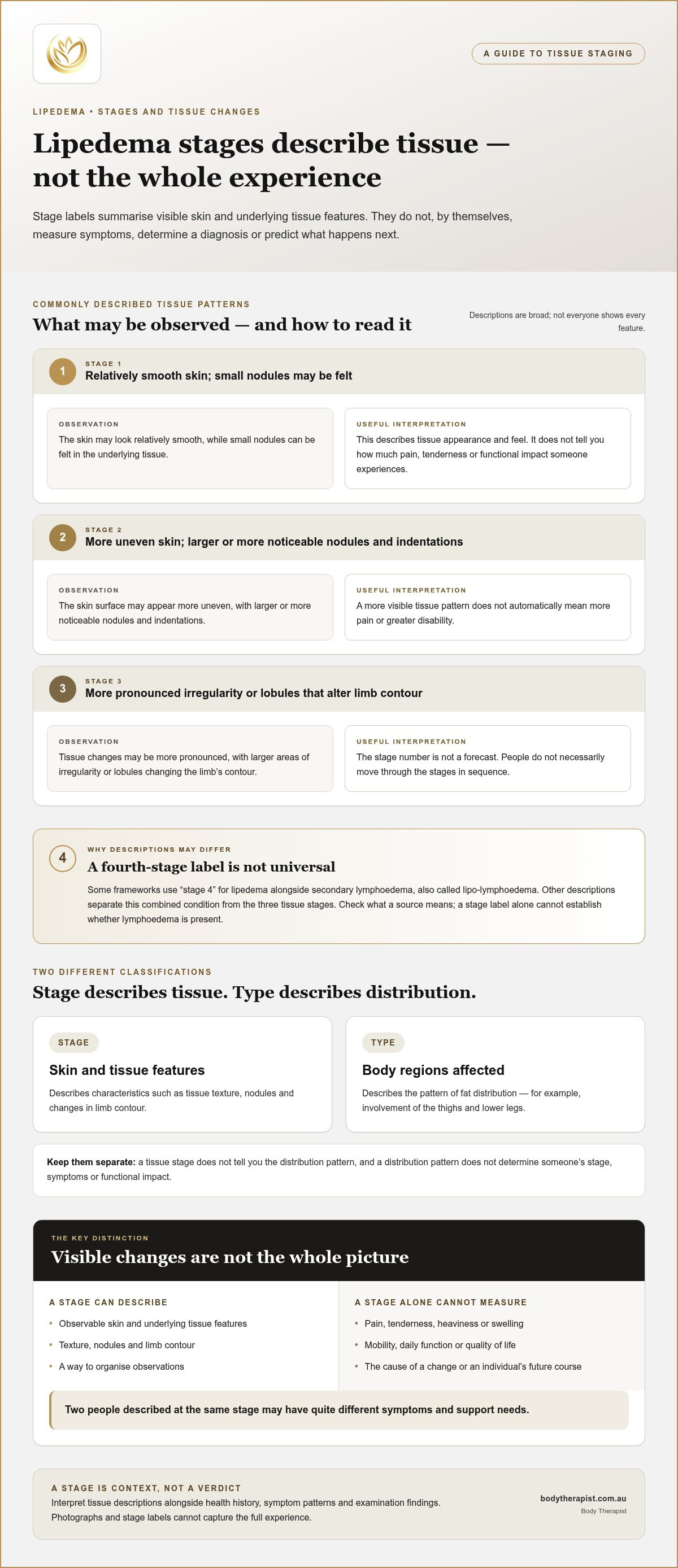
Stage labels generally describe tissue texture, the presence and size of nodules, and changes in limb contour. In commonly used descriptions, the skin may look relatively smooth while small nodules can be felt beneath it. Other descriptions refer to more pronounced unevenness or larger areas of altered contour. These terms summarise observable characteristics rather than every aspect of the condition. The Lipedema stages and characteristics overview also describes how staging relates to tissue appearance and fat distribution.
Lipedema staging describes observable skin and tissue features. On its own, it does not diagnose an individual or predict their future course. A stage label can’t establish the cause of a change, confirm lipedema by itself, or measure pain, tenderness, heaviness, swelling, mobility or quality of life. Two people described at the same stage may have quite different symptoms and support needs. Visible changes also don’t fully measure how someone feels or functions.
That distinction matters when comparing your body with photographs or descriptions online. Images can’t show how tissue feels on examination, how symptoms vary through the day, or whether another condition is contributing. A classification can help organise observations, but an individual clinical assessment considers more than appearance.
Stages and types describe different things
A stage refers to tissue and skin changes. A type refers to the body regions affected, or the pattern of fat distribution. The terms aren’t interchangeable, and knowing one doesn’t automatically tell you the other. Classification systems and their terminology can also vary, so interpret a stage label in the context in which it was assigned.
For example, someone might have a particular tissue stage and a distribution pattern involving the thighs and lower legs. The stage describes tissue features; the pattern describes where they occur. It doesn’t follow that everyone with the same distribution has the same stage, symptoms or functional impact. Keeping these terms separate makes clinical notes and online information easier to interpret without turning a label into a judgement.
Lipedema and lymphoedema are distinct conditions, though they can coexist. If you’re unsure how the terms differ, the guide to lymphoedema and lipedema explains the distinction. A stage description alone can’t establish whether lymphoedema is also present, so changes in swelling or function need individual assessment.
When understanding the stages of lipedema, treat the label as one descriptive detail, not the whole explanation. Your history, symptoms and functional concerns remain relevant, whatever stage seems to match your visible tissue changes.
The commonly described lipedema stages and their tissue changes
Three-stage descriptions focus on how the skin, underlying tissue and limb contour may appear or feel. These are patterns used to describe tissue, not a checklist for self-diagnosis. A stage can’t be assigned reliably from a photograph or a single feature, and one person may not show every feature associated with a particular stage.
How stage 1, stage 2 and stage 3 are commonly described
In commonly used frameworks, the stages are often described as follows:
Stage 1: Skin may look relatively smooth, while small nodules can be felt in the underlying tissue.
Stage 2: The skin surface may appear more uneven, with larger or more noticeable nodules and indentations.
Stage 3: Tissue changes may be more pronounced, with larger areas of irregularity or lobules that alter the limb’s contour.
These descriptions are broad. Palpable nodules and skin texture can vary between people, and appearance may differ across body regions. Symptoms may not correspond neatly to the visible pattern. The stages shouldn’t be read as steps everyone inevitably moves through in sequence, or as a forecast of how the condition will change.
Descriptions can vary between classification systems, so a stage label is most useful when its framework and meaning are clear. Some sources use three stages to describe tissue morphology; others include a fourth category, which can make comparisons confusing. The stage number alone doesn’t explain what was observed or establish an individual diagnosis.
Why some sources refer to a fourth stage
Some frameworks use “stage 4” for lipedema accompanied by secondary lymphoedema, also called lipo-lymphoedema. Other descriptions separate this combined condition from the three tissue stages of lipedema. The fourth-stage label isn’t universal, so clarify whether a source is describing lipedema alone or lipedema alongside lymphoedema.
This distinction matters because lymphoedema can occur alongside lipedema, but its presence shouldn’t be inferred from a stage number alone. The University of Chicago Medicine’s overview of lipedema symptoms and diagnosis also discusses secondary lymphoedema. Changes in swelling or limb function need individual clinical assessment, not interpretation based only on online staging descriptions.
When comparing information about the stages of lipedema, look at the features being described, not just the number used. If you’re exploring lymphatic care, an appropriate health assessment can help guide whether manual lymphatic drainage massage may be a suitable supportive option for your circumstances.
What lipedema stages do not tell you about symptoms or progression
A stage describes visible tissue features, but it can’t measure how those features affect your body or daily life. Understanding the stages of lipedema also means recognising what a stage label leaves out: pain, sensitivity, heaviness, swelling, movement and the effort involved in everyday activities. These experiences deserve attention in their own right, whatever stage description seems to fit.
Why symptoms may not match visible stage
Appearance and symptoms are related considerations, not interchangeable measures. Someone with less obvious contour changes may experience considerable tenderness or difficulty with certain activities, while another person with more visible tissue changes may report less pain. Neither experience makes a stage label more or less valid. Symptoms vary between individuals and may fluctuate over time.
Possible experiences include pain or tenderness when tissue is touched, a sense of heaviness, swelling, or reduced ease with walking, standing or other movement. Not everyone has all these symptoms, and they can have different causes. A stage alone can’t show which symptoms are present, how persistent they are, or whether they limit work, exercise, sleep or social activities.
A simple record can help you describe these differences during a clinical discussion. Note where symptoms occur, what they feel like, when they tend to appear and whether they affect a particular task. For example, record how long you can comfortably stand or whether tenderness changes after a day of activity. The aim isn’t to score yourself or assign a stage. It’s to describe your experience accurately.
The comparison below separates what staging may describe from what it can’t tell you about lived symptoms.
Does lipedema always progress through the stages?
No stage label can predict an individual’s future course. Symptoms, function and visible features can differ, and a change shouldn’t automatically be interpreted as movement to a higher stage. Nor does a higher stage automatically mean more pain or disability. Staging alone can’t tell you what will happen next.
If you notice a change in tenderness, swelling, movement or daily function, record what’s different and discuss it with an appropriate health professional. A change is a reason to seek individual assessment, not proof of a particular stage or inevitable progression. Clinical advice can consider your symptoms and circumstances more fully than a stage number can.
How clinicians assess lipedema beyond a stage label
An individual assessment brings several kinds of information together. A stage may describe tissue appearance, but it can’t establish a diagnosis on its own or explain why swelling, discomfort or changes in limb shape are occurring. Understanding the stages of lipedema provides useful context; clinical assessment adds your health history, symptom pattern and day-to-day function.
What information can support an individual assessment?
You don’t need to arrive with a diagnosis or a perfect record. A few practical notes can make the discussion more specific. Clinicians interpret these details alongside examination findings and the wider health picture, not from photographs or one visible feature alone.
Describe the timeline. Note when you first noticed tissue changes or discomfort, and whether they appeared gradually or changed at a particular time. Include relevant health history or previous assessments.
Map symptoms and changes. Record where tenderness, pain, heaviness or swelling occurs, whether it affects both sides, and whether it varies during the day or with activity. Mention changes in skin texture or limb contour without trying to assign yourself a stage.
Explain the functional effect. Consider whether symptoms affect walking, standing, exercise, sleep, work or other daily activities. A concrete example, such as needing to pause during a usual walk because of discomfort, can help clarify the impact.
Discuss examination and next steps. A clinician may consider the distribution and feel of tissue, relevant examination findings and other possible explanations for swelling or tissue change. The assessment is interpreted as a whole, rather than as a checklist where one feature confirms lipedema.
Other conditions can cause or contribute to swelling and changes in the limbs, so considering alternatives is part of making sense of the findings. No single observation should substitute for an individual assessment. Research may explore additional measures of tissue, fluid or function, but emerging approaches shouldn’t be confused with established clinical assessment or assumed to be routine requirements.
When to seek further clinical advice
Discuss persistent symptoms or changes affecting your comfort or function with an appropriate health professional. Seek prompt medical assessment for swelling that is sudden, unusual or rapidly worsening, particularly if it differs from your usual pattern. A change doesn’t prove a particular stage or diagnosis; it’s a reason to have the symptom assessed in context.
Fluid-related changes have several possible explanations, and online information can’t determine their cause. The guide to lymphatic drainage and fluid health provides related context, not a diagnosis. If hands-on lymphatic care is being considered, first discuss your symptoms with an appropriate health professional. For information about supportive care, explore manual lymphatic drainage massage.
Living with lipedema: supportive care and informed next steps
A useful care plan starts with your symptoms and priorities, not a stage number. You might want to discuss tenderness, heaviness or swelling, or focus on how discomfort affects walking, work, exercise or rest. Understanding the stages of lipedema can help make sense of tissue descriptions, but care decisions should reflect your individual assessment, function and clinical advice.
Building a care conversation around symptoms and function
Before an appointment, consider which changes matter most to you. A brief record of symptoms, activities that feel harder and questions you’d like answered can keep the conversation practical. You could ask what the assessment suggests, whether other factors may be contributing, and which options may support your specific goals. Your priorities are part of the clinical picture.
Consider supportive therapies in context, rather than choosing one just because a stage description seems to fit. Manual lymphatic drainage (MLD), for example, may be discussed as a supportive option where clinically appropriate. It doesn’t diagnose lipedema, remove the underlying tissue changes, cure the condition or replace medical assessment. A discussion about suitability should account for your symptoms and relevant health history.
Understanding what MLD involves can help you prepare questions about its role and limits. The clinical guide to Manual Lymphatic Drainage Massage offers further context about the approach.
A measured next step for supportive lymphatic care
There’s no need to make every care decision at once. Start with an appropriate health assessment, then consider whether supportive care fits the advice you receive and the goals you’ve identified. Keep expectations measured: a conversation about lymphatic care isn’t a promise of symptom change, and massage shouldn’t be treated as a way to prevent progression or reverse lipedema.
Body Therapist provides Manual Lymphatic Drainage Massage as a potential supportive care option. Its role should be considered alongside individual clinical advice, particularly if you have new or changing symptoms. A clear discussion can help establish whether this hands-on care is appropriate for your circumstances and what you hope it may support.
If you’d like to explore this option, learn more about lymphatic therapy support. Use what you’ve learnt about stages as context, while keeping your symptoms, function and personal care needs at the centre.
Choose a next step that fits your needs
Let your next step be guided by what you want support with, rather than pressure to match a particular stage or make decisions before you’re ready. If symptoms affect your comfort or daily activities, discuss those concerns with an appropriate health professional and ask what kind of care may suit your circumstances. Understanding the stages of lipedema offers useful context, but your goals and individual assessment should shape the conversation.
Where lymphatic support is appropriate, Body Therapist offers Manual Lymphatic Drainage Massage and Lymphedema Therapy. Care is provided by Lee Carnegie, a qualified remedial massage and dynamic movement therapist. These services are supportive options, not a diagnosis or cure for lipedema, and should complement rather than replace medical assessment.
Explore Body Therapist’s lymphatic therapy services to learn more and book an appointment.
Frequently Asked Questions
Is lipedema stage the same as lipedema type?
No. Stage refers to tissue features, while type describes the distribution pattern across body regions. For example, a clinical note might describe changes in the thighs and lower legs, then separately record the observed tissue stage. If two sources use different labels, compare what each label refers to rather than assuming they contradict each other. Neither term describes every symptom or determines what support an individual may need.
Can lipedema be diagnosed by looking at its stage?
No. A stage label isn’t a diagnostic test, and a photograph can’t show the full clinical picture. When understanding the stages of lipedema, treat online descriptions as general information, not a way to confirm your own condition. A clinician considers your history and symptoms, examines relevant features and considers other possible causes. If changes persist or concern you, arrange an individual health assessment.
Does lipedema always progress from stage 1 to stage 3?
No. Stage labels don’t guarantee a sequence or predict an individual’s future. Tissue appearance and symptoms can vary, so noticing a change doesn’t automatically mean you’ve moved into another stage. If you’re keeping track, note what changed, where it occurred and whether it affects a specific activity. That record can make a clinical conversation more useful without turning self-monitoring into a diagnosis.
What happens if lipedema is described as stage 4?
The meaning depends on the classification being used. Some sources use “stage 4” for lipedema with secondary lymphoedema, while others describe three lipedema stages and address lymphoedema separately. The label alone doesn’t establish what’s causing swelling. Ask the clinician who used the term to explain what it means in your assessment and whether any swelling needs separate evaluation.
Can someone have severe pain with an early lipedema stage?
Yes. Pain or tenderness can be substantial even when visible tissue changes appear mild. For a practical discussion, describe what the pain feels like, where it occurs and how it affects a particular task, such as climbing stairs or sitting through a workday. Don’t dismiss symptoms because they seem out of proportion to appearance. A health professional can consider them as part of your overall assessment.
Does manual lymphatic drainage cure lipedema?
No. Manual lymphatic drainage doesn’t cure lipedema or reverse its underlying tissue changes. It may be considered as supportive care in some circumstances, guided by your symptoms and clinical advice. Before hands-on care, discuss your health history and goals with an appropriate health professional. You might explore whether lymphatic support fits into a broader plan without assuming a particular result or replacing medical assessment.



Comments