

Radio Frequency for Double Chin: What to Expect in 2026

Updated: 3 days ago
What if the fullness beneath your chin isn’t something skin tightening can fully address? It may relate to loose skin, excess fat or facial anatomy, and those concerns don’t all respond to the same approach. Radio frequency for double chin may improve the appearance of mild skin laxity, but it shouldn’t be mistaken for a guaranteed way to remove fat or change your underlying facial structure. RF uses controlled energy to create a response in tissue, with results that can vary between people and treatment methods.
If conflicting claims have left you unsure what to expect, this guide can help you sort through them. It explains what RF skin tightening is intended to do, what the available under-chin research can and can’t show, and how RF differs from approaches aimed at fat or more pronounced skin excess. You’ll also find practical questions to raise about comfort, treatment planning and expectations. At Body Therapist, an assessment can help you discuss whether RF skin tightening’s intended role aligns with your goals.
Table of Contents
What causes a double chin, and what can radiofrequency address?
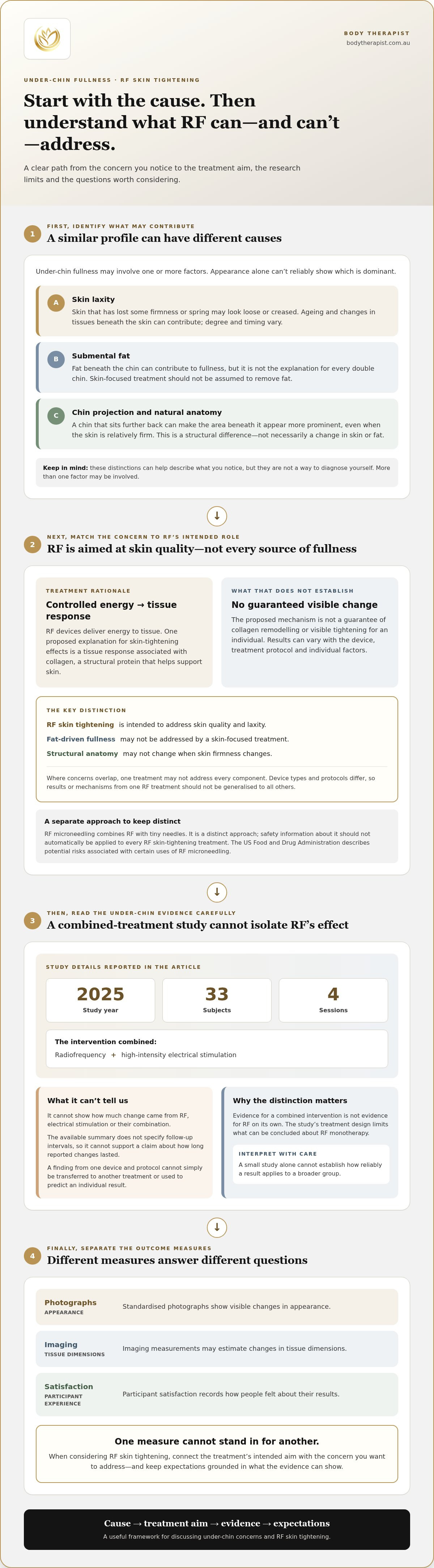
Under-chin fullness can have more than one contributor, and appearance alone can’t reliably show which is dominant. Skin firmness, the amount and position of submental fat, and the shape of the chin and jaw can all affect your profile. The causes of a double chin include both soft-tissue and structural factors, so one treatment approach won’t suit everyone.
How skin laxity, fat and facial structure differ
Skin laxity means the skin has lost some firmness or spring. Ageing and changes in the tissues beneath the skin can contribute, although the degree and timing vary. If the area looks less defined because the skin appears loose or creased, skin quality may be part of your concern.
Submental fat is fat beneath the chin. It can contribute to a fuller appearance, but it isn’t the explanation for every double chin. You may notice fullness when loose skin is more relevant, or have both concerns at once. A treatment aimed at skin firmness shouldn’t be assumed to remove fat.
Chin projection and natural anatomy also shape the side profile. For example, a chin that sits further back can make the area beneath it appear more prominent, even when the skin is relatively firm. This is a structural difference, not necessarily a change in skin or fat. These distinctions aren’t a way to diagnose yourself, but they can help you describe what you notice during an assessment.
What radiofrequency is intended to do
Radiofrequency, often shortened to RF, is energy used in some skin-tightening treatments. It delivers controlled energy to tissue with the aim of creating a skin-tightening effect. The intended tissue effects depend on the device and treatment protocol, so results or mechanisms from one RF treatment shouldn’t be generalised to every other one.
For radio frequency for double chin, the key distinction is the aim: RF skin tightening is directed towards skin quality, not guaranteed fat removal. If submental fat is driving the fullness, a skin-focused treatment may not address it. If chin structure is the main factor, changing skin firmness may not alter the underlying shape. Where concerns overlap, one treatment may not address every component.
RF suitability depends on the concern being treated. Discussing whether laxity, fat, facial structure or a combination is most relevant helps set expectations before treatment. It also keeps the conversation focused on your goal, rather than assuming every change beneath the chin calls for the same solution.
How radiofrequency for a double chin works, and what the evidence shows
RF is used in skin-tightening treatments because the energy delivered to tissue is intended to create a controlled response. That rationale doesn’t prove that a particular device will produce a predictable change beneath the chin. The outcome depends on the treatment approach and the concern being addressed, so it helps to separate how RF is thought to work from what research has demonstrated.
What happens in tissue during an RF treatment?
RF devices deliver energy to tissue. One proposed explanation for skin-tightening effects is that this energy prompts a tissue response associated with collagen, a structural protein that helps support skin. This is a treatment rationale, not a guarantee of collagen remodelling or visible tightening for an individual.
Devices and protocols differ, and individual factors can influence the treatment experience and response. Sensations, tissue effects and outcomes shouldn’t be assumed to be identical across RF treatments. RF microneedling is a distinct approach that combines RF with tiny needles, so safety information about it shouldn’t automatically be applied to every RF skin-tightening treatment. The US Food and Drug Administration describes potential risks associated with certain uses of RF microneedling in its FDA guidance on radiofrequency microneedling.
How to interpret the available double-chin research
A 2025 study cited in discussion of under-chin treatment involved 33 subjects and four sessions combining RF with high-intensity electrical stimulation. It studied a combined intervention, not RF on its own. Any reported outcomes can’t show how much change came from RF, electrical stimulation or their combination. The available summary doesn’t specify follow-up intervals, so it can’t support a claim about how long any reported changes lasted.
Evidence for a combined intervention is not evidence for RF monotherapy. A finding from one device and protocol can’t simply be transferred to another treatment or used to predict an individual result.
Outcome measures also answer different questions. Standardised photographs show visible changes in appearance, while imaging measurements may estimate changes in tissue dimensions. Participant satisfaction records how people felt about their results, but doesn’t measure the same thing as an objective change. One measure can’t stand in for another, and a small study alone can’t establish how reliably a result applies to a broader group.
An assessment can help connect RF skin tightening’s intended aim with your goals and expectations. Discuss RF skin tightening with Body Therapist as part of that conversation.
Radiofrequency compared with other double-chin approaches
Compare treatments by starting with the change you want, rather than assuming one method is best. RF skin tightening is intended to address skin quality; fat-focused approaches aim at submental fat; surgery involves a different level of intervention. These categories aren’t interchangeable, and a treatment’s intended mechanism doesn’t establish what an individual will experience.
Start with the concern and desired change. The table outlines broad differences, not a ranking or personal recommendation.
RF skin tightening versus fat-focused treatments
RF skin tightening is generally discussed in relation to skin firmness, while approaches such as fat-freezing or injectable fat-reduction treatments are designed to target fat. This distinction can frame a conversation, but it can’t predict an individual outcome. A treatment label or proposed mechanism doesn’t prove it will produce the change you want. Fat-focused approaches may also leave laxity or profile factors unaddressed.
RF versus surgery: different treatment commitments
Non-surgical RF and surgery differ in how they intervene, so they shouldn’t be presented as substitutes or routes to equivalent results. Surgery is invasive; RF is a non-surgical treatment modality, with techniques that differ. The broader clinical guide to non-surgical facial rejuvenation offers further context on how non-surgical facial approaches fit within aesthetic care.
If you’re considering radio frequency for double chin, begin by identifying the intended target: skin laxity, fat-related fullness or a profile concern influenced by facial structure. You may have overlapping factors. An assessment can help clarify which concern matters most and whether RF’s aim aligns with the change you’re seeking. It can also help keep expectations grounded, without treating any one approach as the answer for everyone. When researching broader facial procedures and surgical alternatives, resources such as aaronfletchermd.com outline what surgical facial rejuvenation and related consultations involve.
Are you a suitable candidate for RF under the chin?
Suitability can’t be determined from a photo or a general description of a double chin. Before considering radio frequency for double chin, clarify the change you want and discuss whether RF’s intended skin-tightening role aligns with that goal. The steps below are a self-reflection framework, not a diagnostic tool or a way to decide treatment eligibility on your own.
Questions to clarify your treatment goal
Use these prompts to organise your thoughts before an assessment. They can help you describe your concern, but a practitioner needs to consider your individual circumstances before discussing a treatment plan.
Name the change that matters most. Are you hoping for firmer-looking skin, less fullness beneath the chin or a different side profile? Describe what you’d like to look different as specifically as you can.
Consider what seems to contribute. Does the area look loose, appear fuller or seem related to your chin’s shape? These observations can guide a discussion, but they can’t establish the cause.
Match the goal to the treatment aim. RF is used for skin tightening, so discuss whether that aim fits your concern. If you’re primarily seeking a change in fat volume or facial structure, ask whether another approach is more relevant.
Set expectations. Non-surgical treatments don’t guarantee a particular result, and responses vary. Consider whether a possible change would meet your goal or whether you’re seeking a more substantial alteration.
Safety, treatment planning and follow-up
An assessment should include your health history and personal goals. Share relevant health information, previous treatments and any concerns that could affect treatment planning. If you’re unsure whether something matters, mention it. Raise specific medical questions with an appropriately qualified practitioner who can advise in light of your circumstances.
Before treatment, the practitioner should explain the proposed plan, possible effects, what to expect afterwards and any aftercare guidance. You should have the opportunity to ask questions and consider whether the plan feels appropriate. Many aesthetic practices, such as Laser Smooth Aesthetics, emphasise in-depth consultations so clients understand what advanced treatments can realistically achieve. If your desired change appears outside RF’s intended scope, discuss that rather than assuming the treatment will address every contributor to under-chin fullness.
Manual lymphatic drainage is a distinct modality, not another name for RF skin tightening. Its purpose and approach differ, so information in a clinical guide to manual lymphatic drainage relates to that separate treatment, not RF suitability.
At Body Therapist, an assessment can help you connect your goals with RF skin tightening’s intended role and discuss realistic expectations. Arrange an assessment to discuss RF skin tightening.
Explore RF skin tightening with Body Therapist
After weighing the treatment aims and evidence, the next step is to discuss your own goals. Body Therapist offers RF skin tightening as a non-surgical aesthetic treatment. An assessment can help you consider whether its intended role aligns with your concern, without assuming radio frequency for double chin will produce a particular result.
What to discuss during an RF skin-tightening appointment
Start by describing what you notice and what you’d like to change. You might be concerned about skin that looks less firm, fullness beneath the chin or how your profile appears from the side. Being clear about the change that matters to you gives the assessment a practical focus.
It may help to think about:
The area or feature that draws your attention most.
The visible change you hope to see, in your own words.
Relevant health information, previous treatments and any questions or concerns.
How you’ll judge whether the treatment’s intended aim matches your expectations.
These prompts aren’t a test of suitability. They help explain your priorities so the discussion can address whether RF aligns with them. If your goal relates mainly to volume or facial structure, raise that directly. A considered assessment should look at whether the treatment’s scope fits what you’re seeking, rather than treating RF as a solution for every under-chin concern.
A considered next step with Body Therapist
During assessment and treatment planning, discuss what the process involves, possible effects and relevant aftercare. You should understand the proposed approach and have the opportunity to ask questions before deciding how to proceed. The treatment’s intended purpose isn’t a promise of a specific change.
Body Therapist is operated by Lee Carnegie, a qualified remedial massage and dynamic movement therapist. The practice offers RF skin tightening as an option to discuss in an assessment, with your goals and circumstances guiding the conversation. You don’t need to arrive with a conclusion about what’s causing the concern. Describing what you hope to change is a useful place to begin.
To discuss whether RF skin tightening aligns with your goals, explore RF skin tightening with Body Therapist.
Take a considered next step
Choosing what to do about your under-chin profile doesn’t need to start with a treatment decision. Begin with the change you’re hoping for, then discuss whether that goal fits RF’s intended role. This keeps the conversation personal and realistic, rather than relying on broad promises about radio frequency for double chin.
Take time to consider the information, ask questions and decide whether the proposed approach feels right for you. A clear discussion of your goals and expectations can help you make an informed decision.
Body Therapist offers RF skin tightening, with the practice operated by qualified therapist Lee Carnegie. To discuss whether the service may align with your concerns, explore RF skin tightening with Body Therapist.
Move forward at your own pace, with a clear understanding of what you want to address.
Frequently Asked Questions
Can radiofrequency reduce a double chin?
RF shouldn’t be assumed to reduce a double chin caused mainly by fat or facial structure. It may be considered when skin laxity is part of the concern, but the likely effect depends on the treatment approach and individual factors. Describe the change you want, such as firmer-looking skin or less fullness, and discuss whether RF’s intended role matches that goal.
Does RF skin tightening work for loose skin under the chin?
RF skin tightening may be considered for under-chin skin laxity, but it can’t guarantee a visible change or suit every degree of looseness. During an assessment, ask how your skin will be evaluated and what outcome may be realistic for your concern. If the looseness is pronounced, discuss whether a non-surgical treatment’s scope is likely to match the change you’re seeking.
Is radiofrequency for a double chin painful?
Comfort varies with the person and RF method, so treatment can’t be promised to be painless. Before proceeding, ask what sensations to expect, how discomfort will be managed and what to do if the treatment feels uncomfortable. Mention any sensitivity or previous treatment experience so the discussion can take it into account.
How many RF treatments are needed for a double chin?
There isn’t one session count that applies to everyone. If treatment is appropriate, the number depends on the device, protocol, treatment area and goals. Ask how progress will be reviewed and when the plan might be reconsidered if your response differs from expectations. A clear plan should explain what is proposed for you rather than rely on a generic session figure.
What is the difference between RF skin tightening and fat reduction?
RF skin tightening is intended to address skin quality, while fat-reduction approaches are designed to target fat volume. Neither label guarantees a particular outcome, and neither necessarily changes chin projection or other aspects of facial structure. Explain what you hope will look different and discuss which tissue or structural factor the proposed treatment is intended to address.
Is RF treatment for a double chin safe?
Safety depends on the treatment method, device, practitioner and your individual health circumstances, so no general answer can guarantee that it’s suitable for you. Before treatment, disclose relevant health information, medicines, previous procedures and any concerns. Ask about possible effects, aftercare and when to seek advice if you notice an unexpected reaction. Discuss specific medical questions with an appropriately qualified practitioner.



Comments