

How to Massage a Scar After Surgery Safely
Scar massage should start when the wound is completely healed, not simply because a certain number of days has passed. For massage to reduce scar tissue after surgery safely, the skin must be closed, with no scabs, gaps, drainage or weeping; get your surgeon’s approval before beginning. Starting too early can disrupt healing.
It’s understandable to want to ease tightness, tenderness or restricted movement around a new scar. The right approach is gentle, controlled movement of the skin and underlying tissue, not forceful rubbing, and the scar’s location can affect how you care for it.
This guide explains how to recognise when a scar is ready for massage, how to use linear, circular and cross-friction movements, and when to stop. You’ll also learn why breast, chest and armpit scars after cancer surgery may need specific care, and how scars over joints or other areas can affect movement. The aim is to help you approach scar massage confidently while protecting healing tissue.
Table of Contents
Do only certain cancers or areas of the body require scar massage?
No single cancer type or body area is the only reason to massage a scar. Location matters because scars across the chest, shoulders, back, elbows or knees may restrict movement more noticeably.
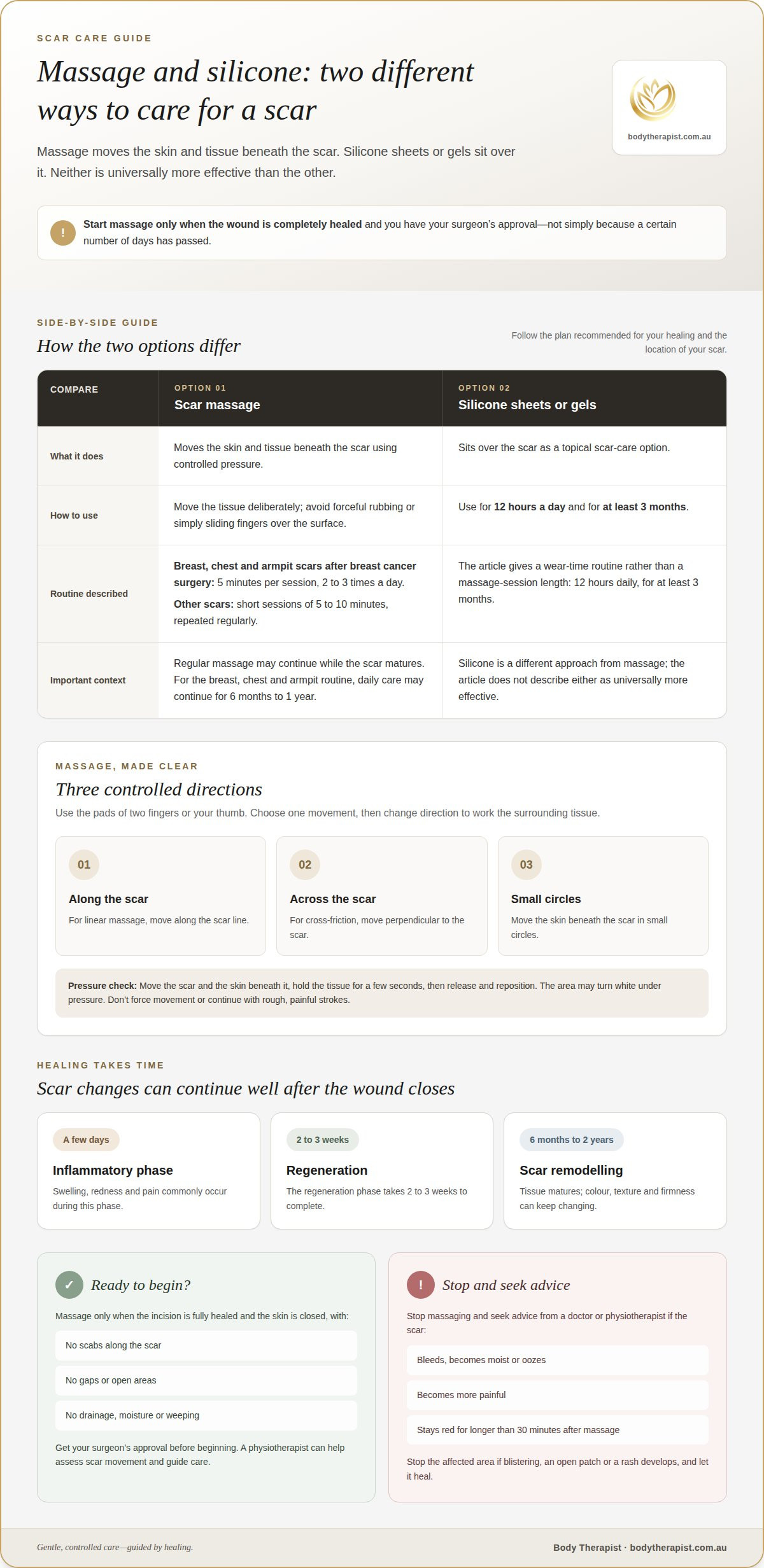
Match the routine to the scar. For breast, chest and armpit scars after breast cancer surgery, massage for 5 minutes per session, 2 to 3 times a day. Daily care may continue for 6 months to 1 year. For other scars, short sessions of 5 to 10 minutes, repeated regularly, are commonly advised. Follow the plan set for your healing and scar location.
Use massage and silicone for different purposes. Massage moves the skin and tissue beneath the scar; silicone sheets or gels sit over the scar. Neither can be described as universally more effective than the other. Silicone products are intended for use for 12 hours a day and at least 3 months.
Target stiffness without forcing movement. Scar massage may help with prolonged sensitivity or discomfort. Gentle movement of the tissue can address tightness around a scar, particularly near a joint such as an elbow or knee. It can’t be assumed to release every deep adhesion; keep pressure tolerable and avoid forcing restricted movement.
Keep a consistent schedule. Massage regularly while the scar is maturing, which can take approximately 6 months. Continue until it feels more like normal skin. If the scar is no longer painful and moves freely, massage can be reduced to 3 to 4 days a week.
Stop for warning signs. Redness that remains after 30 minutes, bleeding, moisture, oozing or increased pain means stop and seek advice from a doctor or physiotherapist. Stop the affected area if blistering, an open patch or a rash develops, and let it heal.
Scar massage technique and directions
Once the incision is fully healed and ready for massage, use controlled movements to mobilise the skin and underlying tissue. Work gradually, moving the tissue deliberately rather than rubbing across the skin’s surface.
Choose a scar massage techniqueBegin with the pads of two fingers or your thumb. For linear massage, move along the scar; for cross-friction, move perpendicular to it. To massage towards the scar, shift the tissue above and below it towards the line, without sliding over it from above. For circular massage, move the skin beneath the scar in small circles. Use one movement at a time, then change direction to address the surrounding tissue.
Apply appropriate pressureApply enough pressure to move the scar and the skin beneath it, rather than letting your fingers glide over the surface. Hold the tissue in position for a few seconds, then release and reposition your fingers. The area may turn white under pressure, but don’t force movement or continue with rough, painful strokes. Blistering, a rash or an open area can indicate excessive pressure or friction.
For back-and-forth massage, move the tissue under the scar in short strokes, then pause before repeating. A warm, dry skin surface, such as after a shower, may feel more comfortable. Keep the skin dry during massage, as cream reduces the friction needed to move the tissue. Afterwards, you may apply a non-perfumed cream, such as sorbolene, Vitamin E or Bio-oil. Avoid perfumed lotions. Use a steady sequence: move the tissue, hold for a few seconds, release, then repeat in another direction. If blistering, a rash or an open area develops, stop massaging that spot and allow it to heal.
Scar formation and wound healing
Allow healing to progress through its stages. The inflammatory phase lasts a few days and commonly involves swelling, redness and pain. Regeneration takes 2 to 3 weeks to complete. Scar remodelling then continues for 6 months to 2 years, as tissue matures. Scar formation can take up to two years to finish. These stages explain why a scar’s colour, texture and firmness can keep changing after the wound closes.
Protect the scar from sunlight during healing. Keep it out of the sun for at least one year following surgery. When the scar is exposed, use sunscreen with an SPF of 30 or greater while it heals. UV exposure can affect the scar’s appearance, so include sun protection in your daily care routine. Covering the area with clothing also limits direct exposure when practical.
Manage itching without heating the skin. A cool compress or firm finger pressure may help settle itchiness during healing. Avoid heat pads and wheat bags on itchy skin, as they can cause burns and blisters. Keep your nails away from the area, since scratching can irritate fragile tissue. If itching persists, don’t respond by adding heat or friction.
Choose topical products for hydration, not promised results. Hydrating lotions or creams can support scar healing and appearance. Vitamin E and cocoa butter offer little additional benefit beyond making massage easier. Products containing quercetin, an onion extract, may improve itching and pigmentation. Silicone gels or sheets are another scar-care option: use them for 12 hours a day and at least 3 months. Scars generally reach about 70 to 80% of normal skin strength, even as remodelling continues.
When to begin scar massage after surgery
A calendar date alone can’t show whether an incision is ready. Avoid massaging an open, scabbed, weeping or hot wound. A physiotherapist can help assess scar movement and guide care in Australia.
Use healing signs as your main guide. Start only when the wound has closed completely, the skin is healed and no scabs remain along the scar. After breast cancer surgery, the scar edges should be well closed, without gaps or drainage. Massaging too early can disrupt healing tissue.
Understand why timelines vary. Guidance describes starting after 2 weeks, ideally at 2 to 3 weeks, at least 3 weeks, or around 4 weeks after surgery. These are different estimates, not a reason to massage an unhealed incision. Stitches or staples should be removed or dissolved, and the area should have no weeping or heat.
Get surgical approval before beginning. Discuss the incision’s healing and any restrictions with your surgeon. This is particularly important after complex surgery, or if the wound has reopened, developed drainage or remains painful. Your surgeon can assess these signs and advise whether pressure or movement could disrupt the tissue.
Pause during radiation-related skin reactions. During radiation treatment, patients may be told to stop scar massage. Restart only when the skin has healed from treatment and the wound itself is closed. If blistering, a rash or an open area develops, stop massaging that spot until it heals.
Seek guidance when motion remains restricted. A physiotherapist can assess scar mobility and explain how it relates to movement, such as reaching after chest surgery. A doctor or physiotherapist should also assess persistent redness, bleeding, moisture, oozing or increasing pain. For tailored recovery support, discuss your recovery needs.
Body Therapist: Manual Lymphatic Drainage Massage
Body Therapist offers Manual Lymphatic Drainage Massage for people seeking support with lymphatic concerns during recovery. It may be relevant when post-surgical swelling or lymphedema needs attention, but it isn’t a substitute for scar massage or advice about incision healing. The scar must be fully healed before direct massage.
For care related to cancer treatment, Oncology Massage provides a tailored therapeutic approach. Lymphedema Therapy may suit people managing lymphatic swelling, while Remedial Massage addresses other muscular concerns. The appropriate option depends on your recovery needs and the area being treated.
If you’re managing swelling or discomfort after surgery, contact Body Therapist to discuss your needs.
Make your next step part of recovery
Consider scar care alongside the movements and everyday activities you want to regain. Notice how the area responds during tasks such as reaching, turning or getting dressed, then use those observations to guide a practical conversation about your recovery. This gives scar care a functional focus, rather than making the scar’s appearance the only measure that matters.
Massage to reduce scar tissue after surgery should suit the stage of healing and the needs of the surrounding tissue. If you’re unsure how scar concerns relate to swelling, discomfort or movement, discuss your priorities with Body Therapist. This can help clarify which type of support fits your needs and what to address next.
Contact Body Therapist to discuss your recovery needs. A considered next step can help you approach scar care with confidence.
Frequently Asked Questions
What is a scar?
A scar forms as the body repairs skin after an injury or surgery. It may look or feel different from surrounding skin, with changes in colour, texture or flexibility. Scar tissue continues to remodel as it matures, so its appearance can change over time. The scar’s surface alone doesn’t show how freely the tissue beneath it moves.
Is it ever too late to start scar massage?
No. Massage to reduce scar tissue after surgery may still help with prolonged sensitivity or discomfort, even if you start later in recovery. For example, an older scar that feels tight when you reach may still benefit from appropriate care. The tissue’s current condition matters: avoid massaging any area that is open, irritated or painful, and seek professional advice if symptoms persist or worsen.
When is it safe to massage a surgical scar after surgery?
Begin only after the incision is fully healed, with no scabs, gaps, drainage or weeping. The time elapsed alone doesn’t establish readiness, since healing varies between wounds. If you’re uncertain or the wound has reopened, speak with your surgeon before applying pressure. During radiation treatment, follow instructions to pause until the skin has healed.
How should you massage a scar after surgery step by step?
For massage to reduce scar tissue after surgery, use the pads of two fingers or your thumb to move the skin and tissue beneath the scar. Try small circles, strokes along the scar or gentle cross-friction across it. Move the tissue rather than sliding over the surface, and hold it briefly before releasing. Keep pressure controlled, and stop if the area becomes more painful or the skin breaks.
Which oils or creams are safe to use on a healing surgical scar?
Don’t use cream during massage, as friction helps your fingers move the tissue. Afterward, a non-perfumed moisturiser such as sorbolene can help hydrate the skin; Vitamin E or Bio-oil can also make massage easier when applied afterwards. Avoid perfumed lotions, and don’t apply products to an incision that hasn’t fully healed. Stop if a product irritates your skin.